Case Reports
. 2020 Aug 27:73:19.
doi: 10.1186/s13620-020-00173-z. eCollection 2020.

Triple nostrils in a calf

Affiliations
Case Reports

Triple nostrils in a calf

Takeshi Tsuka et al. Ir Vet J. .

Abstract

Background: Nasal abnormalities are rare in bovines. In humans, nasal deformities are mainly classified as proboscis lateralis or supernumerary nostrils. This report discusses the etiology of triple nostrils in a calf, based on computed tomography, magnetic resonance imaging, and endoscopy.

Case presentation: A female Holstein calf presented with triple nostrils. The following abnormalities were observed: (1) formation of a small and flat blind-ended middle nostril between the right and left nostrils; (2) presence of a hair-bearing surface on the muzzle; (3) abnormal curvature of the nasal septum, resulting in a narrower right nasal cavity due to transformation of the nasal bones; and (4) formation of a bone-like structure within the nasal septum. These findings were similar to those of supernumerary nostrils in humans.

Conclusions: To the best of our knowledge, this represents the first description of a calf with triple nostrils. The use of imaging modalities is necessary for investigating the etiology of triple nostrils.

Keywords: Calf; Computed tomography; Endoscopy; Magnetic resonance imaging; Triple nostrils.


Conflict of interest statement

Competing interestsThe authors declare that they have no competing interests.

Figures
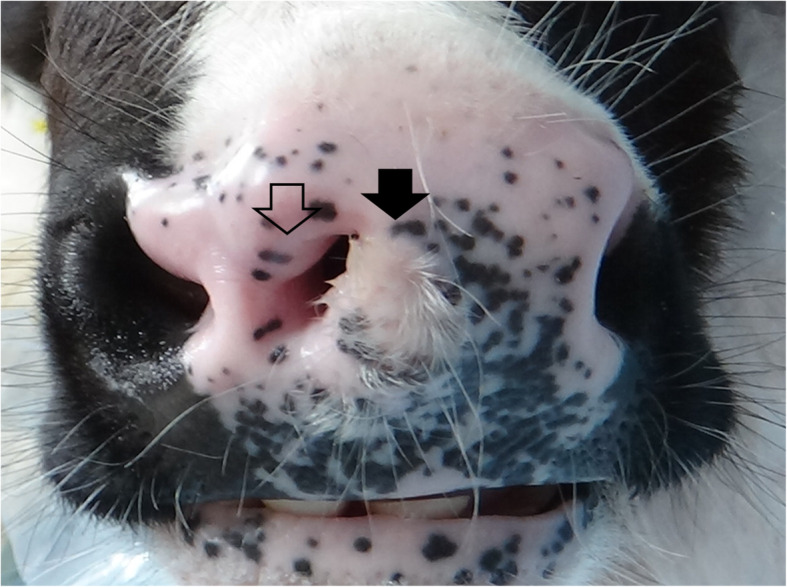
Fig. 1
Fig. 1
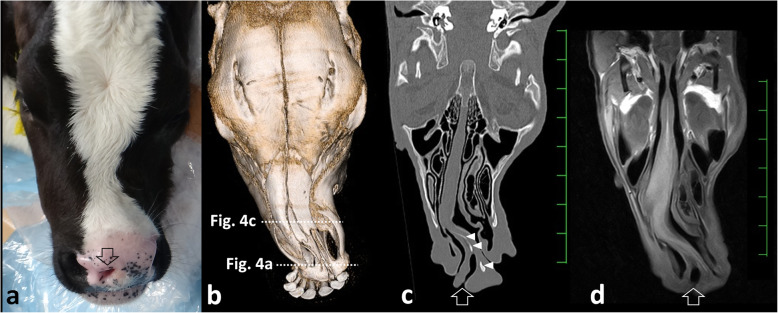
Macroscopic appearance of the nose of the 1-month-old female Holstein calf. A small, flat nostril (empty arrow) is evident within the region of the muzzle and between the right and left nostrils, which exit at the normal locations. A hair-bearing region (black arrow) is evident near the left edge of the middle nostril
Fig. 2
Fig. 2
Dorsal macroscopic view of the nose (a), three-dimensional computed tomography (CT) visualizing the dorsal surface of the nasal bones (b), and dorsal CT (c) and T1-weighted MRI (d) visualizing the nasal cavity in the 1-month-old female Holstein calf. a The bridge of the nose is significantly curved toward the left. The middle nostril (empty arrow) is located in close proximity to the right nostril. b The transformation of the nasal bone allowed a curvature of approximately 30° from the central line of the nasal bone to the left. c The abnormal curve of the nasal septum allowed constriction within the right nasal cavity. The blind end is evident within the middle nostril (empty arrow). Bone-like structures (white arrowheads) are observed within the nasal septum. d A blind-ended middle nostril is evident (empty arrow), although a bone-like structure is not evident. Scale: 25 mm on CT and MRI
Fig. 3
Fig. 3
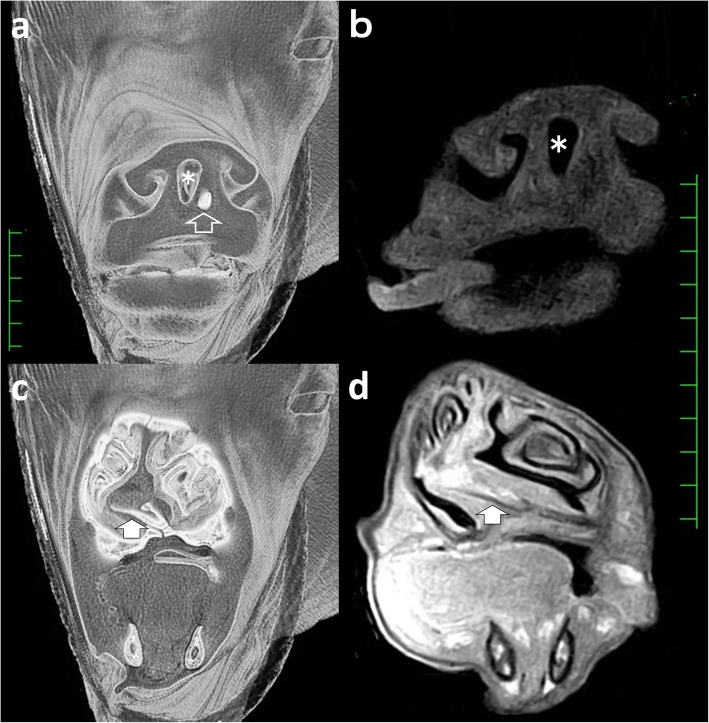
Transverse 3D-CT and T1-weighted MRI corresponding to approximately 1 cm (a and b) and 7 cm (c and d) deeper than the muzzle. a A bone-like structure (empty arrow) is observed in the left inferior site of the middle nostril (asterisk). b An elliptical middle nostril (asterisk) is seen in the space between the right and left nostrils. c The hyperdense vomer (white arrow) leans toward the right, along the transformed nasal septum. d The transformed vomer (white arrow) is imaged as a low-signal-intensity structure. The transformed turbinate bones are also clear. Scale: 10 mm on CT and MRI
Fig. 4
Fig. 4
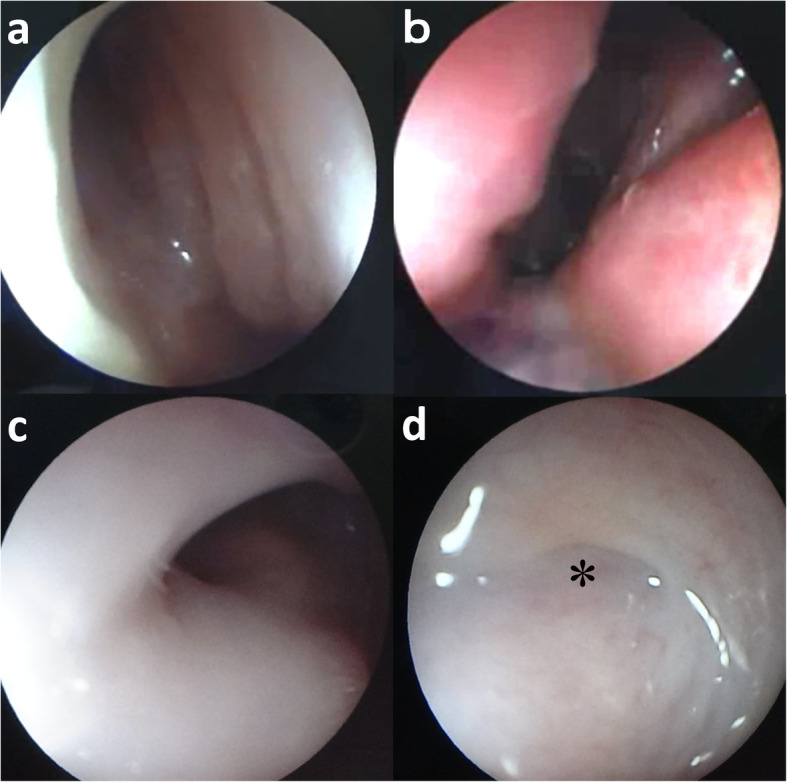
Endoscopy of the nasal cavities in the left nostril (a), the right nostril (b), the lumen near the opening (c), and the deepest site (d) of the middle nostril. a and b The lumen of the right nostril is narrower compared with that of the left nostril. c The mucosa is smooth and pale pink in the lumen of the middle nostril. d The blind-ended structure (asterisk) is observed approximately 5 cm deeper than the opening of the middle nostril
Fig. 5
Fig. 5
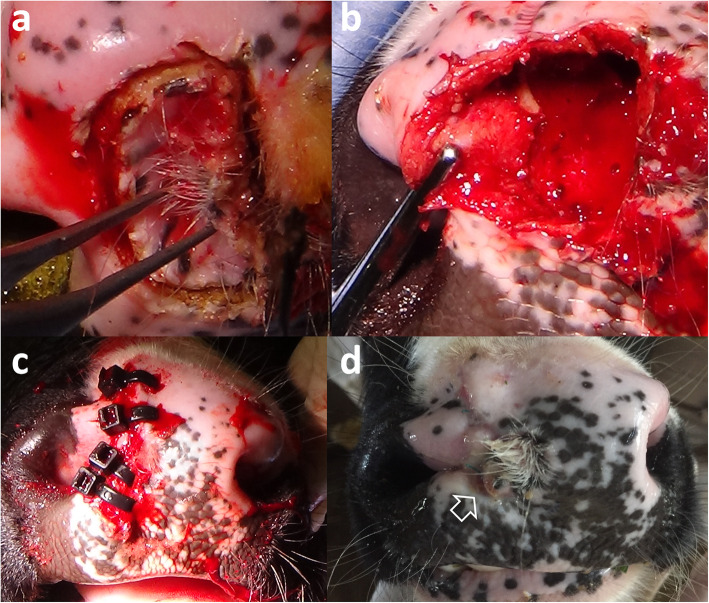
Intraoperative layout during removal of the middle nostril (a and b), and macroscopic layout of the nose soon after surgery (c) and at 1 month after surgery (d). a The muzzle is incised around the entire circumference of the edge of the middle nostril. b The middle nostril is removed (intact) by whole-circumference exfoliation toward the deepest part of the middle nostril. c The incision line on the muzzle is closed by clamping using four cable ties. d The incised line has healed, although irregularities are observed in a dorsoventral direction on the surface of the muzzle (empty arrow)
Fig. 6
Fig. 6
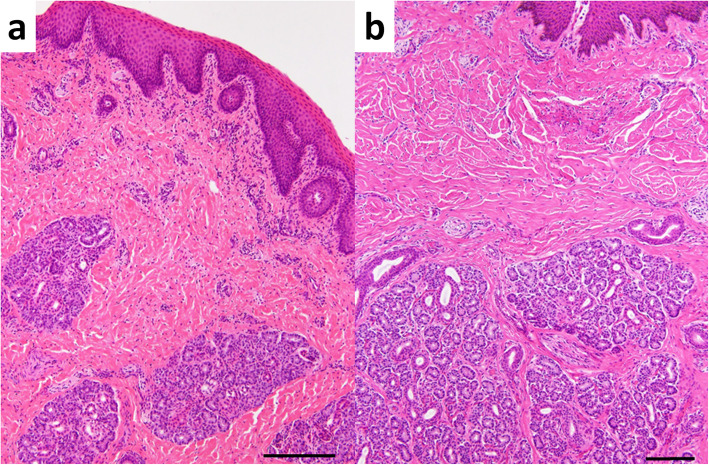
Histology of the middle nostril and hair-bearing surface of the muzzle in the present case (a) and the mucosal surface of the muzzle and nostrils in a normal, age-matched calf (b). a The tissue comprises normal skin structures, including nasal glands and subcutaneous connective tissues (H&E, bar = 250 μm). b Compared with the present case, the glandular lobes are larger in the middle nostril of the age-matched calf (H&E; bar = 100 μm)

References

    1. Martin S, Hogan E, Sorenson EP. Proboscis lateralis. Childs Nerv Syst. 2013;29:885–891. doi: 10.1007/s00381-012-1989-0. - DOI - PubMed
    1. Uppal SK, Garg R, Gupta A, et al. Supernumerary nostril: a rare congenital anomaly. Ann Maxillofac Surg. 2011;1:169–171. doi: 10.4103/2231-0746.92788. - DOI - PMC - PubMed
    1. Progressive Dairyman: Third nostril doesn’t bother North Carolina cow. https://www.progressivedairy.com/news/industry-news/third-nostril-doesnt.... .
    1. Braun U, Brammertz C, Maischberger E, et al. T-cell lymphoma in the nasal cavity of a Brown Swiss heifer. Acta Vet Scand. 2015;57:8. doi: 10.1186/s13028-015-0100-8. - DOI - PMC - PubMed
    1. Reinartz S, Hellige M, Feige K, et al. Phenotypic classification of variability of non-syndromic congenital cleft lip and jaw in Vorderwald × Montbéliarde cattle. Acta Vet Scand. 2015;57:87. doi: 10.1186/s13028-015-0177-0. - DOI - PMC - PubMed

Publication types

LinkOut - more resources