


Multidisciplinary, three-dimensional and individualized comprehensive treatment for severe/critical COVID-19
- PMID: 32864178
- PMCID: PMC7445583
- DOI: 10.1016/j.livres.2020.08.001
Multidisciplinary, three-dimensional and individualized comprehensive treatment for severe/critical COVID-19
Abstract
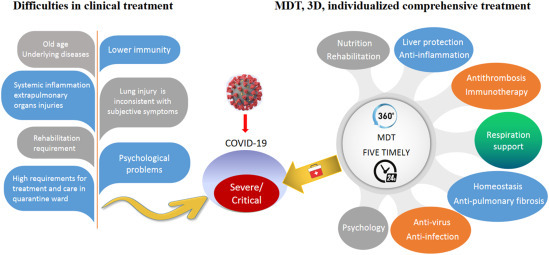
Severe/critical cases account for 18-20% of all novel coronavirus disease 2019 (COVID-19) patients, but their mortality rate can be up to 61.5%. Furthermore, all deceased patients were severe/critical cases. The main reasons for the high mortality of severe/critical patients are advanced age (>60 years old) and combined underlying diseases. Elderly patients with comorbidities show decreased organ function and low compensation for damage such as hypoxia and inflammation, which accelerates disease progression. The lung is the main target organ attacked by severe acute respiratory syndrome coronavirus 2 (SARS-CoV-2) while immune organs, liver, blood vessels and other organs are damaged to varying degrees. Liver volume is increased, and mild active inflammation and focal necrosis are observed in the portal area. Virus particles have also been detected in liver cells. Therefore, multidisciplinary teams (MDTs) and individualized treatment plans, accurate prediction of disease progression and timely interventions are vital to effectively reduce mortality. Specifically, a "multidisciplinary three-dimensional management, individualized comprehensive plan" should be implemented. The treatment plan complies with three principles, namely, multidisciplinary management of patients, individualized diagnosis and treatment plans, and timely monitoring and intervention of disease. MDT members are mainly physicians from critical medicine, infection and respiratory disciplines, but also include cardiovascular, kidney, endocrine, digestion, nerve, nutrition, rehabilitation, psychology and specialty care. According to a patient's specific disease condition, an individualized diagnosis and treatment plan is formulated (one plan for one patient). While selecting individualized antiviral, anti-inflammatory and immunomodulatory treatment, we also strengthen nutritional support, psychological intervention, comprehensive rehabilitation and timely and full-course intervention to develop overall and special nursing plans. In response to the rapid progression of severe/critical patients, MDT members need to establish a three-dimensional management model with close observation and timely evaluation. The MDT should make rounds of the quarantine wards both morning and night, and of critical patient wards nightly, to implement "round-the-clock rounds management", to accurately predict disease progression, perform the quick intervention and prevent rapid deterioration of the patient. Our MDT has cumulatively treated 77 severe/critical COVID-19 cases, including 62 (80.5%) severe cases and 15 (19.5%) critical cases, with an average age of 63.8 years. Fifty-three (68.8%) cases presented with more than one underlying disease and 65 (84.4%) severe cases recovered from COVID-19. The average hospital stay of severe/critical cases was 22 days, and the mortality rate was 2.6%, both of which were significantly lower than the 30-40 days and 49.0-61.5%, respectively, reported in the literature. Therefore, a multidisciplinary, three-dimensional and individualized comprehensive treatment plan can effectively reduce the mortality rate of severe/critical COVID-19 and improve the cure rate.
Keywords: Critical COVID-19; Multidisciplinary teams; Novel coronavirus disease 2019 (COVID-19); Severe COVID-19; Severe acute respiratory syndrome coronavirus 2 (SARS-CoV-2); Treatment.
© 2020 The Third Affiliated Hospital of Sun Yat-sen University. Publishing Services by Elsevier B. V. on behalf of KeAi Communications Co., Ltd.
Conflict of interest statement
The authors declare that they have no conflict of interest.
Figures
References
-
- Epidemiology Working Group for NCIP Epidemic Response, Chinese Center for Disease Control and Prevention The epidemiological characteristics of an outbreak of 2019 novel coronavirus diseases (COVID-19) in China. Zhonghua Liuxingbingxue Zazhi. 2020;41:145–151. (in Chinese) - PubMed
-
- National Health Commission of the People’s Republic of China . 2020-03-04. National Recommendations for Diagnosis and Treatment of Novel Coronavirus- Infected-Pneumonia (Trial Edition 7)http://www.nhc.gov.cn/xcs/zhengcwj/202003/46c9294a7dfe4cef80dc7f5912eb19... [2020-03-15]
-
- National Health Commission of the People’s Republic of China. National Recommendations for Diagnosis and Treatment of Severe/critical Novel Corona Virus Disease 2019 (COVID-19) (Trial Edition 3) (in Chinese).
Publication types
LinkOut - more resources
Full Text Sources
Miscellaneous