


Trimetallic composite nanofibers for antibacterial and photocatalytic dye degradation of mixed dye water
- PMID: 32864283
- PMCID: PMC7446745
- DOI: 10.1007/s13204-020-01540-6
Trimetallic composite nanofibers for antibacterial and photocatalytic dye degradation of mixed dye water
Abstract
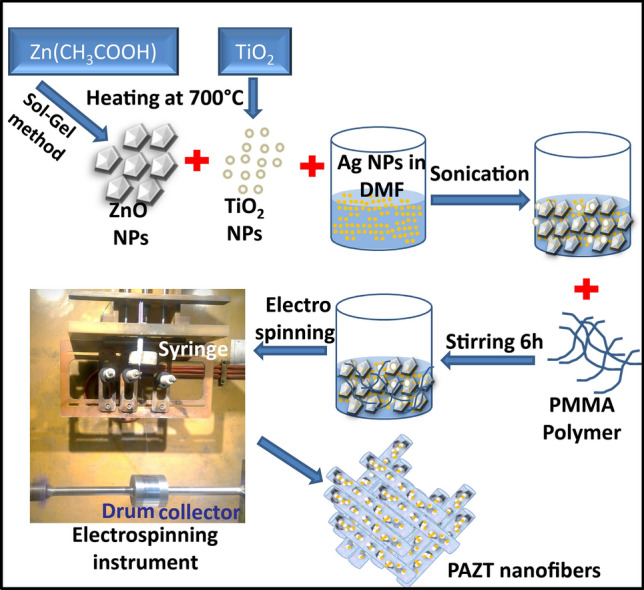
Membrane technology is an advanced approach to making a healthier and cleaner environment. Using such catalytic membrane technology to get clean, usable water by removal of dye impurities as well as pathogenic microbes is the main goal behind the research work. Here, we present the synthesis and efficacy study of polymethyl methacrylate (PMMA)-based Ag/ZnO/TiO2 trimetallic bifunctional nanofibers with antibacterial and photocatalytic activity. The nanofibers have been proven to be effective for the degradation of methylene blue (MB 93.4%), rhodamine B (Rh 34.6%), auramine-O (Au 65.0%) and fuchsin basic (FB 69.8%) dyes individually within 90 min in daylight. The study is further extended in abating a mixture of these dyes from contaminated water using composite nanofibers. Also, in the case of a mixture of these dyes (3 ppm each), nanofibers show dye degradation efficiency (DDE) of 90.9% (MB), 62.4% (Au) and 90.3% (FB and Rh) in 60 min. The role of Ag nanoparticles with a synergic photocatalytic effect on ZnO and TiO2 is also demonstrated. Also, PMMA/ZnO/TiO2 composite fiber membrane in synergy with silver particles shows better antibacterial activity against Gram-negative bacteria E. coli, making PMMA/Ag/ZnO/TiO2 fibers a promising candidate in water purification.
Keywords: Antibacterial; Dye mixture; Membrane; Nanofibers; Photocatalysis.
© King Abdulaziz City for Science and Technology 2020.
Conflict of interest statement
Conflict of interestThe authors declare no conflict of interest.
Figures



References
-
- Aboua KN, Yobouet YA, Yao KB, Goné DL, Trokourey A. Investigation of dye adsorption onto activated carbon from the shells of Macoré fruit. J Environ Manage. 2015;156:10–14. - PubMed
-
- Adamek E, Baran W, Ziemiańska J, Sobczak A. The comparison of photocatalytic degradation and decolorization processes of dyeing effluents. Int J Photoenergy. 2013;2013:578191.
-
- Arslan I, Balcioğlu IA. Degradation of commercial reactive dyestuffs by heterogenous and homogenous advanced oxidation processes: a comparative study. Dyes Pigm. 1999;43(2):95–108.
-
- Augugliaro V, Baiocchi C, Prevot AB, García-López E, Loddo V, Malato S, Marcí G, Palmisano L, Pazzi M, Pramauro E (2002) Azo-dyes photocatalytic degradation in aqueous suspension of TiO2 under solar irradiation. Chemosphere 49(10): 1223–1230 - PubMed
LinkOut - more resources
Full Text Sources
Miscellaneous