


THE DEVELOPING BRAIN REVEALED DURING SLEEP
- PMID: 32864534
- PMCID: PMC7450535
- DOI: 10.1016/j.cophys.2019.11.002
THE DEVELOPING BRAIN REVEALED DURING SLEEP
Abstract
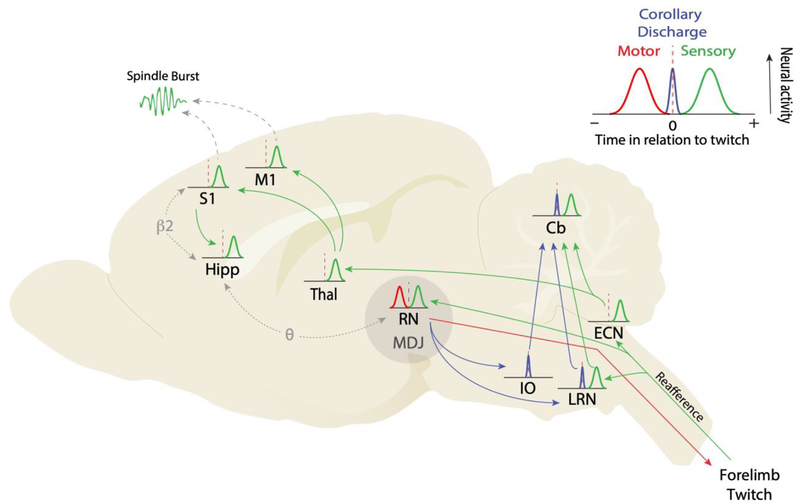
Given the prevalence of sleep in early development, any satisfactory account of infant brain activity must consider what happens during sleep. Only recently, however, has it become possible to record sleep-related brain activity in newborn rodents. Using such methods in rat pups, it is now clear that sleep, more so than wake, provides a critical context for the processing of sensory input and the expression of functional connectivity throughout the sensorimotor system. In addition, sleep uniquely reveals functional activity in the developing primary motor cortex, which establishes a somatosensory map long before its role in motor control emerges. These findings will inform our understanding of the developmental processes that contribute to the nascent sense of embodiment in human infants.
Keywords: REM sleep; brain rhythms; corollary discharge; embodiment; functional connectivity; myoclonic twitching; neurodevelopment disorders; sensorimotor integration; sensory development; somatosensory.
Conflict of interest statement
Conflict of Interest Statement: Nothing declared
Figures
References
-
- Blumberg MS, Sokoloff G, Tiriac A, Del Rio-Bermudez C, A valuable and promising method for recording brain activity in behaving newborn rodents, Dev Psychobiol. 57 (2015) 506–517. doi: 10.1002/dev.21305. - DOI - PMC - PubMed
-
* This paper describes a method for recording neural activity in unanesthetized, head-fixed infant rats.
-
- Roffwarg HP, Muzio JN, Dement WC, Ontogenetic development of the human sleep-dream cycle, Science. 152 (1966) 604–619. - PubMed
-
- Parmelee A, Wenner W, Akiyama Y, Schultz M, Stern E, Sleep states in premature infants, Dev Med Child Neurol. 9 (1967) 70–77. - PubMed
-
- Kohyama J, Iwakawa Y, Developmental changes in phasic sleep parameters as reflections of the brain-stem maturation polysomnographical examinations of infants, including premature neonates, Electroencephalogr Clin Neurophysiol. 76 (1990) 325–330. - PubMed
Grants and funding
LinkOut - more resources
Full Text Sources