Review
. 2021 Jul;18(7):972-987.
doi: 10.1080/15476286.2020.1809186. Epub 2020 Aug 30.

RNA-binding proteins in neurological development and disease

Affiliations
Review

RNA-binding proteins in neurological development and disease

Shavanie Prashad et al. RNA Biol. 2021 Jul.

Abstract

RNA-binding proteins are a critical group of multifunctional proteins that precisely regulate all aspects of gene expression, from alternative splicing to mRNA trafficking, stability, and translation. Converging evidence highlights aberrant RNA metabolism as a common pathogenic mechanism in several neurodevelopmental and neurodegenerative diseases. However, dysregulation of disease-linked RNA-binding proteins results in widespread, often tissue-specific and/or pleiotropic effects on the transcriptome, making it challenging to determine the underlying cellular and molecular mechanisms that contribute to disease pathogenesis. Understanding how splicing misregulation as well as alterations of mRNA stability and localization impact the activity and function of neuronal proteins is fundamental to addressing neurodevelopmental defects and synaptic dysfunction in disease. Here we highlight recent exciting studies that use high-throughput transcriptomic analysis and advanced genetic, cell biological, and imaging approaches to dissect the role of disease-linked RNA-binding proteins on different RNA processing steps. We focus specifically on efforts to elucidate the functional consequences of aberrant RNA processing on neuronal morphology, synaptic activity and plasticity in development and disease. We also consider new areas of investigation that will elucidate the molecular mechanisms RNA-binding proteins use to achieve spatiotemporal control of gene expression for neuronal homeostasis and plasticity.

Keywords: FMRP; FUS; Local translation; RBFOX1; RNA-binding proteins; SMN; TDP-43; mRNA stability and localization in synaptic function; neurobiology/neurological disease; splicing in neurodevelopment.


Figures
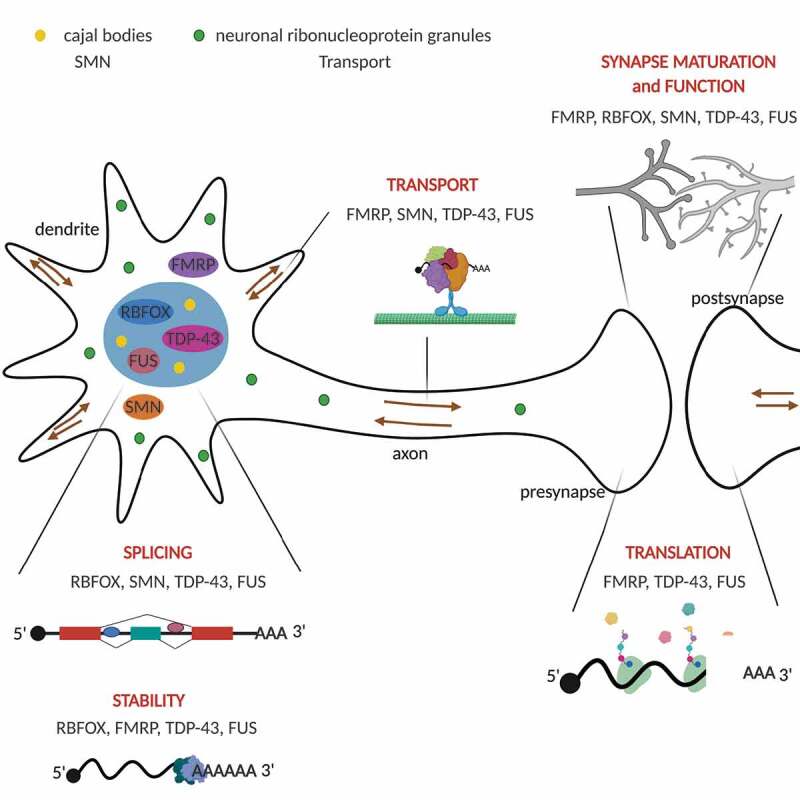
Figure 1.
Figure 1.
Dysfunction of RNA-binding proteins has profound effects on the neuronal transcriptome. RNA-binding proteins precisely regulate mRNA processing, stability, transport and translation to meet critical functions in neurodevelopment, synaptic function, and plasticity. In this review, we discuss how the RNA-binding proteins, RBFOX1, FMRP, SMN, TDP-43 and FUS, regulate myriad aspects of RNA metabolism and impact neurodevelopment, synapse homeostasis, and the neuronal cytoskeleton. The figure depicts the nuclear localization and functions of RBFOX1, TDP-43 and FUS, whereas SMN and FMRP are mainly localized in the cytoplasm. SMN also is a component of Cajal bodies in the nucleus. RNA-binding proteins are components of neuronal ribonucleoprotein granules that function in the bidirectional transport, localization and/or translation of mRNAs in the dendrites and axon
Figure 2.
Figure 2.
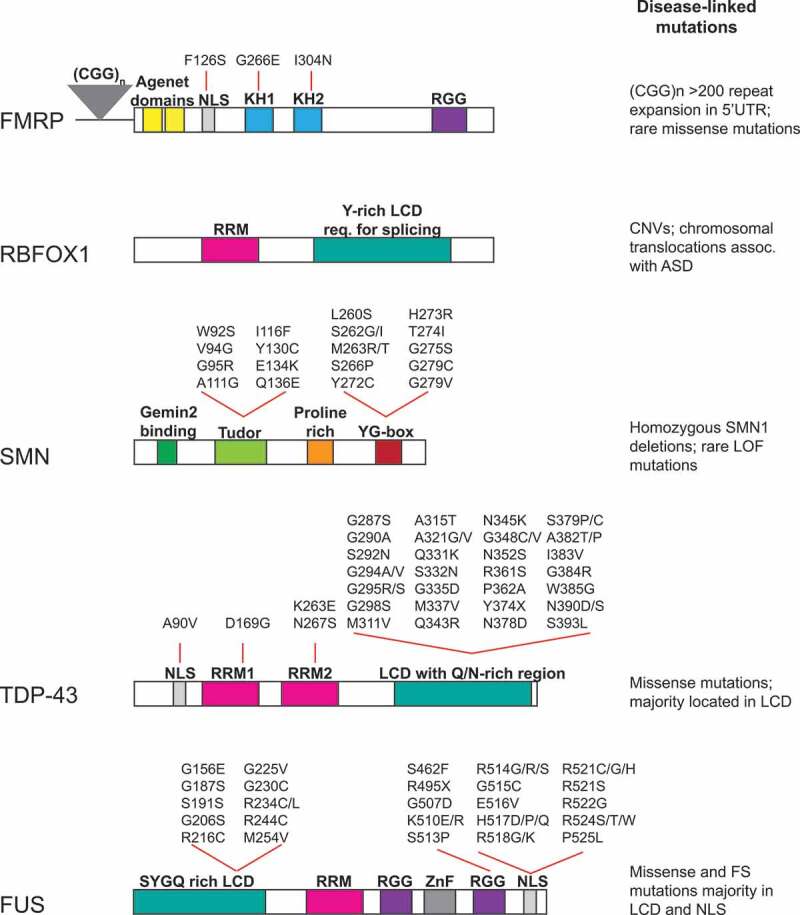
Schematic of RNA-binding protein domain structure, mutations, and disease mechanism. RBFOX1, FMRP, SMN, TDP-43 and FUS functional domains and locations of disease-linked mutations are highlighted. Abbreviations used: Nuclear localization signal (NLS); hnRNP K protein homology (KH); arginine-glycine-glycine box (RGG); RNA recognition motif (RRM); Low complexity domain (LCD); Zinc finger (ZnF); Tyrosine- and glycine-rich region (YG-box); Frameshift (FS); Loss of function (LOF)
Figure 3.
Figure 3.
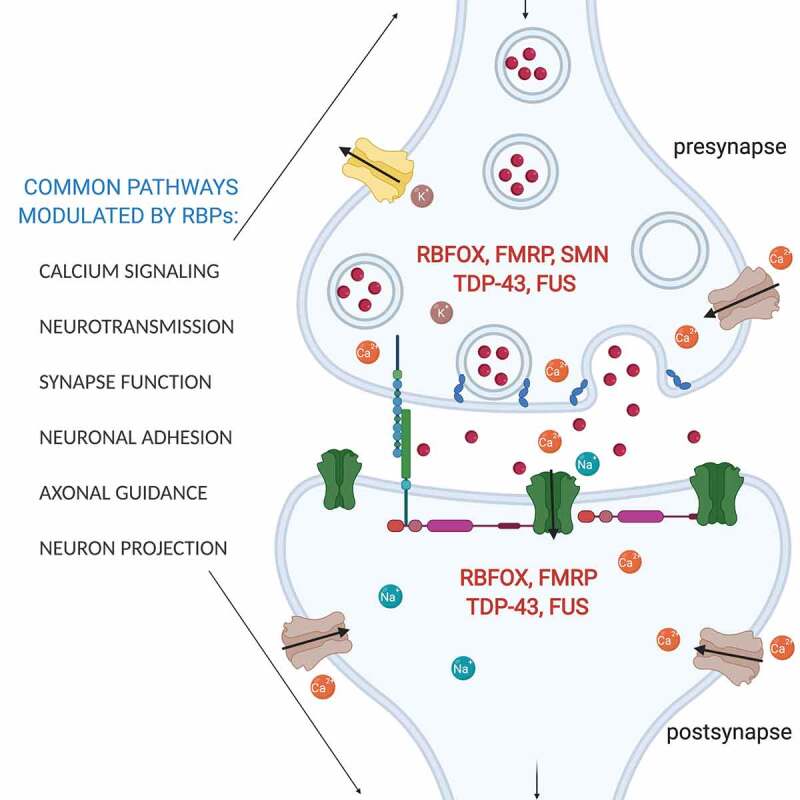
Shared functional pathways at the pre- and post-synapse that are influenced by RBFOX1, FMRP, SMN, TDP-43 and FUS. RNA-binding proteins can regulate mRNA targets at the level of alternative splicing, stability, transport, or translation to modulate several common pathways in neurons. Examples of mRNA targets for each RNA-binding proteins are highlighted: RBFOX1 (Snap25, Grin1, Vamp1, Kcnd3), FMRP (CamKIIa, Map1b), SMN (beta-actin, neuritin), TDP-43 (Rac1, Nefl, Map1b), and FUS (Mapt, GluA1, synGAPa2, Nd1-L)

References

    1. Holt CE, Schuman EM.. The central dogma decentralized: new perspectives on RNA function and local translation in neurons. Neuron. 2013;80(3):648–657. - PMC - PubMed
    1. Raj T, Li YI, Wong G, et al.. Integrative transcriptome analyses of the aging brain implicate altered splicing in Alzheimer’s disease susceptibility. Nat Genet. 2018;50(11):1584–1592. DOI: 10.1038/s41588-018-0238-1 - DOI - PMC - PubMed
    1. Voineagu I, Wang X, Johnston P, et al.. Transcriptomic analysis of autistic brain reveals convergent molecular pathology. Nature. 2011;474(7351):380–384. DOI: 10.1038/nature10110 - DOI - PMC - PubMed
    1. Irimia M, Weatheritt R, Ellis JD, et al.. A highly conserved program of neuronal microexons is misregulated in autistic brains. Cell. 2014;159(7):1511–1523. DOI: 10.1016/j.cell.2014.11.035 - DOI - PMC - PubMed
    1. Tollervey JR, Curk T, Rogelj B, et al.. Characterizing the RNA targets and position-dependent splicing regulation by TDP-43. Nat Neurosci. 2011;14(4):452–458. DOI: 10.1038/nn.2778 - DOI - PMC - PubMed

Publication types

MeSH terms