


Three-Year Results of the IN.PACT SFA Japan Trial Comparing Drug-Coated Balloons With Percutaneous Transluminal Angioplasty
- PMID: 32865145
- PMCID: PMC7649941
- DOI: 10.1177/1526602820948240
Three-Year Results of the IN.PACT SFA Japan Trial Comparing Drug-Coated Balloons With Percutaneous Transluminal Angioplasty
Abstract
Purpose: To evaluate the 3-year safety and effectiveness of the MDT-2113 (IN.PACT Admiral) drug-coated balloon (DCB) vs percutaneous transluminal angioplasty (PTA) in a Japanese population with femoropopliteal occlusive disease.
Materials and methods: The multicenter, prospective, IN.PACT SFA Japan randomized controlled trial (ClinicalTrials.gov identifier NCT01947478) was an independently adjudicated study evaluating Japanese participants randomized 2:1 to DCB (n=68) or PTA (n=32). The effectiveness endpoint was primary patency through 36 months, defined as freedom from clinically-driven target lesion revascularization (CD-TLR) and freedom from restenosis (by duplex ultrasound). The effectiveness endpoint was evaluated using the Kaplan-Meier method; estimates are presented with the 95% confidence intervals (CIs). The safety composite endpoint was freedom from device- and procedure-related death through 30 days and freedom from major target limb amputation and clinically-driven target vessel revascularization through 36 months.
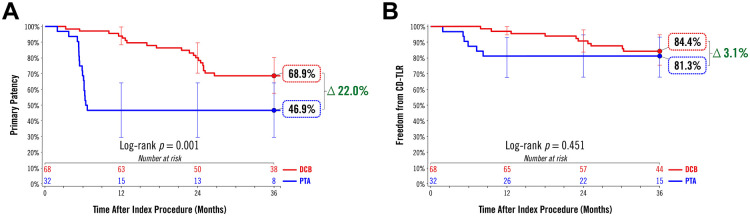
Results: Primary patency by Kaplan-Meier estimate was higher in the DCB group (68.9%, 95% CI 57.5% to 80.2%) vs the PTA group (46.9%, 95% CI 29.6% to 64.2%) at 36 months (log-rank p=0.001). The CD-TLR rates were 14.9% (10/67) for the DCB group and 20.7% (6/29) for PTA (p=0.554). The safety composite endpoint occurred in 83.6% (56/67) of DCB participants and 75.9% (22/29) of PTA participants (p=0.402). All-cause death was similar between groups at 36 months [DCB 6.0% (4/67) vs PTA 6.9% (2/29), p>0.999), with no device- or procedure-related deaths in either group.
Conclusion: The final report of the IN.PACT SFA Japan trial showed that the IN.PACT Admiral DCB is safe and had durable outcomes through 3 years in Japanese participants with femoropopliteal occlusive disease.
Keywords: amputation; balloon angioplasty; drug-coated balloon; femoropopliteal segment; mortality; restenosis; target lesion revascularization.
Conflict of interest statement
Figures

References
-
- Gerhard-Herman MD, Gornik HL, Barrett C, et al. 2016 AHA/ACC guideline on the management of patients with lower extremity peripheral artery disease: executive summary: a report of the American College of Cardiology/American Heart Association Task Force on Clinical Practice Guidelines. J Am Coll Cardiol. 2017;69:1465–1508. - PubMed
-
- Bailey SR, Beckman JA, Dao TD, et al. ACC/AHA/SCAI/SIR/SVM 2018 appropriate use criteria for peripheral artery intervention: a report of the American College of Cardiology Appropriate Use Criteria Task Force, American Heart Association, Society for Cardiovascular Angiography and Interventions, Society of Interventional Radiology, and Society for Vascular Medicine. J Am Coll Cardiol. 2019; 73:214–237. - PMC - PubMed
-
- Feldman DN, Armstrong EJ, Aronow HD, et al. SCAI consensus guidelines for device selection in femoral-popliteal arterial interventions. Catheter Cardiovasc Interv. 2018;92:124–140. - PubMed
-
- Laird JR, Schneider PA, Tepe G, et al. Durability of treatment effect using a drug-coated balloon for femoropopliteal lesions: 24-month results of IN.PACT SFA. J Am Coll Cardiol. 2015;66:2329–2338. - PubMed
Publication types
MeSH terms
Substances
Associated data
LinkOut - more resources
Full Text Sources
Medical
Miscellaneous
