Association of Selective Serotonin Reuptake Inhibitor Use After Intracerebral Hemorrhage With Hemorrhage Recurrence and Depression Severity
- PMID: 32865558
- PMCID: PMC7489430
- DOI: 10.1001/jamaneurol.2020.3142
Association of Selective Serotonin Reuptake Inhibitor Use After Intracerebral Hemorrhage With Hemorrhage Recurrence and Depression Severity
Abstract
Importance: Selective serotonin reuptake inhibitors (SSRIs) are widely used to treat poststroke depression but are associated with increased incidence of first-ever intracerebral hemorrhage (ICH) in the general population. The decision to treat ICH survivors with SSRIs must therefore balance potential risks of ICH recurrence with presumed benefits on depressive symptoms.
Objective: To determine whether SSRI use among survivors of primary ICH was associated with ICH recurrence and decreased severity of depressive symptoms.
Design, setting, and participants: Longitudinal ICH cohort study at a tertiary care center enrolling from January 2006 to December 2017, with follow-up for a median of 53.2 months (interquartile range, 42.3-61.2 months). The study included 1279 consenting individuals (1049 White, 89 Black, 77 Hispanic, and 64 other race/ethnicity) of 1335 eligible patients presenting with primary ICH and who were discharged alive from initial hospitalization for stroke.
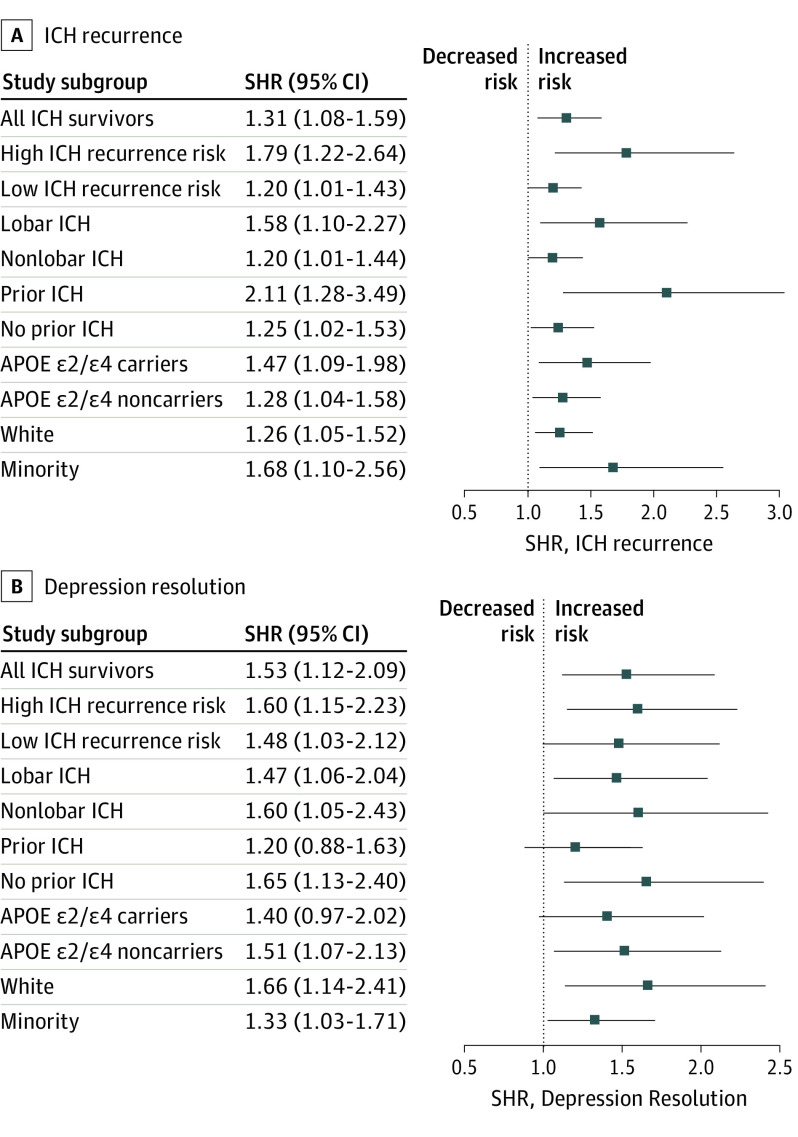
Main outcomes and measures: We conducted univariable and multivariable analyses for ICH recurrence risk and depression severity, including subset analyses for patients with 1 or more of the following characteristics associated with high ICH recurrence risk: (1) lobar ICH; (2) presence of the apolipoprotein ε2/ε4 gene variants; (3) prior history of ICH/TIA/ischemic stroke; and (4) Black or Hispanic race/ethnicity.
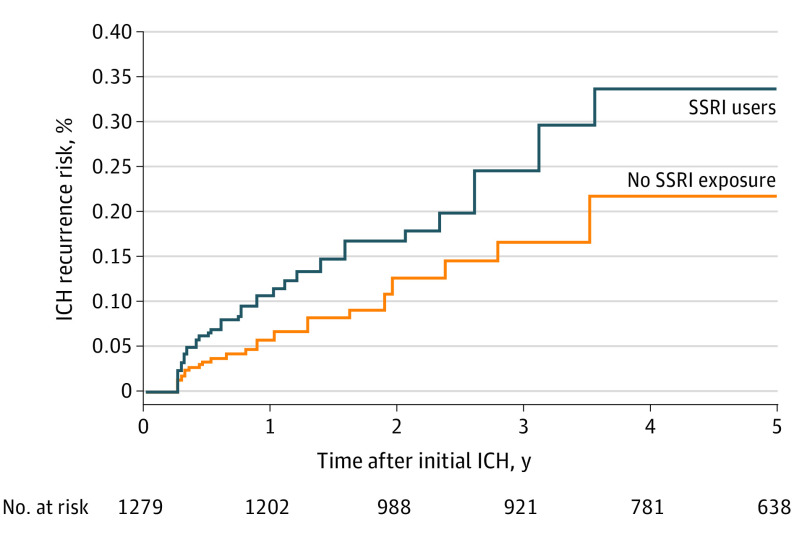
Results: Mean age of study participants was 71.3 years, with 602 women (47%); of the 1279 participants, 1049 were White, 89 were Black, 77 were Hispanic, and 64 were other race/ethnicity. SSRI exposure was associated with both ICH recurrence (subhazard ratio [SHR], 1.31; 95% CI, 1.08-1.59) and resolution of post-ICH depression (SHR, 1.53; 95% CI, 1.12 2.09). Among those individuals at high risk for recurrent ICH, SSRIs were associated with further elevation in risk for ICH recurrence (SHR, 1.79; 95% CI, 1.22-2.64) compared with all other survivors of ICH (SHR, 1.20; 95% CI, 1.01-1.42; P = .008 for comparison of effect sizes). The association of SSRI with reduced depressive symptoms did not differ between high those at high risk for recurrent ICH and all other ICH survivors.
Conclusions and relevance: Selective serotonin reuptake inhibitor exposure after ICH is associated with both improvement in depressive symptoms and increased risk of recurrent hemorrhagic stroke. Clinical history, neuroimaging data, and genetic biomarkers may help to identify survivors of ICH more likely to safely tolerate SSRI use.
Conflict of interest statement
Figures
Comment in
-
Research round up.Lancet Psychiatry. 2020 Nov;7(11):937. doi: 10.1016/S2215-0366(20)30439-9. Lancet Psychiatry. 2020. PMID: 33069312 No abstract available.
-
SSRI nach Hirnblutung vorsichtig einsetzen.MMW Fortschr Med. 2021 Mar;163(Suppl 1):23. doi: 10.1007/s15006-021-9909-4. MMW Fortschr Med. 2021. PMID: 33950439 German. No abstract available.
References
-
- Thrift AG, Thayabaranathan T, Howard G, et al. Global stroke statistics. Int J Stroke. 2017;12(1):13-32. - PubMed
-
- Boulouis G, Charidimou A, Pasi M, et al. Hemorrhage recurrence risk factors in cerebral amyloid angiopathy: comparative analysis of the overall small vessel disease severity score versus individual neuroimaging markers. J Neurol Sci. 2017;380:64-67. doi: 10.1016/j.jns.2017.07.015 - DOI - PMC - PubMed
Grants and funding
LinkOut - more resources
Full Text Sources
Other Literature Sources