


Challenges and Opportunities in Clinical Applications of Blood-Based Proteomics in Cancer
- PMID: 32867043
- PMCID: PMC7564506
- DOI: 10.3390/cancers12092428
Challenges and Opportunities in Clinical Applications of Blood-Based Proteomics in Cancer
Abstract
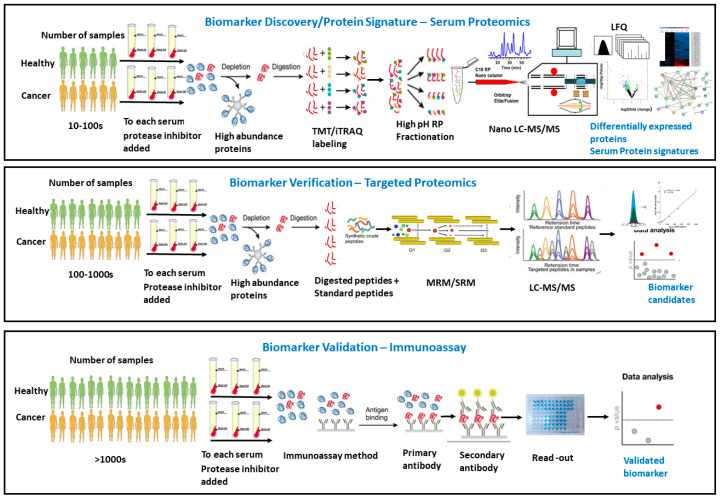
Blood is a readily accessible biofluid containing a plethora of important proteins, nucleic acids, and metabolites that can be used as clinical diagnostic tools in diseases, including cancer. Like the on-going efforts for cancer biomarker discovery using the liquid biopsy detection of circulating cell-free and cell-based tumor nucleic acids, the circulatory proteome has been underexplored for clinical cancer biomarker applications. A comprehensive proteome analysis of human serum/plasma with high-quality data and compelling interpretation can potentially provide opportunities for understanding disease mechanisms, although several challenges will have to be met. Serum/plasma proteome biomarkers are present in very low abundance, and there is high complexity involved due to the heterogeneity of cancers, for which there is a compelling need to develop sensitive and specific proteomic technologies and analytical platforms. To date, liquid chromatography mass spectrometry (LC-MS)-based quantitative proteomics has been a dominant analytical workflow to discover new potential cancer biomarkers in serum/plasma. This review will summarize the opportunities of serum proteomics for clinical applications; the challenges in the discovery of novel biomarkers in serum/plasma; and current proteomic strategies in cancer research for the application of serum/plasma proteomics for clinical prognostic, predictive, and diagnostic applications, as well as for monitoring minimal residual disease after treatments. We will highlight some of the recent advances in MS-based proteomics technologies with appropriate sample collection, processing uniformity, study design, and data analysis, focusing on how these integrated workflows can identify novel potential cancer biomarkers for clinical applications.
Keywords: biomarkers; mass spectrometry; proteomics; serum.
Conflict of interest statement
The authors declare no conflict of interest.
Figures
References
Publication types
Grants and funding
LinkOut - more resources
Full Text Sources
Medical
Miscellaneous
