. 2020 Dec;9(1):2013-2019.
doi: 10.1080/22221751.2020.1817796.

A serological survey of SARS-CoV-2 in cat in Wuhan

Affiliations

A serological survey of SARS-CoV-2 in cat in Wuhan

Qiang Zhang et al. Emerg Microbes Infect. 2020 Dec.

Abstract

COVID-19 is a new respiratory illness caused by SARS-CoV-2, and has constituted a global public health emergency. Cat is susceptible to SARS-CoV-2. However, the prevalence of SARS-CoV-2 in cats remains largely unknown. Here, we investigated the infection of SARS-CoV-2 in cats during COVID-19 outbreak in Wuhan by serological detection methods. A cohort of serum samples were collected from cats in Wuhan, including 102 sampled after COVID-19 outbreak, and 39 prior to the outbreak. Fifteen sera collected after the outbreak were positive for the receptor binding domain (RBD) of SARS-CoV-2 by indirect enzyme linked immunosorbent assay (ELISA). Among them, 11 had SARS-CoV-2 neutralizing antibodies with a titer ranging from 1/20 to 1/1080. No serological cross-reactivity was detected between SARS-CoV-2 and type I or II feline infectious peritonitis virus (FIPV). In addition, we continuously monitored serum antibody dynamics of two positive cats every 10 days over 130 days. Their serum antibodies reached the peak at 10 days after first sampling, and declined to the limit of detection within 110 days. Our data demonstrated that SARS-CoV-2 has infected cats in Wuhan during the outbreak and described serum antibody dynamics in cats, providing an important reference for clinical treatment and prevention of COVID-19.

Keywords: COVID-19; SARS-CoV-2; cats; serological investigation; serum antibody dynamic.


Conflict of interest statement

No potential conflict of interest was reported by the author(s).

Figures
None
Graphical abstract
Figure 1.
Figure 1.
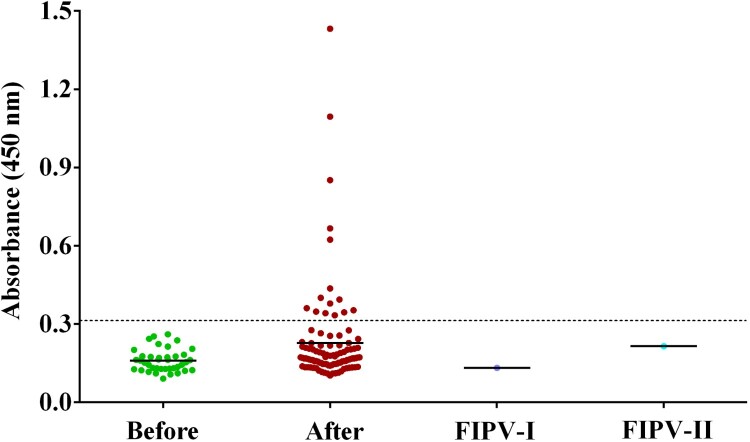
ELISA of cat serum samples against the recombinant receptor binding domain (RBD) of SARS-CoV-2 spike protein. The dashed line is the cut-off. Each dot represents one individual sample within each antigen panel. Before, serum samples collected between Mar. and May, 2019 prior to COVID-19 outbreak; After, serum samples collected between Jan to Mar., 2020 after COVID-19 outbreak; FIPV- I, hyperimmune sera against type I feline infectious peritonitis virus (FIPV); FIPV-II, hyperimmune sera against type II FIPV.
Figure 2.
Figure 2.
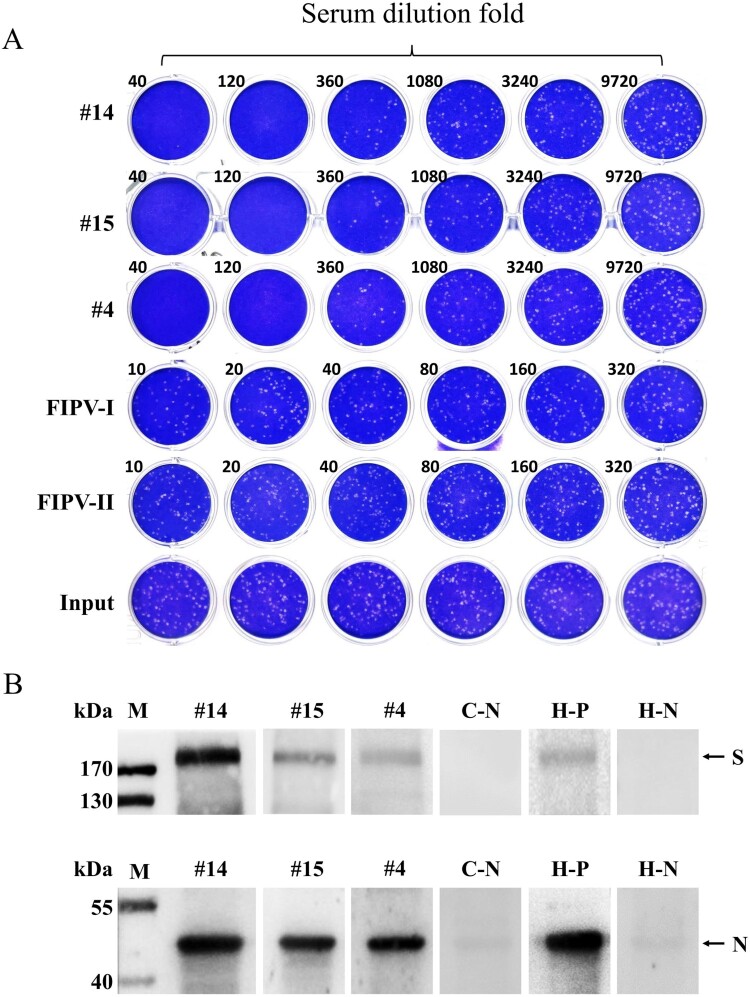
Virus neutralization test and Western blot assay of cat serum samples for SARS-CoV-2 (A) Cat#14, Cat#15 and Cat#4 sera were 3-fold serially diluted and mixed with SARS-CoV-2; after incubated at 37°C for 1 h, the mixture was used to infect Vero E6 cells, and replaced with semi-solid media 1 h later. The plates were fixed and stained 3 days later. All samples were tested in duplicate. (B) Western blot of purified SARS-CoV-2 with cat or human sera. All sera were diluted 100 folds. C-N, negative cat serum. H-P, human convalescent serum. H-N, healthy human serum.
Figure 3.
Figure 3.
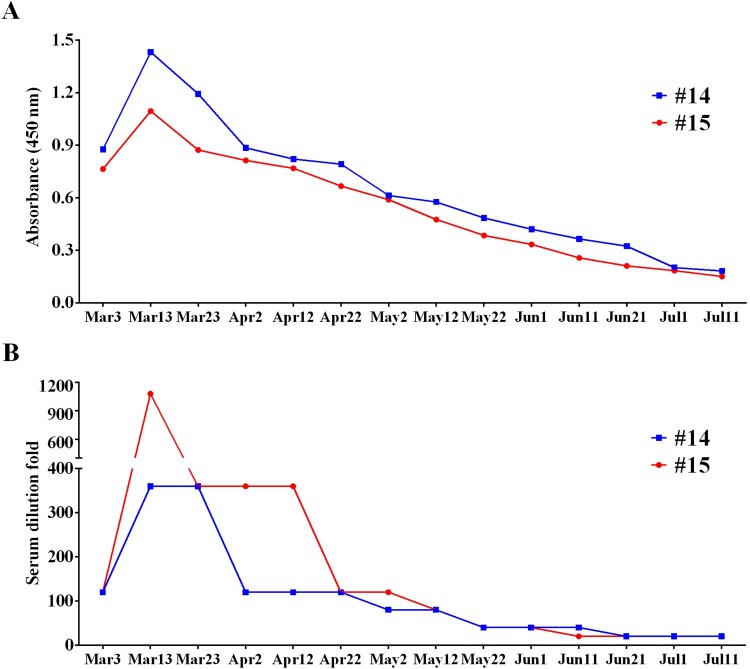
The dynamic change of cat serum antibody for SARS-CoV-2. (A) ELISA detection and (B) neutralization test of cat serums. The serums of Cat#14 and Cat#15 were collected every 10 days from Mar. 3 to Jul. 11. Then the ELISA against SARS-CoV-2 RBD and the virus neutralization test were performed.

References

    1. Zhou F, Yu T, Du R, et al. . Clinical course and risk factors for mortality of adult inpatients with COVID-19 in Wuhan, China: a retrospective cohort study. Lancet. 2020;395(10229):1054–1062. doi: 10.1016/S0140-6736(20)30566-3 - DOI - PMC - PubMed
    1. Chen N, Zhou M, Dong X, et al. . Epidemiological and clinical characteristics of 99 cases of 2019 novel coronavirus pneumonia in Wuhan, China: a descriptive study. Lancet. 2020;395:507–513. doi: 10.1016/S0140-6736(20)30211-7 - DOI - PMC - PubMed
    1. Huang C, Wang Y, Li X, et al. . Clinical features of patients infected with 2019 novel coronavirus in Wuhan, China. Lancet. 2020;395:497–506. doi: 10.1016/S0140-6736(20)30183-5 - DOI - PMC - PubMed
    1. Liu Y, Gayle AA, Wilder-Smith A, et al. . The reproductive number of COVID-19 is higher compared to SARS coronavirus. J Travel Med. 2020;27(2):taaa021. doi: 10.1093/jtm/taaa021 - DOI - PMC - PubMed
    1. Petersen E, Koopmans M, Go U, et al. . Comparing SARS-CoV-2 with SARS-CoV and influenza pandemics. Lancet Infect Dis. 2020;20(9):e238–e244. doi: 10.1016/S1473-3099(20)30484-9 - DOI - PMC - PubMed

MeSH terms

LinkOut - more resources