Effects of carbohydrate quality and amount on plasma lactate: results from the OmniCarb trial
- PMID: 32868311
- PMCID: PMC7462151
- DOI: 10.1136/bmjdrc-2020-001457
Effects of carbohydrate quality and amount on plasma lactate: results from the OmniCarb trial
Abstract
Introduction: Plasma lactate is a marker of non-oxidative glucose metabolism associated with progression to diabetes. We examined the effect of carbohydrate quality (glycemic index (GI)) and amount (%kcal) on plasma lactate. We hypothesized that low GI (≤45 (g)) versus high (≥65 (G)) and low %kcal from carbohydrate (40% kcal (c)) versus high (58% kcal (C)) each would reduce lactate levels.
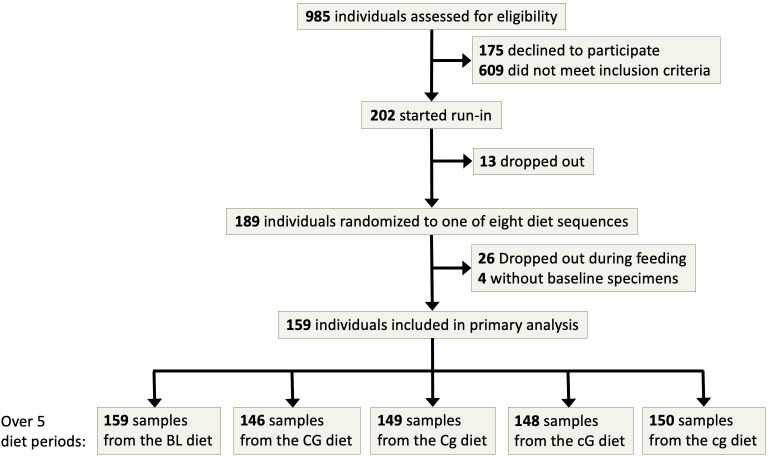
Research design and methods: We measured lactate in OmniCarb, a randomized, cross-over trial of four diets in overweight/obese adults without diabetes or cardiovascular disease (N=163). The four diets were high carbohydrate+high GI (CG, reference), high carbohydrate+low GI (Cg), low carbohydrate+high GI (cG), and low carbohydrate+low GI (cg). Participants (N=163) consumed each of the four diets over a 5-week period, separated by 2-week washout periods. Plasma lactate levels were measured at baseline, during which the participants consumed their own diets, and after each 5-week period.
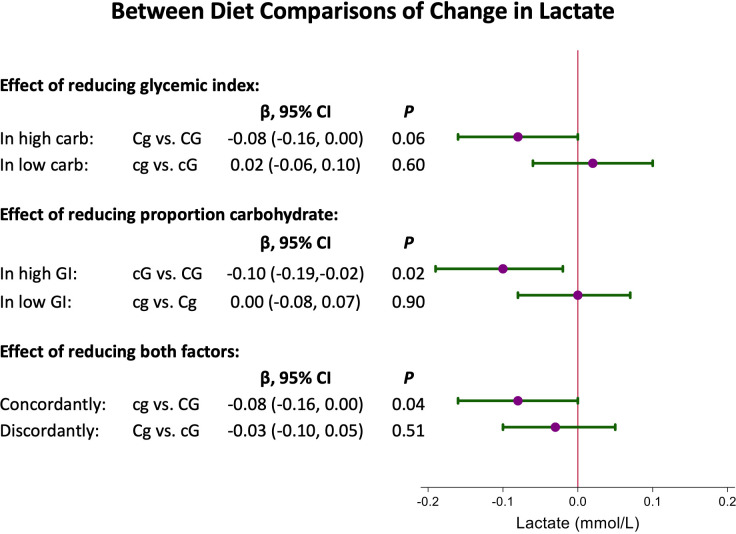
Results: Baseline plasma lactate was 1.2 mmol/L. In the setting of high carbohydrate amount, reducing GI lowered plasma lactate non-significantly by 0.08 mmol/L (Cg vs CG: 95% CI -0.16 to 0.00; p=0.06). In the setting of high GI, reducing carbohydrate amount lowered plasma lactate by 0.10 mmol/L (cG vs CG: 95% CI -0.19 to -0.02; p=0.02). The combined effect of reducing GI and carbohydrate proportion in the diet (cg vs CG) was similar (cg vs CG: -0.08; 95% CI -0.16 to 0.00; p=0.04). All four diets reduced plasma lactate compared with baseline.
Conclusions: Compared with a diet with high GI and high carbohydrate amount, diets with low GI and/or low carbohydrate amount reduced plasma lactate. Whether this change in lactate leads to long-term change in glucose metabolism needs to be examined.
Trial registration number: NCT00608049.
Keywords: carbohydrates; diet; insulin resistance; lactic acidosis.
© Author(s) (or their employer(s)) 2020. Re-use permitted under CC BY-NC. No commercial re-use. See rights and permissions. Published by BMJ.
Conflict of interest statement
Competing interests: None declared.
Figures
References
-
- Centers for Disease Control and Prevention National diabetes statistics report, 2017. Atlanta, GA: Centers for Disease Control and Prevention, 2017.
Publication types
MeSH terms
Substances
Associated data
Grants and funding
LinkOut - more resources
Full Text Sources
Medical