Review
. 2020 Nov 11;108(3):401-412.
doi: 10.1016/j.neuron.2020.08.003. Epub 2020 Aug 31.

How Can Hearing Loss Cause Dementia?

Affiliations
Review

How Can Hearing Loss Cause Dementia?

Timothy D Griffiths et al. Neuron. .

Abstract

Epidemiological studies identify midlife hearing loss as an independent risk factor for dementia, estimated to account for 9% of cases. We evaluate candidate brain bases for this relationship. These bases include a common pathology affecting the ascending auditory pathway and multimodal cortex, depletion of cognitive reserve due to an impoverished listening environment, and the occupation of cognitive resources when listening in difficult conditions. We also put forward an alternate mechanism, drawing on new insights into the role of the medial temporal lobe in auditory cognition. In particular, we consider how aberrant activity in the service of auditory pattern analysis, working memory, and object processing may interact with dementia pathology in people with hearing loss. We highlight how the effect of hearing interventions on dementia depends on the specific mechanism and suggest avenues for work at the molecular, neuronal, and systems levels to pin this down.

Keywords: Alzheimer disease; auditory cognition; dementia; hearing loss; medial temporal lobe.


Conflict of interest statement

Declaration of Interests The authors declare no competing interests.

Figures
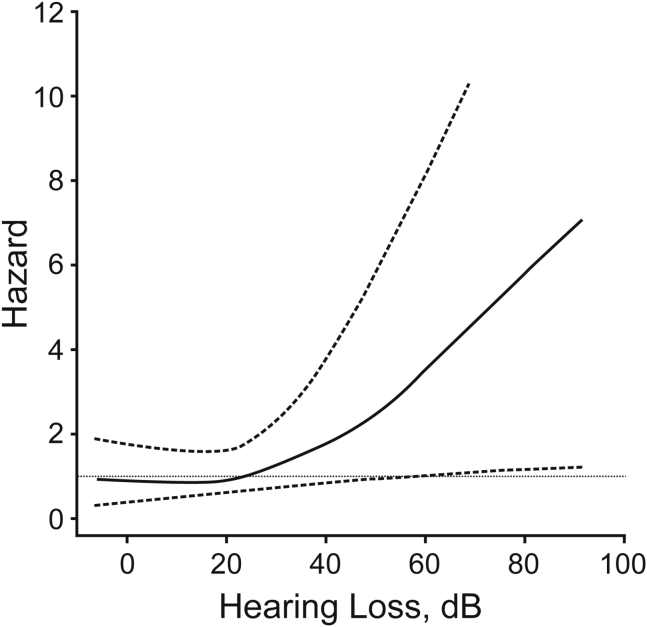
Figure 1
Figure 1
Risk of Incident Dementia (Hazard Ratio) as a Function of Hearing Loss The plotted hazard ratio accounts for other risk factors. Reproduced with permission from Lin, F.R., Metter, E.J., O’Brien, R.J., Resnick, S.M., Zonderman, A.B., and Ferrucci, L. (2011). Hearing loss and incident dementia. Arch. Neurol. 68, 214–220. Copyright © 2011 American Medical Association. All rights reserved.
Figure 2
Figure 2
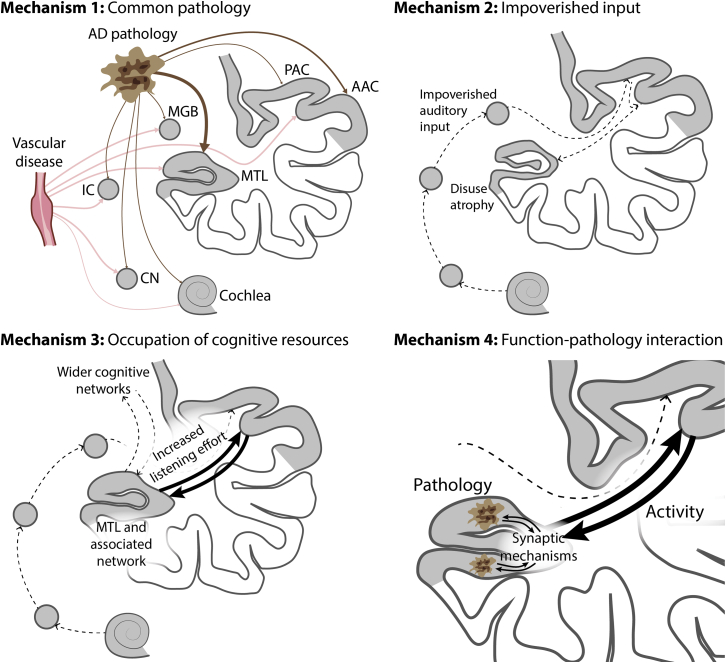
Possible Mechanisms for Dementia Related to Hearing Loss Mechanism 1: common pathology due to Alzheimer disease (AD) or vascular disease affects the cochlea and/or the ascending pathway (causing hearing loss) and MTL (causing dementia). Mechanism 2: impoverished environment caused by hearing loss leads to altered brain structure in the auditory cortex and hippocampus and decreased cognitive reserve, and therefore decreased resilience to dementia. Mechanism 3: increased brain activity in the MTL and a wider network during speech-in-noise analysis competes for the resources within that network that are also needed for other aspects of higher cognition. We argue in the text that this may be a better model for cognitive deficits in elderly people due to hearing loss as opposed to dementia per se. Mechanism 4: interaction between altered activity related to pattern analysis in the MTL during difficult listening and the pathology of AD. The model is based on the same mechanism for increased activity as mechanism 3, but it differs in the incorporation of a specific interaction with the molecular bases of AD. This is based on an interaction between increased activity and synaptic changes associated with AD. We also consider a mechanism in the text due to decreased activity interacting with AD pathology (not shown here). AAC, auditory association cortex; CN, cochlea nucleus; IC, inferior colliculus; MGB, medial geniculate body; MTL, medial temporal lobe; PAC, primary auditory cortex.

References

    1. Adank P. The neural bases of difficult speech comprehension and speech production: two Activation Likelihood Estimation (ALE) meta-analyses. Brain Lang. 2012;122:42–54. - PubMed
    1. Ahmed M.S., Priestley J.B., Castro A., Stefanini F., Solis Canales A.S., Balough E.M., Lavoie E., Mazzucato L., Fusi S., Losonczy A. Hippocampal Network Reorganization Underlies the Formation of a Temporal Association Memory. Neuron. 2020;107:283–291.e6. - PMC - PubMed
    1. Akeroyd M.A. Are individual differences in speech reception related to individual differences in cognitive ability? A survey of twenty experimental studies with normal and hearing-impaired adults. Int. J. Audiol. 2008;47(Suppl 2):S53–S71. - PubMed
    1. Alain C., Du Y., Bernstein L.J., Barten T., Banai K. Listening under difficult conditions: an activation likelihood estimation meta-analysis. Hum. Brain Mapp. 2018;39:2695–2709. - PMC - PubMed
    1. Armstrong N.M., An Y., Doshi J., Erus G., Ferrucci L., Davatzikos C., Deal J.A., Lin F.R., Resnick S.M. Association of Midlife Hearing Impairment With Late-Life Temporal Lobe Volume Loss. JAMA Otolaryngol. Head Neck Surg. 2019:e191610. - PMC - PubMed

Publication types