Nuchal-type Fibroma: Single-Center Experience and Systematic Literature Review
- PMID: 32871744
- PMCID: PMC7652458
- DOI: 10.21873/invivo.12032
Nuchal-type Fibroma: Single-Center Experience and Systematic Literature Review
Abstract
Background: Nuchal-type fibroma is a rare benign tumor arising from the connective tissue. Our aim was to present our experience via two cases of this tumor and a comprehensive review of the literature.
Patients and methods: We report a case of a 23-year-old female with a mass located in the posterior neck and the upper back and a case of a 50-year-old male with a mass located in the posterior neck, which were proved to be nuchal-type fibromas in the histopathological examination. We also searched the PubMed/Medline database for published cases of nuchal-type fibromas.
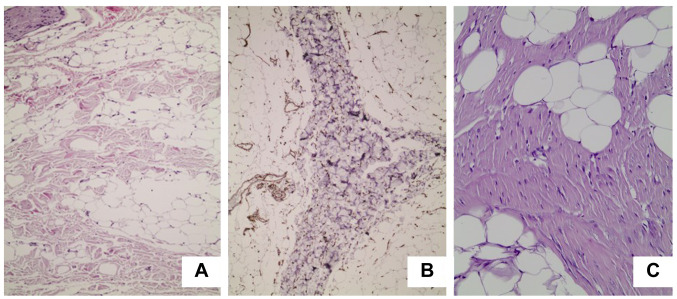
Results and discussion: Nuchal-type fibroma is a rare benign tumor arising from the connective tissue, usually in the posterior neck, which affects different ages, with most patients being male. It is a poorly circumscribed tumor consisting of hypocellular, thick, dense and haphazardly arranged collagen bundles with entrapped adipocytes, nerve fibers and muscle fascicles and a few scattered spindle cells, which are CD34 positive. Its excision is curative, and the recurrence risk is generally low. However, patients with Gardner's syndrome may experience recurrence more frequently.
Conclusion: Nuchal-type fibroma should be included in the differential diagnosis of subcutaneous, soft-tissue masses, especially when these involve the posterior neck.
Keywords: CD34; Nuchal; fibroma; review; tumor.
Copyright© 2020, International Institute of Anticancer Research (Dr. George J. Delinasios), All rights reserved.
Conflict of interest statement
All the Authors declare that there are no conflicts of interest regarding this study.
Figures
References
-
- Enzinger FM, Weiss SW. Benign tumors and tumorlike lesions of fibrous tissue. In: Soft Tissue Tumors, 2nd Ed. Enzinger FM (ed.) St Louis, Mosby. 1988;In:pp 102–135.
-
- Balachandran K, Allen PW, MacCormac LB. Nuchal fibroma. A clinicopathological study of nine cases. Am J Surg Pathol. 1995;19(3):313–317. - PubMed
Publication types
MeSH terms
LinkOut - more resources
Full Text Sources
Medical