


High Prevalence of Intestinal Pathogens in Indigenous in Colombia
- PMID: 32872252
- PMCID: PMC7564226
- DOI: 10.3390/jcm9092786
High Prevalence of Intestinal Pathogens in Indigenous in Colombia
Abstract
Background: Intestinal infections remain a major public health burden in developing countries. Due to social, ecological, environmental, and cultural conditions, Indigenous peoples in Colombia are at particularly high risk.
Materials: 137 stool samples were analyzed by microscopy and real-time-Polymerase Chain Reaction (RT-PCR), targeting protozoan parasites (Giardia intestinalis, Entamoeba histolytica, Cryptosporidium spp., and Cyclospora cayetanensis), bacteria (Campylobacter jejuni, Salmonella spp., Shigella ssp./enteroinvasive E. coli (EIEC), Yersinia spp., enterohemorrhagic E. coli (EHEC), enteropathogenic E. coli ( EPEC), enterotoxin-producing E. coli (ETEC), enteroaggregative E. coli (EAEC), and Tropheryma whipplei), and helminths (Necator americanus, Strongyloides stercoralis, Ascaris lumbricoides, Ancylostoma spp., Trichuris. trichiura, Taenia spp., Hymenolepis nana, Enterobius vermicularis, and Schistosoma spp.). Microscopy found additional cases of helminth infections.
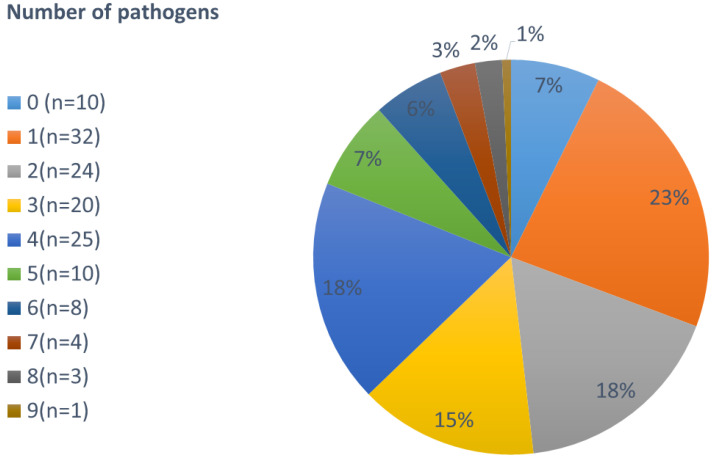
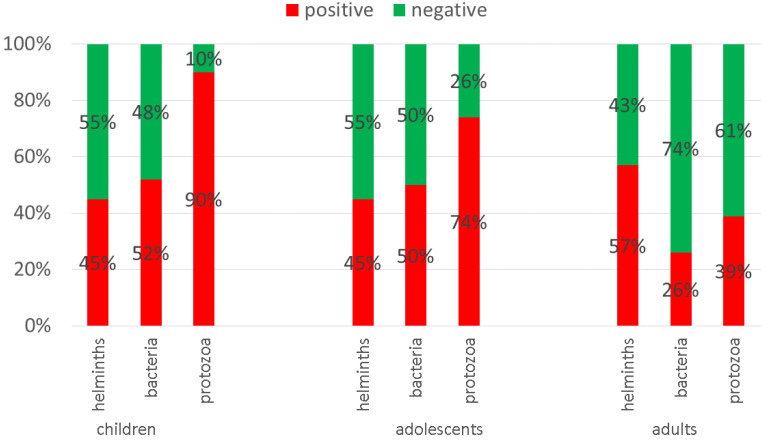
Results: At least one pathogen was detected in 93% of the samples. The overall results revealed protozoa in 79%, helminths in 69%, and bacteria in 41%. G. intestinalis (48%), Necator/hookworm (27%), and EAEC (68%) were the most common in each group. Noteworthy, T. whipplei was positive in 7% and T. trichirua in 23% of the samples. A significant association of one infection promoting the other was determined for G. intestinalis and C. jejuni, helminth infections, and EIEC.
Conclusions: The results illustrate the high burden of gastrointestinal pathogens among Indigenous peoples compared to other developing countries. Countermeasures are urgently required.
Keywords: bacterial infections; gastrointestinal infection; helminthes; protozoa infections.
Conflict of interest statement
There are no conflict of interest.
Figures
References
-
- Hawash Y.A., Ismail K.A., Almehmadi M. High Frequency of Enteric Protozoan, Viral, and Bacterial Potential Pathogens in Community-Acquired Acute Diarrheal Episodes: Evidence Based on Results of Luminex Gastrointestinal Pathogen Panel Assay. Korean J. Parasitol. 2017;55:513–521. doi: 10.3347/kjp.2017.55.5.513. - DOI - PMC - PubMed
-
- WHO Soil-Transmitted Helminth Infections. [(accessed on 19 June 2020)]; Available online: https://www.who.int/news-room/fact-sheets/detail/soil-transmitted-helmin....
-
- Köller T., Hahn A., Altangerel E., Verweij J.J., Landt O., Kann S., Dekker D., May J., Loderstädt U., Podbielski A., et al. Comparison of commercial and in-house real-time PCR platforms for 15 parasites and microsporidia in human stool samples without a gold standard. Acta Trop. 2020;207:105516. doi: 10.1016/j.actatropica.2020.105516. - DOI - PubMed
-
- Wiemer D., Loderstaedt U., von Wulffen H., Priesnitz S., Fischer M., Tannich E., Hagen R.M. Real-time multiplex PCR for simultaneous detection of Campylobacter jejuni, Salmonella, Shigella and Yersinia species in fecal samples. Int. J. Med. Microbiol. 2011;301:577–584. doi: 10.1016/j.ijmm.2011.06.001. - DOI - PubMed
-
- Hahn A., Luetgehetmann M., Landt O., Schwarz N.G., Frickmann H. Comparison of one commercial and two in-house TaqMan multiplex real-time PCR assays for detection of enteropathogenic, enterotoxigenic and enteroaggregative Escherichia coli. Trop. Med. Int. Health. 2017;22:1371–1376. doi: 10.1111/tmi.12976. - DOI - PubMed
Grants and funding
LinkOut - more resources
Full Text Sources
Miscellaneous
