


Co-infection with trichomonas vaginalis increases the risk of cervical intraepithelial neoplasia grade 2-3 among HPV16 positive female: a large population-based study
- PMID: 32873233
- PMCID: PMC7466445
- DOI: 10.1186/s12879-020-05349-0
Co-infection with trichomonas vaginalis increases the risk of cervical intraepithelial neoplasia grade 2-3 among HPV16 positive female: a large population-based study
Abstract
Background: Evidence suggested that vaginal microbiome played a functional role in the progression of cervical lesions in female infected by HPV. This study aimed at evaluating the influence of common vaginal infection on the carcinogenicity of high risk HPV (hr-HPV).
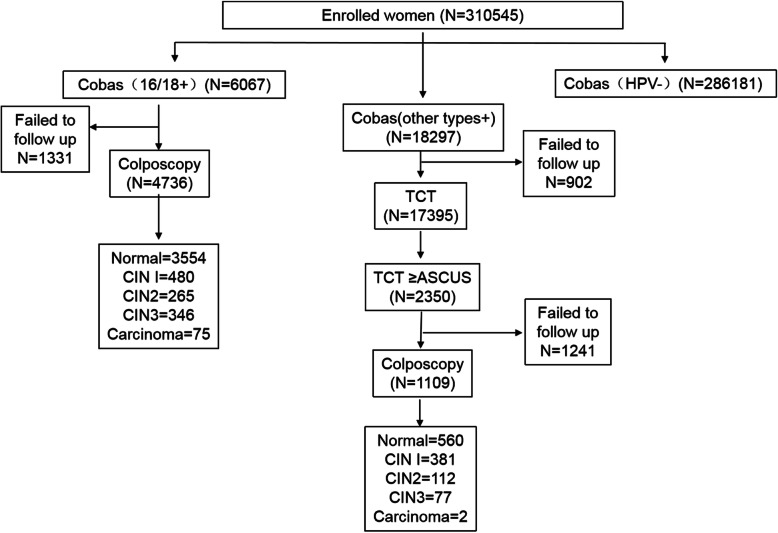
Methods: From January 15, 2017 to December 31, 2017, 310,545 female aged at least 30 years old had been recruited for cervical cancer screening from 9 clinical research centers in Central China. All the recruited participants received hr-HPV genotyping for cervical cancer screening and vaginal microenvironment test by a high vaginal swab. Colposcopy-directed biopsy was recommended for female who were infected with HPV 16 and HPV 18, and other positive hr-HPV types through test had undertaken triage using liquid-based cytology, cases with the results ≥ ASCUS among them were referred to colposcopy directly, and cervical tissues were taken for pathology examination to make clear the presence or absence of other cervical lesions.
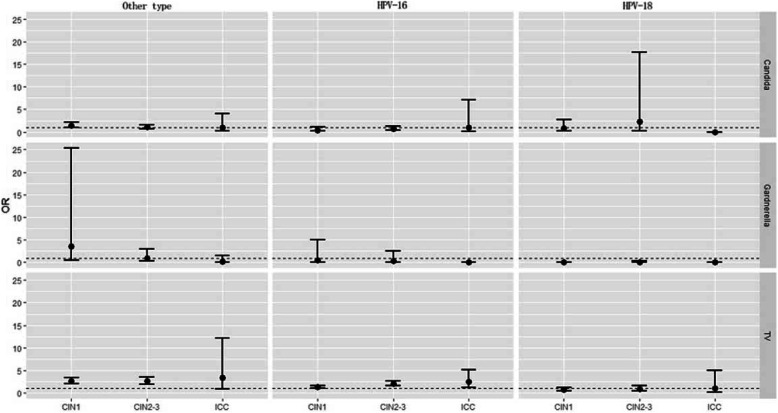
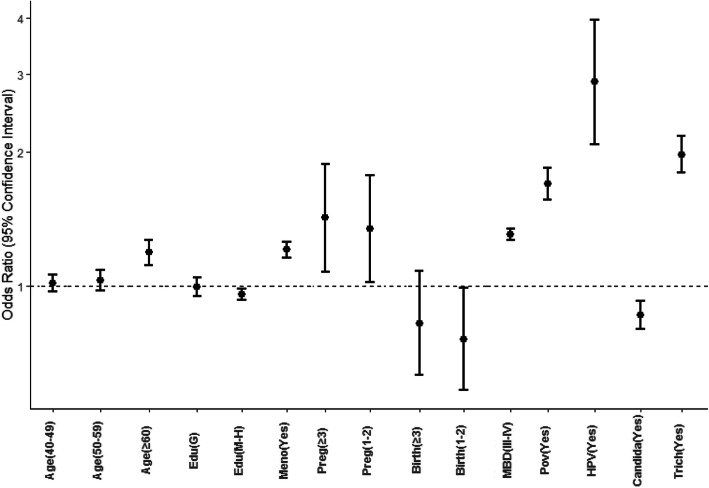
Results: Among 310,545 female, 6067 (1.95%) were tested with positive HPV 16 and HPV 18, 18,297 (5.89%) were tested with other positive hr-HPV genotypes, cervical intraepithelial neoplasia (CIN) 1, CIN 2, CIN 3 and invasive cervical cancer (ICC) were detected in 861 cases, 377 cases, 423 cases, and 77 cases, respectively. Candida albicans and Gardnerella were not associated with the detection of cervical lesions. Positive trichomonas vaginitis (TV) was correlated with hr-HPV infection (p < 0.0001). Co-infection with TV increased the risk of CIN 1 among female infected with hr-HPV (OR 1.18, 95% CI: 1.42-2.31). Co-infection with TV increased the risk of CIN 2-3 among female infected with HPV 16 (OR 1.71, 95% CI: 1.16-2.53).
Conclusions: Co-infection of TV and HPV 16 is a significant factor for the detection of cervical lesions.
Keywords: Cervical intraepithelial neoplasia; Human papillomavirus; Invasive cervical cancer; Trichomonas vaginitis; Vaginal microenvironment.
Conflict of interest statement
All authors declare that they have no competing interests. All authors have submitted the ICMJE Form for Disclosure of Potential Conflicts of Interest. Conflicts that the editors consider relevant to the content of the manuscript have been disclosed.
Figures
References
-
- Bray F, Ferlay J, Soerjomataram I, Siegel RL, Torre LA, Jemal A. Global cancer statistics 2018: GLOBOCAN estimates of incidence and mortality worldwide for 36 cancers in 185 countries. CA Cancer J Clin. 2018;68(6):394–424. - PubMed
-
- Ghosh I, Muwonge R, Mittal S, et al. Association between high risk human papillomavirus infection and co-infection with Candida spp. and trichomonas vaginalis in women with cervical premalignant and malignant lesions. J Clin Virol. 2017;87:43–48. - PubMed
