


National mapping of soil-transmitted helminth and schistosome infections in Ethiopia
- PMID: 32873333
- PMCID: PMC7466696
- DOI: 10.1186/s13071-020-04317-6
National mapping of soil-transmitted helminth and schistosome infections in Ethiopia
Abstract
Background: An accurate understanding of the geographical distributions of both soil-transmitted helminths (STHs; Ascaris lumbricoides, Trichuris trichiura, and the hookworms Necator americanus and Ancylostoma duodenale) and schistosomes (SCH; Schistosoma mansoni and S. haematobium) is pivotal to be able to effectively design and implement mass drug administration (MDA) programmes. The objective of this study was to provide up-to-date data on the distribution of both STH and SCH in Ethiopia to inform the design of the national control program and to be able to efficiently achieve the 75% MDA coverage target set by the WHO.
Methods: Between 2013 and 2015, we assessed the distributions of STH and SCH infections in a nationwide survey covering 153,238 school-aged children (aged 5-15 years), from 625 woredas (districts), representing all nine Regional States and two City Administrations of Ethiopia. Nationwide disease maps were developed at the woreda level to enable recommendations on the design of the national MDA programme.
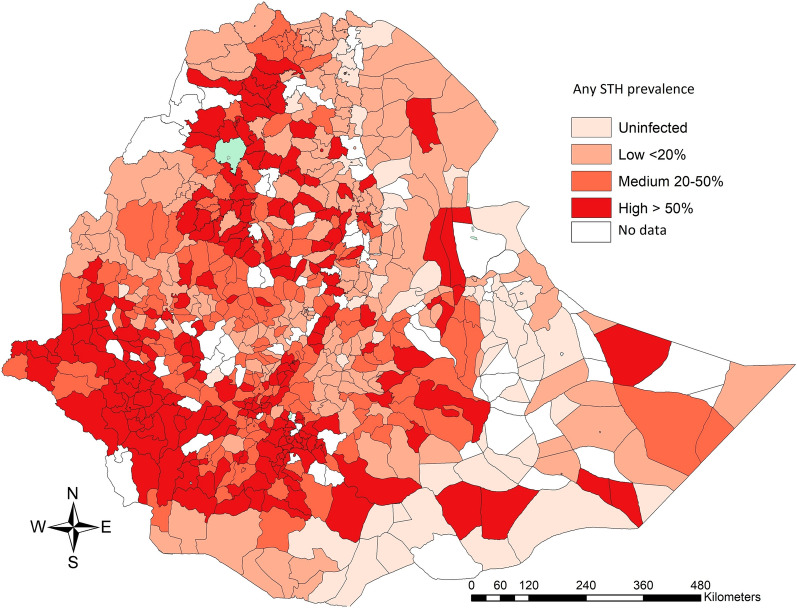
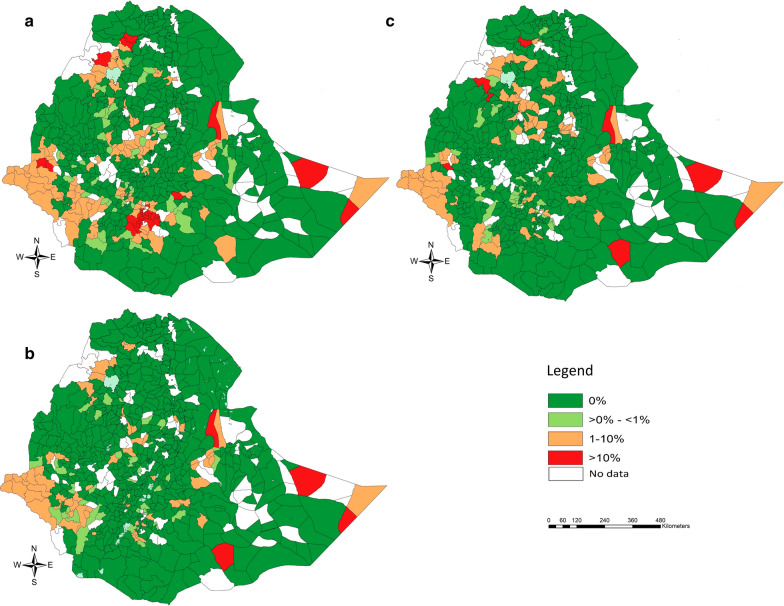
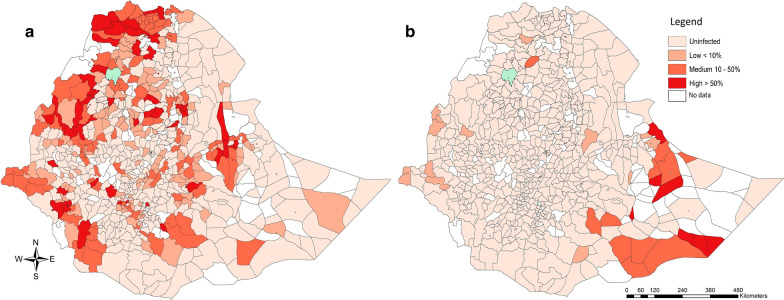
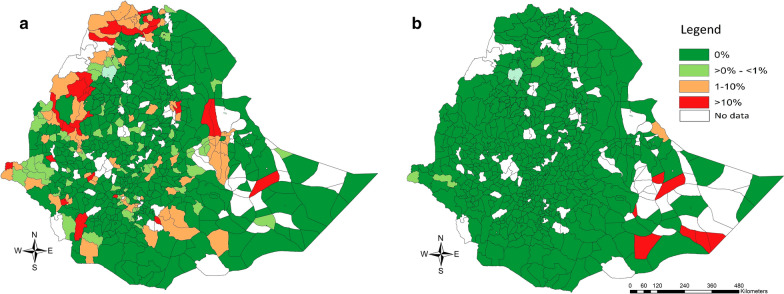
Results: The prevalence of any STH infection across the study population was 21.7%, with A. lumbricoides (12.8%) being the most prevalent STH, followed by hookworms (7.6%) and T. trichiura (5.9%). The prevalence for any SCH was 4.0% in areas where both SCH species were evaluated. Schistosoma mansoni was the most prevalent SCH (3.5 vs 0.3%). STHs were more prevalent in southwest Ethiopia, whereas SCH was found mostly in the west and northeast of the country. The prevalence of moderate-to-heavy intensity infections was 2.0% for STHs and 1.6% for SCH. For STH, a total of 251 woredas were classified as moderately (n = 178) or highly endemic (n = 73), and therefore qualify for an annual and biannual MDA program, respectively. For SCH, 67 woredas were classified as endemic and 8 as highly endemic, and hence they require every two years and annual MDA programme, respectively.
Conclusions: The results confirm that Ethiopia is endemic for both STHs and SCH, posing a significant public health problem. Following the WHO recommendations on mass drug administration, 18 and 14 million school-aged children are in need of MDA for STHs and SCH, respectively, based on the number of SACs that live on the eligible geographical areas.
Keywords: Ascaris; Disease maps; Endemicity; Mass drug administration; Schistosoma haematobium; Schistosoma mansoni; Schistosomiasis; School-aged children; Soil-transmitted helminthiasis; Trichuris; Woreda (districts); hookworms.
Conflict of interest statement
The authors declare that they have no competing interests.
Figures
References
-
- WHO. Accelerating work to overcome the global impact of neglected tropical diseases. A roadmap for implementation. Geneva: World Health Organization; 2012. https://www.who.int/neglected_diseases/NTD_RoadMap_2012_Fullversion.pdf?.... Accessed 1 Jul 2019.
-
- WHO. Preventive chemotherapy in human helminthiasis: coordinated use of anthelminthic drugs in control interventions: a manual for health professionals and programme managers. Geneva: World Health Organization; 2006. https://apps.who.int/iris/bitstream/handle/10665/43545/9241547103_eng.pd.... Accessed 1 Jul 2019.
-
- WHO. Fifty-Fourth World Health Assembly. Resolution 54.19. Schistosomiasis and soil-transmitted helminth infections. Geneva: World Health Organization; 2001. https://apps.who.int/iris/bitstream/handle/10665/260183/WHA54-2001-REC1-.... Accessed 1 Jul 2019.
-
- WHO. Helminth control in school-age children: a guide for managers of control programmes. Geneva: World Health Organization; 2011. https://apps.who.int/iris/bitstream/handle/10665/44671/9789241548267_eng.... Accessed 1 Jul 2019.
-
- Polderman AM. The transmission of intestinal schistosomiasis in Begemder province, Ethiopia. PhD Thesis, Leiden University, Leiden, Netherlands; 1975. - PubMed
MeSH terms
Substances
LinkOut - more resources
Full Text Sources
Miscellaneous
