Review
. 2021 May;39(5):474-487.
doi: 10.1016/j.tibtech.2020.07.012. Epub 2020 Aug 29.

Gene Delivery to the Skin - How Far Have We Come?

Affiliations
Review

Gene Delivery to the Skin - How Far Have We Come?

Qurrat Ul Ain et al. Trends Biotechnol. 2021 May.

Abstract

Gene therapies are powerful tools to prevent, treat, and cure human diseases. The application of gene therapies for skin diseases received little attention so far, despite the easy accessibility of skin and the urgent medical need. A major obstacle is the unique barrier properties of human skin, which significantly limits the absorption of biomacromolecules, and thus hampers the efficient delivery of nucleic acid payloads. In this review, we discuss current approaches, successes, and failures of cutaneous gene therapy and provide guidance toward the development of next-generation concepts. We specifically allude to the delivery strategies as the major obstacle that prevents the full potential of gene therapies - not only for skin disorders but also for almost any other human disease.

Keywords: CRISPR; RNA therapy; gene editing; gene therapy; genodermatoses; skin; topical gene delivery.


Figures

Figure 1
Figure 1
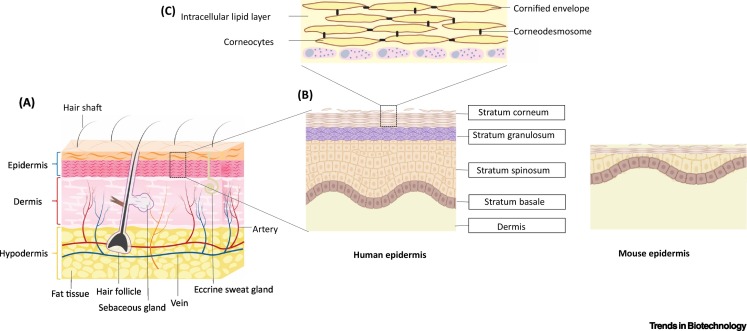
Structure of Human Skin. (A) Human skin is composed of three layers: the epidermis, which mainly consists of keratinocytes; the dermis, which contains connective tissue, sweat glands, and hair follicles; and the hypodermis, which is mainly composed of adipose tissue. (B) In the epidermal layer, keratinocytes undergo continuous maturation and differentiation resulting in four epidermal layers: stratum basale, stratum spinosum, stratum granulosum, and the stratum corneum (SC), which forms the outermost layer of the skin. A schematic depiction of mouse epidermis (created with BioRender.com) highlights the anatomical differences between human and mouse skin. (C) The SC consists of terminally differentiated keratinocytes (= corneocytes), which are connected by corneodesmosomes and surrounded by an insoluble cornified envelope. Corneocytes are embedded in highly lipophilic lipid layers mainly composed of ceramides, cholesterol, and fatty acids.
Figure 2,
Figure 2
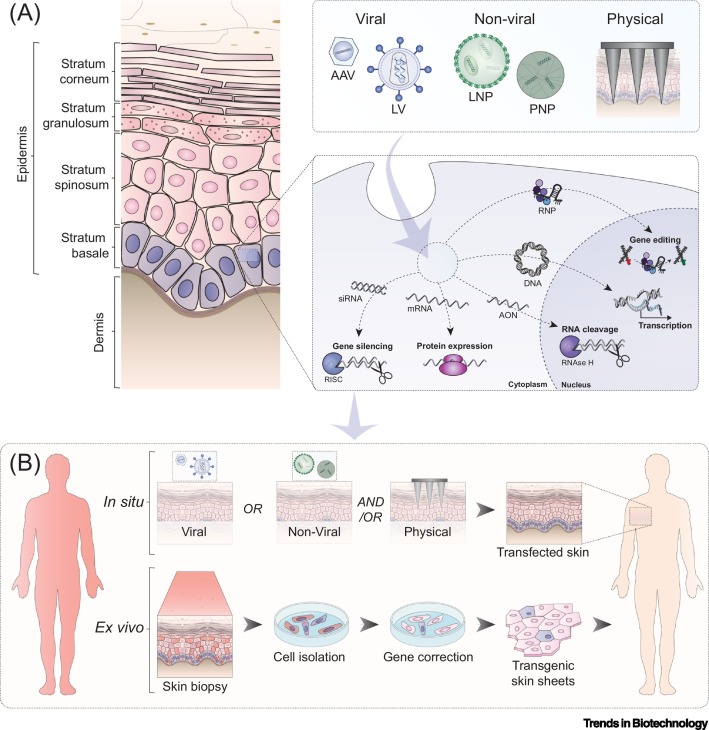
Key Figure. Application of Gene Therapies for the Treatment of Skin Diseases (A) Viral, non-viral, and physical methods can be employed to deliver genetic cargo efficiently into skin (stem) cells. (B) To enable gene therapy, the genetic cargo can be introduced ex vivo, after which transgenic skin sheets can be regrafted onto the human body, something which is currently already applied in the clinics. Another more elegant approach is in situ gene therapy which allows the topical application of gene therapies in vivo, but this still requires substantial research efforts. AAV, adeno-associated virus; AON, antisense oligonucleotide; LNP, lipid-based nanoparticle; LV, lentivirus; PNP, polymeric nanoparticle; RISC, RNA-induced silencing complex; RNP, ribonucleoprotein.

References

    1. Doudna J.A. The promise and challenge of therapeutic genome editing. Nature. 2020;578:229–236. - PMC - PubMed
    1. Choate K.A., et al. Transglutaminase 1 delivery to lamellar ichthyosis keratinocytes. Hum. Gene Ther. 1996;7:2247–2253. - PubMed
    1. Farboud B., et al. Enhanced genome editing with Cas9 ribonucleoprotein in diverse cells and organisms. J. Vis. Exp. 2018 - PMC - PubMed
    1. Bilousova G. Gene therapy for skin fragility diseases: the new generation. J. Invest. Dermatol. 2019;139:1634–1637. - PubMed
    1. Laughter M.R., et al. The burden of skin and subcutaneous diseases in the United States from 1990 to 2017. JAMA Dermatol. 2020 doi: 10.1001/jamadermatol.2020.1573. Published online June 10, 2020. - DOI - PMC - PubMed

Publication types