Clearing the surgical backlog caused by COVID-19 in Ontario: a time series modelling study
- PMID: 32873541
- PMCID: PMC7647484
- DOI: 10.1503/cmaj.201521
Clearing the surgical backlog caused by COVID-19 in Ontario: a time series modelling study
Abstract
Background: To mitigate the effects of coronavirus disease 2019 (COVID-19), jurisdictions worldwide ramped down nonemergent surgeries, creating a global surgical backlog. We sought to estimate the size of the nonemergent surgical backlog during COVID-19 in Ontario, Canada, and the time and resources required to clear the backlog.
Methods: We used 6 Ontario or Canadian population administrative sources to obtain data covering part or all of the period between Jan. 1, 2017, and June 13, 2020, on historical volumes and operating room throughput distributions by surgery type and region, and lengths of stay in ward and intensive care unit (ICU) beds. We used time series forecasting, queuing models and probabilistic sensitivity analysis to estimate the size of the backlog and clearance time for a +10% (+1 day per week at 50% capacity) surge scenario.
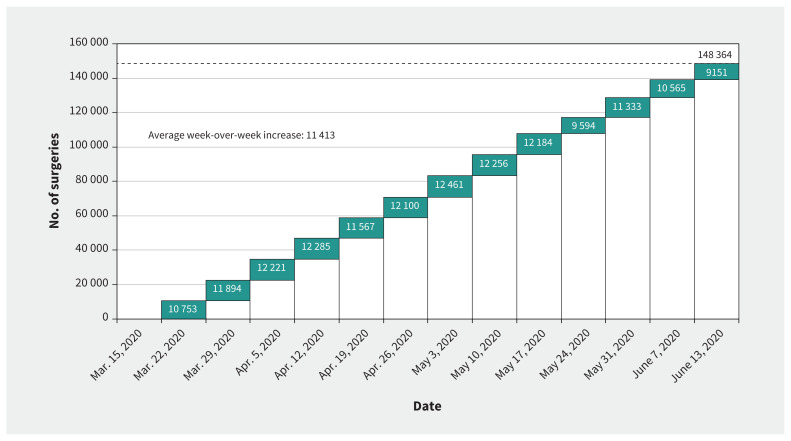
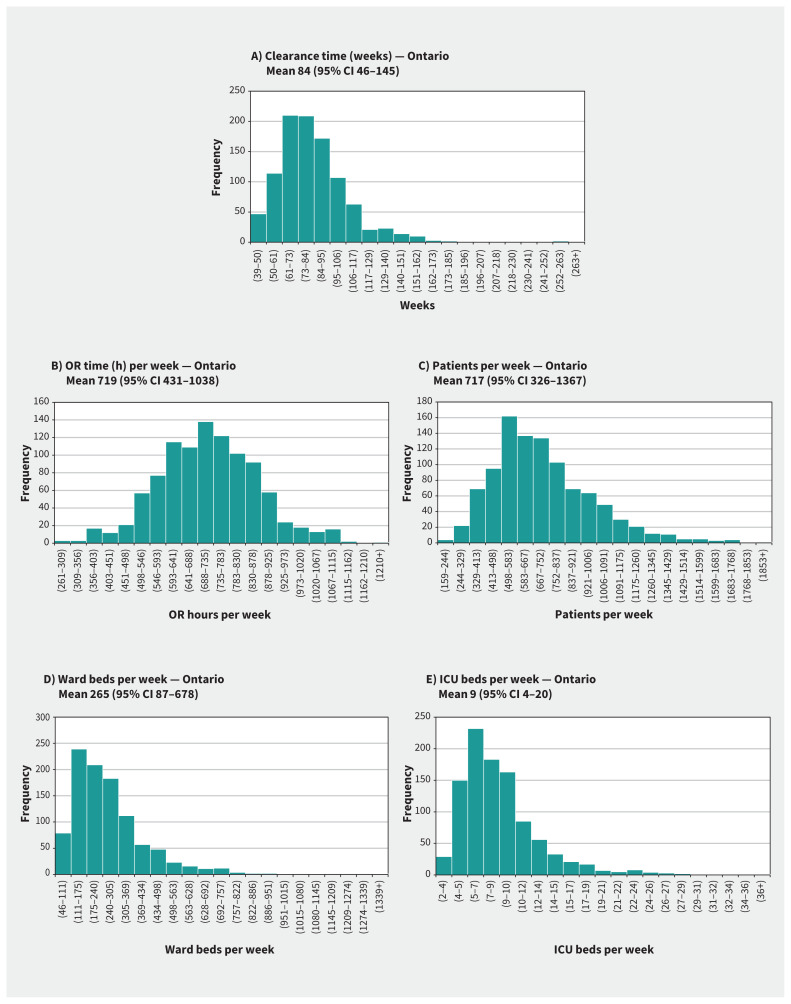
Results: Between Mar. 15 and June 13, 2020, the estimated backlog in Ontario was 148 364 surgeries (95% prediction interval 124 508-174 589), an average weekly increase of 11 413 surgeries. Estimated backlog clearance time is 84 weeks (95% confidence interval [CI] 46-145), with an estimated weekly throughput of 717 patients (95% CI 326-1367) requiring 719 operating room hours (95% CI 431-1038), 265 ward beds (95% CI 87-678) and 9 ICU beds (95% CI 4-20) per week.
Interpretation: The magnitude of the surgical backlog from COVID-19 raises serious implications for the recovery phase in Ontario. Our framework for modelling surgical backlog recovery can be adapted to other jurisdictions, using local data to assist with planning.
© 2020 Joule Inc. or its licensors.
Conflict of interest statement
Competing interests: Maria Eberg is currently an employee of IQVIA, Canada; all work performed for the submitted manuscript was done while employed at Ontario Health (Cancer Care Ontario). The work performed for the submitted manuscript is unrelated to any of her duties as an employee of IQVIA. Frances Wright reports being an employee of Ontario Health (Cancer Care Ontario), as the Skin Cancer Lead and Surgical Oncology Quality and Knowledge Transfer Lead. This article is a result of some of the work performed at Ontario Health (Cancer Care Ontario). Jonathan Irish reports receiving salary support from Ontario Health (Cancer Care Ontario) as the Provincial Head, Surgical Oncology Program. No other competing interests were declared.
Figures
Comment in
-
A team-based approach in primary care can alleviate the burden created by the COVID-19 surgical backlog for people with hip and knee osteoarthritis.CMAJ. 2020 Nov 16;192(46):E1471. doi: 10.1503/cmaj.76844. CMAJ. 2020. PMID: 33199455 Free PMC article. No abstract available.
-
Using pathology data to evaluate surgical backlogs: considerations for resource planning.CMAJ. 2021 Mar 8;193(10):E343. doi: 10.1503/cmaj.77883. CMAJ. 2021. PMID: 33685954 Free PMC article. No abstract available.
-
Transitioning to outpatient arthroplasty during COVID-19: time to pivot.CMAJ. 2021 Mar 29;193(13):E455. doi: 10.1503/cmaj.78145. CMAJ. 2021. PMID: 33782174 Free PMC article. No abstract available.
References
-
- WHO timeline — COVID-19 [statement]. Geneva: World Health Organization; updated 2020 July 30. Available: www.who.int/news-room/detail/27-04-2020-who-timeline-covid-19 (accessed 2020 June 14).
-
- Rosenbaum L. The untold toll — the pandemic’s effects on patients without COVID-19. N Engl J Med 2020;382:2368–71. - PubMed
-
- Ramping down elective surgeries and other non-emergent activities [memorandum to Ontario Health and hospitals]. Toronto: Ministry of Health and Long-Term Care; 2020. Mar. 15 Available: www.health.gov.on.ca/en/pro/programs/publichealth/coronavirus/docs/memos... (accessed 2020 Aug. 24).
MeSH terms
LinkOut - more resources
Full Text Sources
Medical