. 2020 Nov 13;295(46):15527-15539.
doi: 10.1074/jbc.RA120.015277. Epub 2020 Sep 1.

Lysine acetylation of F-actin decreases tropomyosin-based inhibition of actomyosin activity

Affiliations

Lysine acetylation of F-actin decreases tropomyosin-based inhibition of actomyosin activity

William Schmidt et al. J Biol Chem. .

Abstract

Recent proteomics studies of vertebrate striated muscle have identified lysine acetylation at several sites on actin. Acetylation is a reversible post-translational modification that neutralizes lysine's positive charge. Positively charged residues on actin, particularly Lys326 and Lys328, are predicted to form critical electrostatic interactions with tropomyosin (Tpm) that promote its binding to filamentous (F)-actin and bias Tpm to an azimuthal location where it impedes myosin attachment. The troponin (Tn) complex also influences Tpm's position along F-actin as a function of Ca2+ to regulate exposure of myosin-binding sites and, thus, myosin cross-bridge recruitment and force production. Interestingly, Lys326 and Lys328 are among the documented acetylated residues. Using an acetic anhydride-based labeling approach, we showed that excessive, nonspecific actin acetylation did not disrupt characteristic F-actin-Tpm binding. However, it significantly reduced Tpm-mediated inhibition of myosin attachment, as reflected by increased F-actin-Tpm motility that persisted in the presence of Tn and submaximal Ca2+ Furthermore, decreasing the extent of chemical acetylation, to presumptively target highly reactive Lys326 and Lys328, also resulted in less inhibited F-actin-Tpm, implying that modifying only these residues influences Tpm's location and, potentially, thin filament regulation. To unequivocally determine the residue-specific consequences of acetylation on Tn-Tpm-based regulation of actomyosin activity, we assessed the effects of K326Q and K328Q acetyl (Ac)-mimetic actin on Ca2+-dependent, in vitro motility parameters of reconstituted thin filaments (RTFs). Incorporation of K328Q actin significantly enhanced Ca2+ sensitivity of RTF activation relative to control. Together, our findings suggest that actin acetylation, especially Lys328, modulates muscle contraction via disrupting inhibitory Tpm positioning.

Keywords: acetylation; actin; in vitro motility; lysine acetylation; muscle physiology; myosin; thin filament; tropomyosin.


Conflict of interest statement

Conflict of interest—The authors declare that they have no conflicts of interest with the contents of this article.

Figures
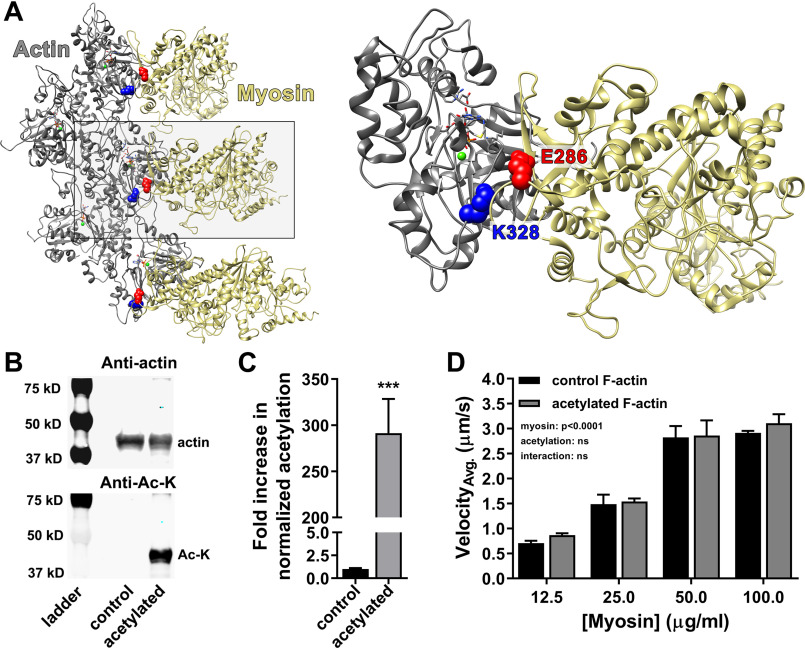
Figure 1.
Figure 1.
Actin acetylation does not significantly alter myosin-driven F-actin sliding velocity. A, proposed Lys328–Glu286 (blue–red, respectively) actin–myosin (gray–tan, respectively) salt bridge established during strong binding (Protein Data Bank code 4A7f) (41). B, Western blots of actin treated with suprastoichiometric acetic anhydride diluted in acetonitrile (acetylated) revealed increased lysine acetylation relative to actin resuspended in acetonitrile only (control). The blots were probed with anti-actin (top panel) and anti–Ac-lysine (bottom panel; Anti-Ac-K) antibodies. C, anti–Ac-lysine intensities in B were normalized to corresponding anti-actin signals. Actin-normalized lysine acetylation increased ∼290-fold (291 ± 37) relative to control. D, in vitro motility of Alexa 568 Ph-labeled control (black) and acetylated (gray) F-actin at varying myosin concentrations. Average velocities (VelocityAvg.) were not significantly different, suggesting no change in actomyosin cross-bridge cycling caused by actin acetylation (two-way ANOVA; n = 4).
Figure 2.
Figure 2.
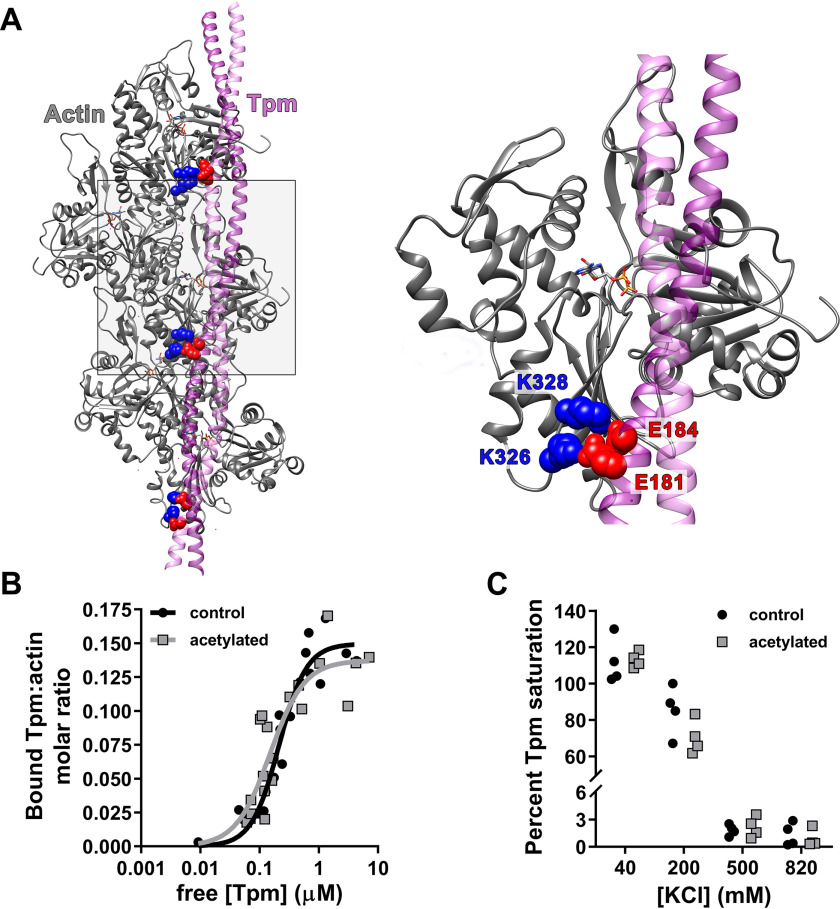
Actin acetylation does not disrupt global F-actin–Tpm binding. A, purported contacts between Lys326/Lys328 (blue) on actin (gray) and negatively charged Tpm (purple) residues (red) in pseudorepeats 4, 5, and 6 (from bottom to top) (12). B, F-actin–Tpm co-sedimentation data were fit to the Hill equation (y = Bmax × xh/(Kdh + xh)), and no significant differences were found in Bmax or Kd of Tpm for control (black; Bmax = 0.15 ± 0.009; Kd = 0.21 ± 0.03 μm, respectively) versus acetylated (gray; Bmax = 0.14 ± 0.013; Kd = 0.15 ± 0.04 μm, respectively) F-actin. C, saturating amounts of Tpm were mixed with control (black) or acetylated (gray) F-actin at 40, 200, 500, and 820 mm [KCl] and pelleted. At 40 mm, the percentage of Tpm saturation of control (112 ± 6.3%) versus acetylated (113 ± 2.2%) F-actin was equivalent. Increasing [KCl] to 200 mm similarly decreased Tpm binding to control (85.4 ± 6.85%) and acetylated (70.4 ± 4.68%) F-actin, which was nearly fully ablated by 500 mm.
Figure 3.
Figure 3.
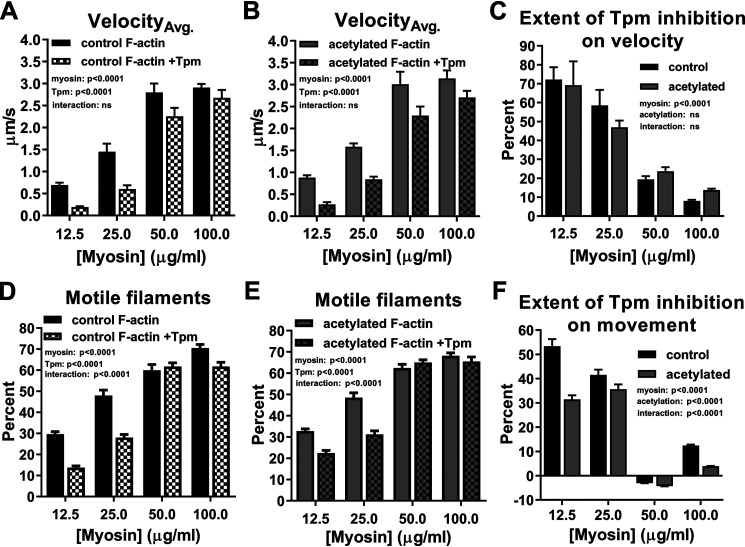
Actin acetylation reduces Tpm-based inhibition of actomyosin binding. A and B, control (A, black) and acetylated (B, gray) F-actin (solid) and F-actin–Tpm (checkered) velocities significantly increased as a function of myosin concentration, whereas Tpm addition significantly decreased velocities (two-way ANOVA; p < 0.0001; n = 4). C, percentage of decrease in control (black) and acetylated (gray) F-actin velocities observed as a result of Tpm addition revealed that acetylation had no significant effect on Tpm-mediated reduction of velocity (two-way ANOVA; n = 4). D–F, the effects of myosin concentration and Tpm on percentage of moving control (D, black) and acetylated (E, gray) F-actin (solid) and F-actin–Tpm (checkered) mirrored those on velocity, whereas actin acetylation (F, gray) significantly decreased Tpm-based inhibition of filament motion relative to control (black) (two-way ANOVA; p < 0.0001; n = 17–22).
Figure 4.
Figure 4.
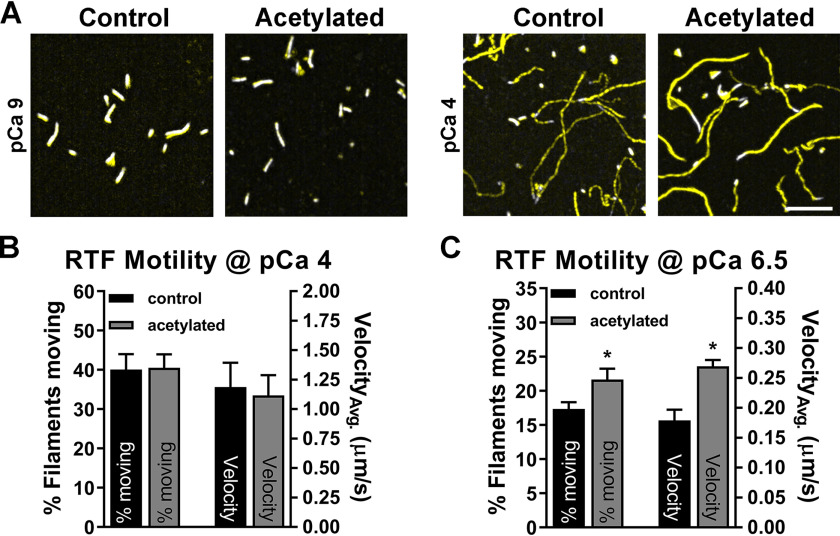
Reduced Tpm-based inhibition persists in acetylated actin-containing RTFs. A, representative images illustrating immeasurable (pCa 9) and equivalent (pCa 4) movement of control and acetylated actin-containing RTFs by overlaying the first frame of a 17–20-s movie (white) with a summative image of total motion (yellow). Scale bar, 7 μm. B, percentage of filaments moving (left; n = 9) and average velocities (right; n = 2) of control (black; 40.1 ± 3.9% and 1.19 ± 0.21 μm/s, respectively) and acetylated (gray; 40.5 ± 3.4% and 1.11 ± 0.17 μm/s, respectively) RTFs at pCa 4 were indistinguishable (two-tailed t test). C, percentage of filaments moving (left; n = 7) and average velocities (right; n = 2) of acetylated (24.75 ± 1.63% and 0.27 ± 0.01 μm/s, respectively) RTFs were significantly greater than control (20.11 ± 1.45% and 0.18 ± 0.02 μm/s, respectively) at pCa 6.5 (two-tailed t test; *, p < 0.05).
Figure 5.
Figure 5.
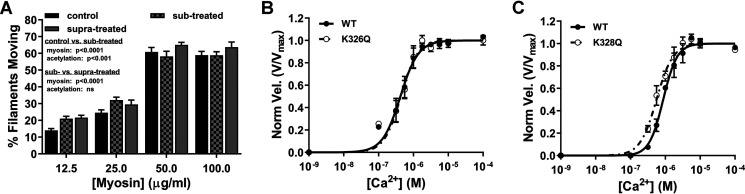
Lys328 pseudoacetylation enhances RTF Ca2+ sensitivity. A, treatment of actin with a substoichiometric amount of acetic anhydride (checkered gray) significantly increased percentage of actin–Tpm filaments moving relative to control (black) (two-way ANOVA; p < 0.001; n = 9–12), whereas substoichiometric-treated F-actin–Tpm movement was not significantly different from suprastoichiometric-treated (gray) (two-way ANOVA, n = 10–12). B and C, velocity-normalized plots of Ca2+-dependent activation of K326Q- and K328Q-containing RTFs relative to respective WT controls. K326Q and K328Q maximum velocities (Vmax = 4.1 ± 0.1 and 3.3 ± 0.06 μm/s, respectively) did not significantly differ from respective internal WT controls (Vmax = 4.2 ± 0.09 and 3.3 ± 0.06 μm/s, respectively). B, Ca2+-dependent activation of K326Q-containing RTFs was equivalent to WT control actin-containing RTFs as revealed by no significant differences in Ca2+ sensitivity ([Ca2+]50 = 0.43 ± 0.029 versus 0.42 ± 0.027 μm, respectively) or cooperativity (h = 1.8 ± 0.25 versus 1.7 ± 0.21, respectively). C, although there was no significant change in cooperativity of K328Q-containing RTFs (h = 1.8 ± 0.21) relative to WT control (h = 2.2 ± 0.22), K328Q-containing RTF Ca2+ sensitivity ([Ca2+]50 = 0.56 ± 0.032 μm) was significantly increased relative to WT control ([Ca2+]50 = 0.87 ± 0.044 μm) (p < 0.0001; n = 4).

References

    1. Gordon A. M., Homsher E., and Regnier M. (2000) Regulation of contraction in striated muscle. Physiol. Rev. 80, 853–924 10.1152/physrev.2000.80.2.853 - DOI - PubMed
    1. Lehman W. (2016) Thin filament structure and the steric blocking model. Compr. Physiol. 6, 1043–1069 10.1002/cphy.c150030 - DOI - PubMed
    1. McNamara J. W., Li A., Dos Remedios C. G., and Cooke R. (2015) The role of super-relaxed myosin in skeletal and cardiac muscle. Biophys. Rev. 7, 5–14 10.1007/s12551-014-0151-5 - DOI - PMC - PubMed
    1. Trivedi D. V., Adhikari A. S., Sarkar S. S., Ruppel K. M., and Spudich J. A. (2018) Hypertrophic cardiomyopathy and the myosin mesa: viewing an old disease in a new light. Biophys. Rev. 10, 27–48 10.1007/s12551-017-0274-6 - DOI - PMC - PubMed
    1. Yamada Y., Namba K., and Fujii T. (2020) Cardiac muscle thin filament structures reveal calcium regulatory mechanism. Nat. Commun. 11, 153 10.1038/s41467-019-14008-1 - DOI - PMC - PubMed

Publication types

MeSH terms

LinkOut - more resources