


Engineering Pseudomonas putida KT2440 for the production of isobutanol
- PMID: 32874178
- PMCID: PMC7447888
- DOI: 10.1002/elsc.201900151
Engineering Pseudomonas putida KT2440 for the production of isobutanol
Abstract
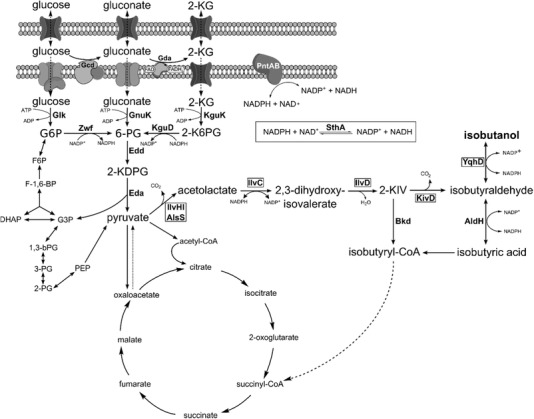
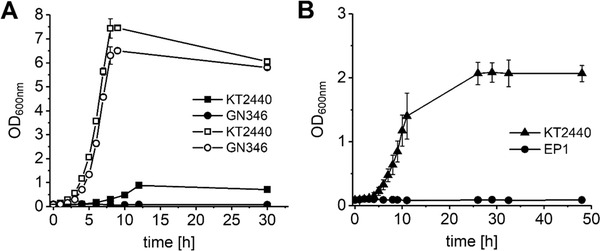
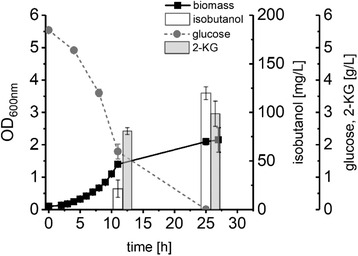
We engineered P. putida for the production of isobutanol from glucose by preventing product and precursor degradation, inactivation of the soluble transhydrogenase SthA, overexpression of the native ilvC and ilvD genes, and implementation of the feedback-resistant acetolactate synthase AlsS from Bacillus subtilis, ketoacid decarboxylase KivD from Lactococcus lactis, and aldehyde dehydrogenase YqhD from Escherichia coli. The resulting strain P. putida Iso2 produced isobutanol with a substrate specific product yield (Y Iso/S) of 22 ± 2 mg per gram of glucose under aerobic conditions. Furthermore, we identified the ketoacid decarboxylase from Carnobacterium maltaromaticum to be a suitable alternative for isobutanol production, since replacement of kivD from L. lactis in P. putida Iso2 by the variant from C. maltaromaticum yielded an identical YIso/S. Although P. putida is regarded as obligate aerobic, we show that under oxygen deprivation conditions this bacterium does not grow, remains metabolically active, and that engineered producer strains secreted isobutanol also under the non-growing conditions.
Keywords: Pseudomonas putida; isobutanol; ketoacid decarboxylase; metabolic engineering; microaerobic.
© 2019 The Authors. Engineering in Life Sciences published by WILEY‐VCH Verlag GmbH & Co. KGaA, Weinheim.
Conflict of interest statement
The authors have declared no conflict of interest.
Figures
References
-
- Eikmanns, B.J. and Blombach, B. , Isobutanol, in: Bisaria, V. S., Kondo, A. (Eds.), Bioprocessing of Renewable Resources to Commodity Bioproducts, John Wiley & Sons, Inc., Weinheim: 2014, pp. 327–352.
-
- Chen, C.‐T. and Liao, J.C. , Frontiers in microbial 1‐butanol and isobutanol production. FEMS Microbiol. Lett. 2016, 363, fnw020. - PubMed
-
- Atsumi, S. , Hanai, T. , Liao, J.C. , Non‐fermentative pathways for synthesis of branched‐chain higher alcohols as biofuels. Nature 2008, 451, 86–89. - PubMed
LinkOut - more resources
Full Text Sources
Molecular Biology Databases