


Risk assessment of aflatoxins in food
- PMID: 32874256
- PMCID: PMC7447885
- DOI: 10.2903/j.efsa.2020.6040
Risk assessment of aflatoxins in food
Abstract
EFSA was asked to deliver a scientific opinion on the risks to public health related to the presence of aflatoxins in food. The risk assessment was confined to aflatoxin B1 (AFB1), AFB2, AFG1, AFG2 and AFM1. More than 200,000 analytical results on the occurrence of aflatoxins were used in the evaluation. Grains and grain-based products made the largest contribution to the mean chronic dietary exposure to AFB1 in all age classes, while 'liquid milk' and 'fermented milk products' were the main contributors to the AFM1 mean exposure. Aflatoxins are genotoxic and AFB1 can cause hepatocellular carcinomas (HCCs) in humans. The CONTAM Panel selected a benchmark dose lower confidence limit (BMDL) for a benchmark response of 10% of 0.4 μg/kg body weight (bw) per day for the incidence of HCC in male rats following AFB1 exposure to be used in a margin of exposure (MOE) approach. The calculation of a BMDL from the human data was not appropriate; instead, the cancer potencies estimated by the Joint FAO/WHO Expert Committee on Food Additives in 2016 were used. For AFM1, a potency factor of 0.1 relative to AFB1 was used. For AFG1, AFB2 and AFG2, the in vivo data are not sufficient to derive potency factors and equal potency to AFB1 was assumed as in previous assessments. MOE values for AFB1 exposure ranged from 5,000 to 29 and for AFM1 from 100,000 to 508. The calculated MOEs are below 10,000 for AFB1 and also for AFM1 where some surveys, particularly for the younger age groups, have an MOE below 10,000. This raises a health concern. The estimated cancer risks in humans following exposure to AFB1 and AFM1 are in-line with the conclusion drawn from the MOEs. The conclusions also apply to the combined exposure to all five aflatoxins.
Keywords: aflatoxin; cancer; exposure; food; liver; margin of exposure (MOE); occurrence.
© 2020 European Food Safety Authority. EFSA Journal published by John Wiley and Sons Ltd on behalf of European Food Safety Authority.
Figures
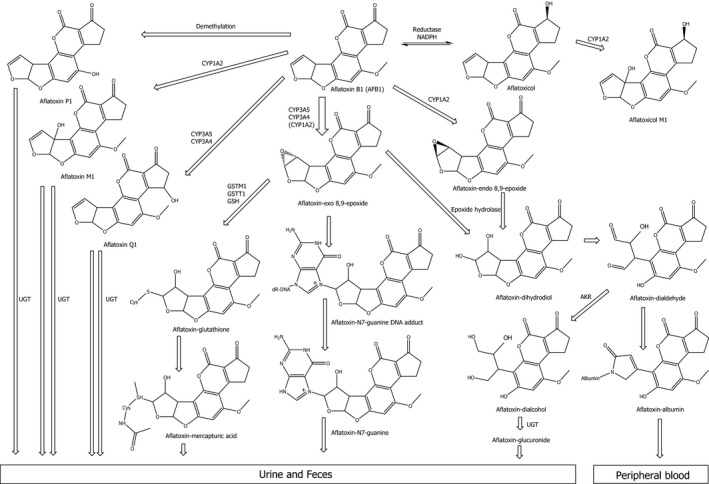
AKR :NADPH ‐dependent aldo‐keto‐reductase;CYP : cytochrome P450;GSH : glutathione;GST : glutathione S‐transferase;NADPH : nicotinamide adenine dinucleotide phosphate;UGT : uridine 5’‐diphospho‐glucuronosyltransferase.
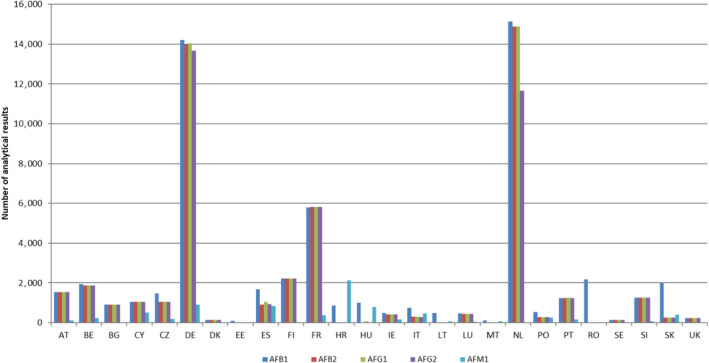
AT : Austria;BE : Belgium;BG : Bulgaria;CY : Cyprus;CZ : Czech Republic;DE : Germany;DK : Denmark;EE : Estonia;ES : Spain;FI : Finland;FR : France;HR : Croatia;HU : Hungary;IE : Ireland;IT : Italy;LT : Lithuania;LU : Luxembourg;MT : Malta;NL : Netherlands;PO : Poland;PT : Portugal;RO : Romania;SE : Sweden;SI : Slovenia;SK : Slovakia;UK : United Kingdom.
References
-
- Accardi R, Sirand C, Gheit T, Hernandez‐Vargas H, Le C‐KF, Wild CP, Tommasino M, Gruffat H, Fusil F, Cosset F‐L, Manet E and Traverse‐Glehen A, 2015. The mycotoxin aflatoxin B1 stimulates Epstein‐Barr virus‐induced B‐cell transformation in in vitro and in vivo experimental models. Carcinogenesis, 36, 1440–1451. - PubMed
-
- Adedara IA, Nanjappa MK, Farombi EO and Akingbemi BT, 2014. Aflatoxin B1 disrupts the androgen biosynthetic pathway in rat Leydig cells. Food and Chemical Toxicology, 65, 252–259. - PubMed
-
- Adjovi YC, Bailly S, Gnonlonfin BJ, Tadrist S, Querin A, Sanni A, Oswald IP, Puel O and Bailly JD, 2014. Analysis of the contrast between natural occurrence of toxigenic Aspergilli of the Flavi section and aflatoxin B1 in cassava. Food Microbiology, 38, 151–159. 10.1016/j.fm.2013.08.005 - DOI - PubMed
-
- Amici M, Cecarini V, Pettinari A, Bonfili L, Angeletti M, Barocci S, Biagetti M, Fioretti E and Eleuteri AM, 2007. Binding of aflatoxins to the 20S proteasome: effects on enzyme functionality and implications for oxidative stress and apoptosis. Biological Chemistry, 388, 107–117. - PubMed