


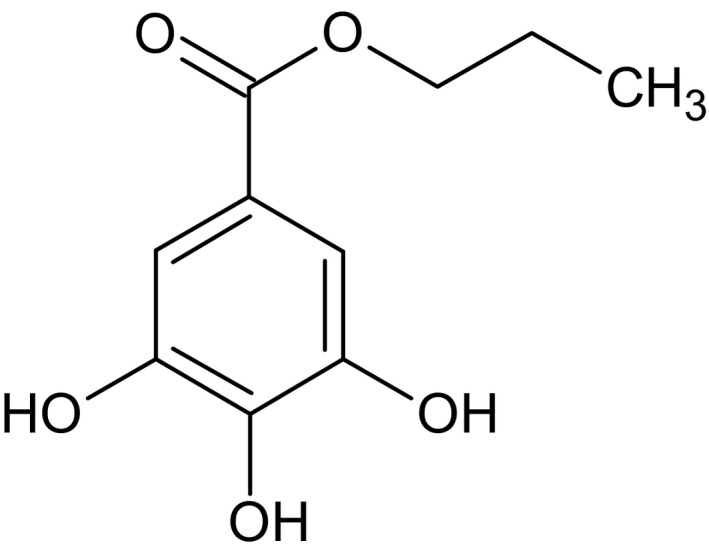
Safety and efficacy of propyl gallate for all animal species
- PMID: 32874281
- PMCID: PMC7447890
- DOI: 10.2903/j.efsa.2020.6069
Safety and efficacy of propyl gallate for all animal species
Abstract
Following a request from the European Commission, the Panel on Additives and Products or Substances used in Animal Feed (FEEDAP) was asked to deliver a scientific opinion on the safety and efficacy of propyl gallate as feed additive for all animal species. Propyl gallate is neither genotoxic nor carcinogenic. Propyl gallate a is safe for veal calves, cattle for fattening, dairy cows, sheep, goats, sows, horses and salmonids at the proposed maximum use level of 40 mg/kg and for ornamental fish at the proposed maximum use level of 100 mg/kg. The following concentrations (mg/kg complete feed) are considered safe for the other target species: 15 for chickens for fattening; 20 for turkeys for fattening, laying hens and rabbits; 27 for piglets and pigs for fattening and 71 for dogs. The Panel cannot conclude on a safe level for cats. The exposure of the consumer to propyl gallate and its metabolites cannot be estimated owing to the absence of reliable data on residues of propyl gallate and its metabolites in edible tissues and products. Therefore, the FEEDAP Panel is not in the position to conclude on the safety for the consumer of propyl gallate, when used as a feed additive for all food-producing animal species. Propyl gallate is irritant to skin and eyes and a dermal sensitiser. Exposure via inhalation is possible and it is considered a hazard. The use of the additive in animal nutrition does not pose a risk for the environment. The FEEDAP Panel concludes that propyl gallate has the potential to act as an antioxidant in feedingstuffs. The Panel did not see a reason for the use of propyl gallate as an antioxidant in water for drinking.
Keywords: Propyl gallate; all animal species; antioxidants; efficacy; safety; technological additive.
© 2020 European Food Safety Authority. EFSA Journal published by John Wiley and Sons Ltd on behalf of European Food Safety Authority.
Figures
References
-
- Abdo KM, Huff JE, Haseman JK, Dieter MP, Boorman GA, Hildebrandt P, Prejean JD and Farnell DR, 1983. Carcinogenesis bioassay of propyl gallate in F344 rats and B6C3F1 mice. Journal of the American College of Toxicology, 2, 425–433.
-
- Cosmetic Ingredient Review Expert Panel (CIR) , 2007. Final report on the amended safety assessment of Propyl Gallate. International Journal of Toxicology, 26, 89–118. - PubMed
-
- Dacre JC, 1974. Long‐term toxicity study of n‐propyl gallate in mice. Food Cosmetic Toxicology, 12, 125–129. - PubMed
LinkOut - more resources
Full Text Sources
Miscellaneous