Review
. 2020 Oct;26(5):631-641.
doi: 10.1007/s13365-020-00903-7. Epub 2020 Sep 2.

Neurological injuries in COVID-19 patients: direct viral invasion or a bystander injury after infection of epithelial/endothelial cells

Affiliations
Review

Neurological injuries in COVID-19 patients: direct viral invasion or a bystander injury after infection of epithelial/endothelial cells

Sayed Ausim Azizi et al. J Neurovirol. 2020 Oct.

Abstract

A subset of patients with coronavirus 2 disease (COVID-19) experience neurological complications. These complications include loss of sense of taste and smell, stroke, delirium, and neuromuscular signs and symptoms. The etiological agent of COVID-19 is SARS-CoV-2 (severe acute respiratory syndrome coronavirus 2), an RNA virus with a glycoprotein-studded viral envelope that uses ACE2 (angiotensin-converting enzyme 2) as a functional receptor for infecting the host cells. Thus, the interaction of the envelope spike proteins with ACE2 on host cells determines the tropism and virulence of SARS-CoV-2. Loss of sense of taste and smell is an initial symptom of COVID-19 because the virus enters the nasal and oral cavities first and the epithelial cells are the receptors for these senses. Stroke in COVID-19 patients is likely a consequence of coagulopathy and injury to cerebral vascular endothelial cells that cause thrombo-embolism and stroke. Delirium and encephalopathy in acute and post COVID-19 patients are likely multifactorial and secondary to hypoxia, metabolic abnormalities, and immunological abnormalities. Thus far, there is no clear evidence that coronaviruses cause inflammatory neuromuscular diseases via direct invasion of peripheral nerves or muscles or via molecular mimicry. It appears that most of neurologic complications in COVID-19 patients are indirect and as a result of a bystander injury to neurons.

Keywords: ACE2; COVID-19; Encephalopathy; SARS-CoV-2; Smell; Stroke; Taste; Tropism.


Figures

Fig. 1
Fig. 1
Images of SARS-CoV-2 and its spike protein. a Electron microscope images of crown-shaped SARS-CoV-2 with protein spikes (red arrows). b Structure of protein spikes showing the receptor-binding domain (green) that attaches to ACE2 and the site of enzymatic cleavage (yellow) that allow conformational changes in the spike protein to facilitate fusing of viral envelope with host cell membrane. c Another view of spike protein with sticky binding sites (red). (From Wrapp et al. , with permission)
Fig. 2
Fig. 2
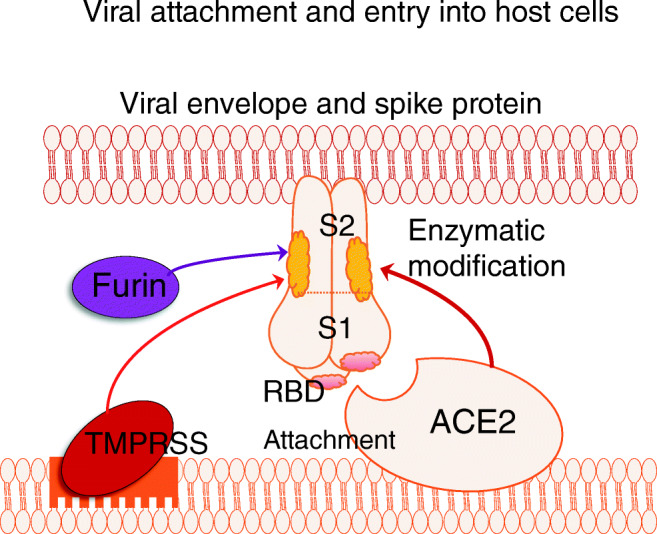
Diagram depicting a compilation of data on attachment and fusion of coronavirus with the host cell. Attachment occurs by fastening of the receptor binding domain (RBD, Fig. 1c) to the ACE2 as a functional receptor. RBD is a variable segment and a target of treatment (see text). The spike proteins undergo conformational changes to fuse virus and cell membranes in order to allow delivery of the viral genome into the target cells. The structural rearrangements are accomplished by enzyme assisted proteolysis involving the transmembrane serine protease 2 (TMPRSS2), Furin, and ACE2. The substrate for these proteolytic enzymes is the polybasic cleavage site (yellow) at the S1-S2 junction of the spike protein. ACE2 plays an indispensable role as it provides a docking port for SARS-CoV2 and facilitates fusion via enzymatic modification of the spike proteins
Fig. 3
Fig. 3
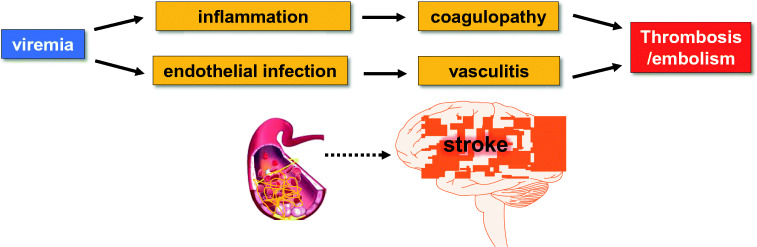
A box-and-arrow diagram depicting the pathogenesis of stroke in COVID-19 patients. The two proximate causes of stroke are cerebral vascular endothelialitis and coagulopathy; these can result in embolic and thrombotic strokes
Fig. 4
Fig. 4
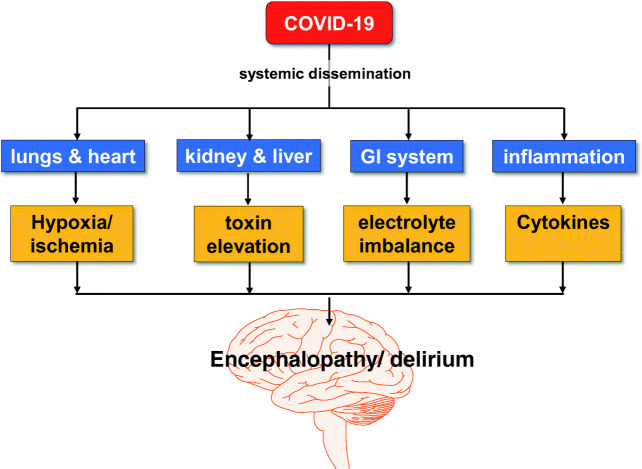
A box-and-arrow diagram showing the clinical genesis and multifactoriality of encephalopathy and delirium in COVID-19 patients

References

    1. Ackermann M, Verlenden SE, Kuehnel M, Haverich A, Welte T, Laenger F, Vanstaplel A, Werlein C, Stark H, Zakov A, Li WW, Li VW, Mentzger SJ, Jonigk D. Pulmonary vascular endothelialitis, thrombosis, and angiogenesis in COVID-19. NEJM. 2020;383:120–128. doi: 10.1056/NEJMoa2015432. - DOI - PMC - PubMed
    1. Alberti P, Beretta S, Piatti M, Karantzoulis A, Piatti ML, Santoro P, Viganò M, Giovannelli G, Pirro F, Montisano DA, Appollonio I, Ferrarese C (2020) Guillain-Barré syndrome related to COVID-19 infection. Neurol Neuroimmunol Neuroinflammation 7(4):e741 - PMC - PubMed
    1. Alcami A, Koszinowski UH. Viral mechanisms of immune evasion. Trends Microbiol. 2000;8(9):410–418. doi: 10.1016/s0966-842x(00)01830-8. - DOI - PMC - PubMed
    1. Andersen KG, Rambaut A, Lipkin WI, Holmes EC, Garry RF. The proximal origin of SARS-CoV-2. Nat Med. 2020;26:450–452. doi: 10.1038/s41591-020-0820-9. - DOI - PMC - PubMed
    1. Atkinson BT, Jasuja R, Chen VM, Nandivada P, Furie B, Furie BC. Laser-induced endothelial cell activation supports fibrin formation. Blood. 2010;116(22):4675–4683. doi: 10.1182/blood-2010-05-283986. - DOI - PMC - PubMed

MeSH terms

Substances