. 2020 Dec;7(4):851-866.
doi: 10.1007/s40744-020-00231-6. Epub 2020 Sep 2.

Efficacy and Safety of Baricitinib in Chinese Rheumatoid Arthritis Patients and the Subgroup Analyses: Results from Study RA-BALANCE

Affiliations

Efficacy and Safety of Baricitinib in Chinese Rheumatoid Arthritis Patients and the Subgroup Analyses: Results from Study RA-BALANCE

Yue Yang et al. Rheumatol Ther. 2020 Dec.

Abstract

Introduction: Baricitinib is an oral selective inhibitor of Janus kinase (JAK) 1 and JAK 2, which has demonstrated significant efficacy in patients with moderately to severely active rheumatoid arthritis (RA). This analysis aims to describe the efficacy and safety of baricitinib in Chinese RA patients with an inadequate response to methotrexate (MTX-IR), and to analyze the effects of baseline characteristics on the efficacy of baricitinib treatment.

Methods: In this 52-week, randomized, double-blind, placebo-controlled study, 231 Chinese patients with moderately to severely active RA who had MTX-IR were randomly assigned to placebo (n = 115) or baricitinib 4 mg once daily (n = 116). The primary endpoint was American College of Rheumatology 20% (ACR20) response at week 12. Other efficacy measures included ACR50, ACR70, Physician's Global Assessment of Disease Activity, Patient's Global Assessment of Disease Activity, patient's assessment of pain, Disease Activity Score in 28 joints using high-sensitivity C-reactive protein, remission and low disease activity rates according to Simplified Disease Activity Index or Clinical Disease Activity Index, Health Assessment Questionnaire-Disability Index, and mean duration and severity of morning joint stiffness, worst tiredness and worst joint pain were analyzed. Additionally, subgroup analyses were performed across baseline characteristics.

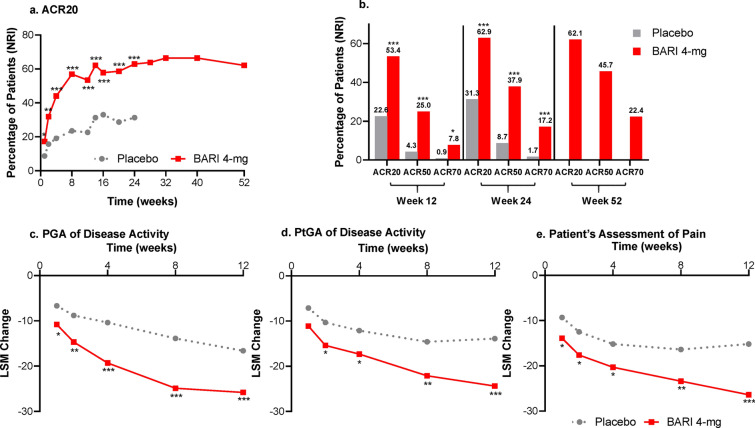
Results: Statistically significant improvement in ACR20 response was achieved with baricitinib at week 12 (53.4 vs. 22.6%, p = 0.001) in Chinese patients, compared to placebo. Most of the secondary objectives were met with statistically significant improvements. Efficacy of baricitinib was irrespective of patient demographics and baseline characteristics. Safety events were similar between the baricitinib and placebo groups.

Conclusions: The efficacy of baricitinib 4 mg in Chinese patients with moderately to severely active RA and prior MTX-IR was clinically significant compared to placebo regardless of baseline characteristics. Baricitinib was well tolerated with an acceptable safety profile during the full study period.

Trial registration: NCT02265705.

Keywords: Arthritis; Baricitinib; China; Rheumatoid.


Figures
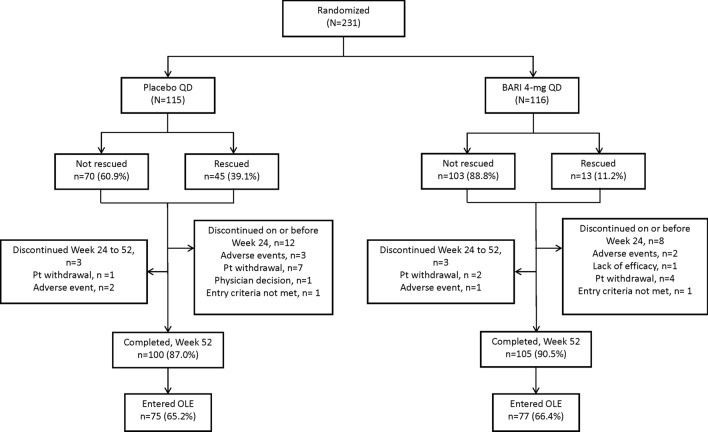
Fig. 1
Fig. 1
Chinese patient disposition to 52 weeks. BARI baricitinib, OLE open-label extension/long-term extension, Pt patients, QD once daily
Fig. 2
Fig. 2
ACR response and ACR core set values improvements for baricitinib 4 mg and placebo. a ACR20 responses for placebo and baricitinib 4 mg over time through week 52. Data presented are NRI on modified intent-to-treat population. *p < 0.05, **p < 0.01, ***p < 0.001 vs. placebo. p values are based on logistic regression model. b ACR responses at week 12, 24, and 52. Data presented are NRI on modified intent-to-treat population. *p < 0.05, **p < 0.01, ***p < 0.001 vs. placebo. ce Improvements over time to week 12 in PGA of Disease Activity, PtGA of Disease Activity, and patient’s assessment of pain. Data presented are LSM change from baseline using modified last observation carried forward on the modified intent-to-treat population. *p < 0.05; **p < 0.01, ***p < 0.001 vs. placebo. ACR20 American College of Rheumatology 20% improvement criteria, ACR 50 American College of Rheumatology 50% improvement criteria, ACR 70 American College of Rheumatology 70% improvement criteria, LSM least squares mean, NRI non-responder imputation, PGA Physician’s Global Assessment, PtGA Patient’s Global Assessment
Fig. 3
Fig. 3
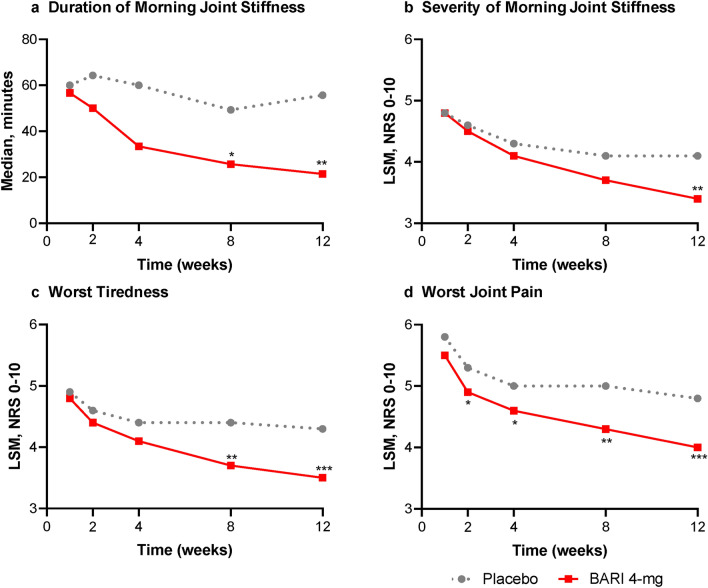
Change in PRO results comparing baricitinib 4 mg with placebo. ad Data are median durations of morning joint stiffness in minutes and LSM scores for severity of morning joint stiffness, worst tiredness, and worst joint pain. Average of 7 days preceding each scheduled visit. *p < 0.05; **p < 0.01, ***p < 0.001 vs. placebo. p values are based on Wilcoxon rank-sum test (duration of morning joint stiffness); ANCOVA model for remaining parameters. ANCOVA analysis of covariance, LSM least squares mean, NRS numeric rating scale, PRO patient-reported outcome
Fig. 4
Fig. 4
Forest plot depicting efficacy of baricitinib and placebo on subgroups at weeks 12 and 24. ACR20 American College of Rheumatology 20% improvement criteria, BARI baricitinib, CDAI Clinical Disease Activity Index, cDMARDs conventional disease-modifying antirheumatic drugs, CI confidence interval, DAS28-hsCRP Disease Activity Score for 28 joint counts based on the level of high-sensitivity C reactive protein, HAQ-DI Health Assessment Questionnaire-Disability Index, LDA low disease activity, LSMD least squares mean difference, MTX methotrexate, OR odds ratio, RA rheumatoid arthritis, SDAI Simplified Disease Activity Index

References

    1. Amaya AJ, Botello CD, Calixto OJP, et al. Usefulness of patients-reported outcomes in rheumatoid arthritis focus group. Arthritis. 2012 doi: 10.1155/2012/935187. - DOI - PMC - PubMed
    1. Li R, Sun J, Ren LM, et al. Epidemiology of eight common rheumatic diseases in China: a large-scale cross-sectional survey in Beijing. Rheumatology. 2012;51:721–729. doi: 10.1093/rheumatology/ker370. - DOI - PubMed
    1. Zhu H, Li R, Da Z, et al. Remission assessment of rheumatoid arthritis in daily practice in China: a cross-sectional observational study. Clin Rheumatol. 2018;37:597–605. doi: 10.1007/s10067-017-3850-z. - DOI - PubMed
    1. Chinese Rheumatology Association 2018 Chinese guideline for the diagnosis and treatment of rheumatoid arthritis. Zhonghua Nei Ke Za Zhi. 2018;57:242–251. - PubMed
    1. Yu C, Li M, Duan X, et al. Chinese registry of rheumatoid arthritis (CREDIT): I. Introduction and prevalence of remission in Chinese patients with rheumatoid arthritis. Clin Exp Rheumatol. 2018;36:836–840. - PubMed

Associated data