


Use of Population-Based Surveys for Estimating the Population Size of Persons Who Inject Drugs in the United States
- PMID: 32877538
- PMCID: PMC8176905
- DOI: 10.1093/infdis/jiaa318
Use of Population-Based Surveys for Estimating the Population Size of Persons Who Inject Drugs in the United States
Abstract
Background: In the United States, injection is an increasingly common route of administration for opioids and other substances. Estimates of the number of persons who inject drugs (PWID) are needed for monitoring risk-specific infectious disease rates and health services coverage.
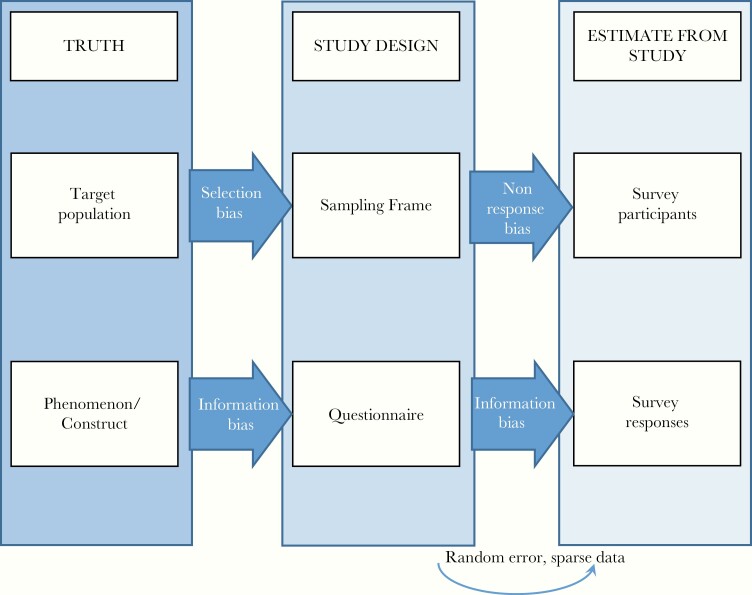
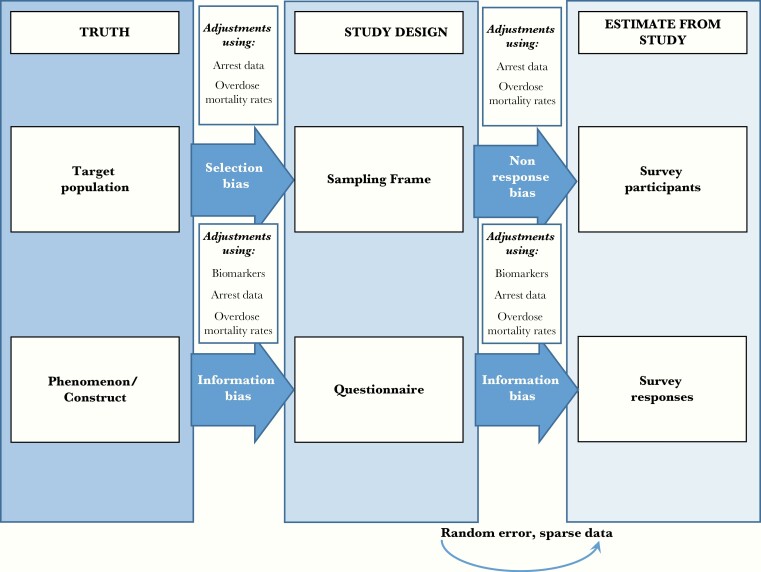
Methods: We reviewed design and instruments for 4 national household surveys, 2012-2016, for their ability to produce unbiased injection drug use (IDU) prevalence estimates. We explored potential analytic adjustments for reducing biases through use of external data on (1) arrest, (2) narcotic overdose mortality, and (3) biomarker-based sensitivity of self-reported illicit drug use.
Results: Estimated national past 12 months IDU prevalence ranged from 0.24% to 0.59% across surveys. All surveys excluded unstably housed and incarcerated persons, and estimates were based on <60 respondents reporting IDU behavior in 3 surveys. No surveys asked participants about nonmedical injection of prescription drugs. Analytic adjustments did not appreciably change IDU prevalence estimates due to suboptimal specificity of data points.
Conclusions: PWID population size estimates in the United States are based on small numbers and are likely biased by undercoverage of key populations and self-report. Novel methods as discussed in this article may improve our understanding of PWID population size and their health needs.
Keywords: PWID; injection behavior; population-based surveys.
© The Author(s) 2020. Published by Oxford University Press for the Infectious Diseases Society of America. All rights reserved. For permissions, e-mail: journals.permissions@oup.com.
Figures
References
-
- Jones CM. Trends and key correlates of prescription opioid injection misuse in the United States. Addict Behav 2018; 78:145–52. - PubMed
MeSH terms
Grants and funding
LinkOut - more resources
Full Text Sources
Miscellaneous
