Review
. 2020 Aug 31;12(9):2464.
doi: 10.3390/cancers12092464.

Circular RNAs: A New Piece in the Colorectal Cancer Puzzle

Affiliations
Review

Circular RNAs: A New Piece in the Colorectal Cancer Puzzle

Pinelopi I Artemaki et al. Cancers (Basel). .

Abstract

Colorectal cancer (CRC) is the third most fatal type of malignancy, worldwide. Despite the advances accomplished in the elucidation of its molecular base and the existing CRC biomarkers introduced in the clinical practice, additional research is required. Circular RNAs (circRNAs) constitute a new RNA type, formed by back-splicing of primary transcripts. They have been discovered during the 1970s but were characterized as by-products of aberrant splicing. However, the modern high-throughput approaches uncovered their widespread expression; therefore, several questions were raised regarding their potential biological roles. During the last years, great progress has been achieved in the elucidation of their functions: circRNAs can act as microRNA sponges, transcription regulators, and interfere with splicing, as well. Furthermore, they are heavily involved in various human pathological states, including cancer, and could serve as diagnostic and prognostic biomarkers in several diseases. Particularly in CRC, aberrant expression of circRNAs has been observed. More specifically, these molecules either inhibit or promote colorectal carcinogenesis by regulating different molecules and signaling pathways. The present review discusses the characteristics and functions of circRNA, prior to analyzing the multifaceted role of these molecules in CRC and their potential value as biomarkers and therapeutic targets.

Keywords: RNA splicing; circRNA; circularization; gastrointestinal cancer; microRNA sponges; peptide translation; regulation of carcinogenesis; therapeutic targets; transcription regulation; tumor biomarkers.


Conflict of interest statement

The authors declare no conflict of interest.

Figures
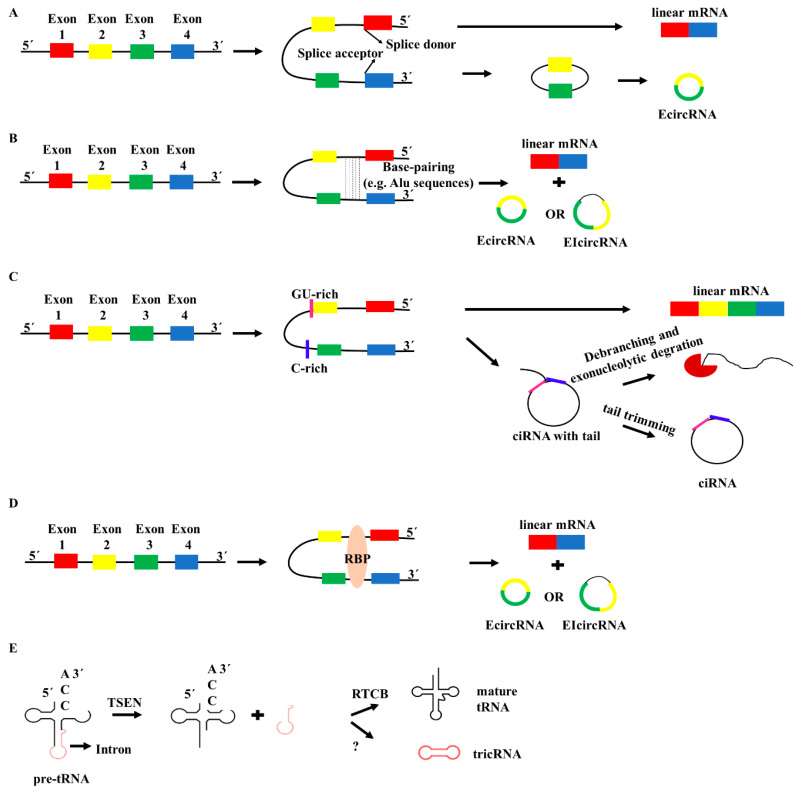
Figure 1
Figure 1
The proposed models for circular RNA (circRNA) biosynthesis. (A) Lariat-driven circularization or exon skipping. The pre-mRNA folds partially, encouraging the attack of the 5’ splicing site (splice donor) of the upstream intron to the 3’ splicing site (splice acceptor) of the downstream intron. This back-splicing of the folded region generates the circRNA and the rest exons generate a linear mRNA. (B) Intron pairing-driven circularization. Flanking reverse complementary sequences at the introns (mostly Alu sequences) mediate back-splicing generating circRNAs, i.e., EcircRNAs and EIcircRNAs. (C) The biogenesis of intronic circRNAs necessitates a consensus motif composed of a 7-nt GU-rich element near the 5’ splice site and an 11-nt C-rich element near the branchpoint site. (D) RNA-binding proteins (RBPs), such as muscleblind-like splicing regulator 1 (MBNL1) and Quaking homolog KH domain RNA-binding (QKI) protein, bring closer the donor site and the acceptor site via binding the flanks of the introns and, hence, assist circularization. (E) circRNAs derive from pre-tRNAs (tricRNAs), as well. tRNA splicing endonuclease (TSEN) cleaves the pre-tRNA at specific sites. The RNA 2’,3’-cyclic phosphate and 5’-OH ligase (RTCB) is essential for the ligation of the tRNA exons, but the intron ligase for the generation of the tricRNA is unknown.
Figure 2
Figure 2
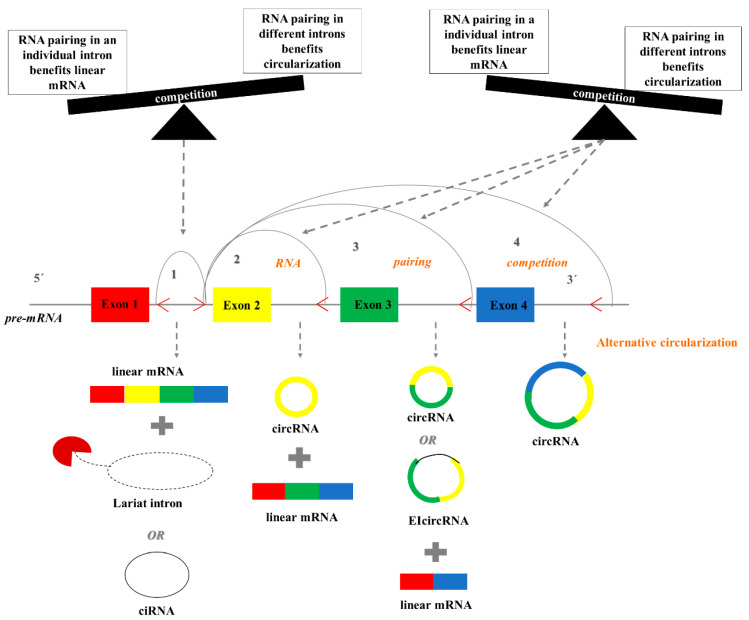
The model of alternative circularization. Multiple circRNAs and linear RNAs can be generated from a single gene locus, via RNA pairing competition. Complementary sequences within individual flanking introns favor linear mRNA formation, while complementary sequences in different flanking introns promote circularization. The competition between these reverse complementary sequences can lead to multiple circRNAs.
Figure 3
Figure 3
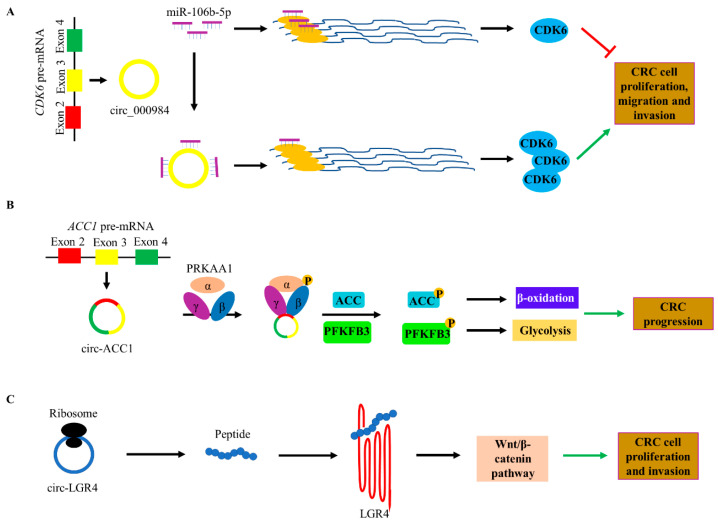
Functions of circRNAs in colorectal cancer (CRC). (A) Function as miRNA sponges. circ_000984 bears miRNA binding sites for miR-106b-5p. When circRNA is absent, the miRNA binds to the miRNA-response elements (MREs) of CDK6 mRNA, leading to decreased levels of CDK6 protein and, hence, decreased proliferation, migration, and invasion. The presence of circ_000984 impedes this regulation of CDK6 expression by sequestering miR-106b-5p. (B) Interaction with RBPs. circACC1 interacts with β and γ subunits of PRKAA1 (AMPK), leading to its stabilization and activation. PRKAA1 phosphorylates ACC and PFKFB3, leading to increased β-oxidation and glycolysis, respectively. This mechanism promotes CRC progression. (C) circRNAs can encode for peptides. circ-LGR4 encodes for a peptide, which interacts with LGR4 receptor and activates Wnt/β-catenin signaling pathway, resulting in CRC cell proliferation and invasion.
Figure 4
Figure 4
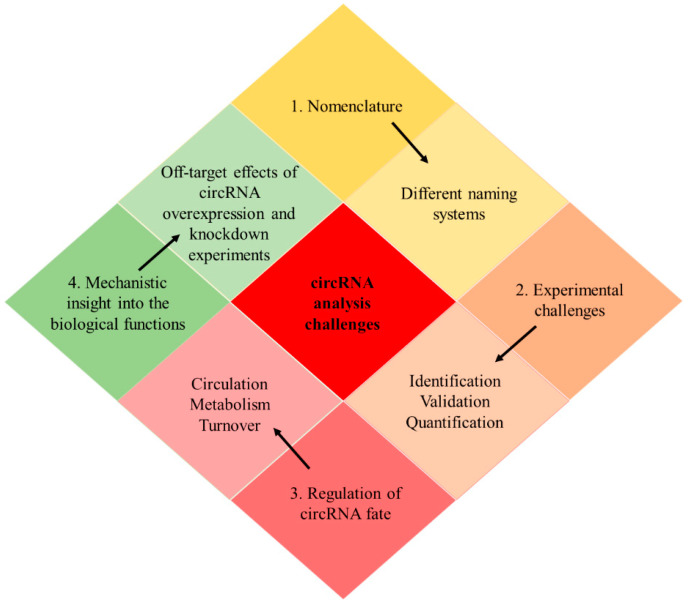
Main challenges in the field of circRNA analysis. Firstly, different nomenclature systems create ambiguity, which necessitates the establishment of a universal system, probably based on the circID of the circBase. Secondly, experimental challenges exist, which are summarized in the following categories: identification, validation, and quantification of circRNAs. Thirdly, there is a lack of information regarding the regulation of key aspects of circRNAs, such as circularization, metabolism, and turnover of these molecules. Fourthly, mechanistic insights into the biological functions of circRNAs should be gained. Novel approaches, such as the CRISPR-Cas system, could be exploited for mechanism exploration and replace the circRNA overexpression or knockdown experiments, which have off-target effects.

References

    1. Arnold M., Sierra M.S., Laversanne M., Soerjomataram I., Jemal A., Bray F. Global patterns and trends in colorectal cancer incidence and mortality. Gut. 2017;66:683–691. doi: 10.1136/gutjnl-2015-310912. - DOI - PubMed
    1. Nguyen H.T., Duong H.Q. The molecular characteristics of colorectal cancer: Implications for diagnosis and therapy. Oncol. Lett. 2018;16:9–18. doi: 10.3892/ol.2018.8679. - DOI - PMC - PubMed
    1. Taborda M.I., Ramirez S., Bernal G. Circular RNAs in colorectal cancer: Possible roles in regulation of cancer cells. World J. Gastrointest. Oncol. 2017;9:62–69. doi: 10.4251/wjgo.v9.i2.62. - DOI - PMC - PubMed
    1. Sanger H.L., Klotz G., Riesner D., Gross H.J., Kleinschmidt A.K. Viroids are single-stranded covalently closed circular RNA molecules existing as highly base-paired rod-like structures. Proc. Natl. Acad. Sci. USA. 1976;73:3852–3856. doi: 10.1073/pnas.73.11.3852. - DOI - PMC - PubMed
    1. Memczak S., Jens M., Elefsinioti A., Torti F., Krueger J., Rybak A., Maier L., Mackowiak S.D., Gregersen L.H., Munschauer M., et al. Circular RNAs are a large class of animal RNAs with regulatory potency. Nature. 2013;495:333–338. doi: 10.1038/nature11928. - DOI - PubMed

LinkOut - more resources