. 2020 Oct 21;58(11):e00147-20.
doi: 10.1128/JCM.00147-20. Print 2020 Oct 21.

Targeted Metagenomics for Clinical Detection and Discovery of Bacterial Tick-Borne Pathogens

Affiliations

Targeted Metagenomics for Clinical Detection and Discovery of Bacterial Tick-Borne Pathogens

Luke Kingry et al. J Clin Microbiol. .

Abstract

Tick-borne diseases, due to a diversity of bacterial pathogens, represent a significant and increasing public health threat throughout the Northern Hemisphere. A high-throughput 16S V1-V2 rRNA gene-based metagenomics assay was developed and evaluated using >13,000 residual samples from patients suspected of having tick-borne illness and >1,000 controls. Taxonomic predictions for tick-borne bacteria were exceptionally accurate, as independently validated by secondary testing. Overall, 881 specimens were positive for bacterial tick-borne agents. Twelve tick-borne bacterial species were detected, including two novel pathogens, representing a 100% increase in the number of tick-borne bacteria identified compared to what was possible by initial PCR testing. In three blood specimens, two tick-borne bacteria were simultaneously detected. Seven bacteria, not known to be tick transmitted, were also confirmed to be unique to samples from persons suspected of having tick-borne illness. These results indicate that 16S V1-V2 metagenomics can greatly simplify diagnosis and accelerate the discovery of bacterial tick-borne pathogens.

Keywords: Lyme disease; anaplasmosis; human granulocytic ehrlichiosis; metagenomics; tick-borne bacteria; vector-borne diseases.


Figures

FIG 1
FIG 1
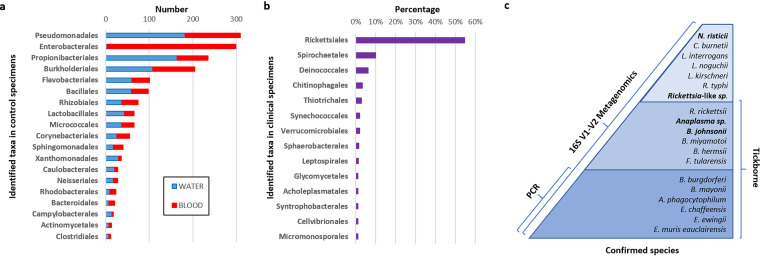
Identified taxa in controls and clinical specimens. (a) Distribution of order-level taxonomic predictions in healthy donor blood specimens and molecular-grade water arranged by descending prevalence. Data are shown only for those taxonomic predictions present in >10 individual specimens. A full list of taxonomic predictions is can be found in Fig. S3 in the supplemental material. (b) Proportion (percentage) of order-level taxonomic predictions in samples from patients suspected of having tick-borne illness relative to all other taxonomic predictions. The data shown are after the subtraction of background taxa identified in control specimens. Data are shown only for those taxonomic predictions represented in >1% of patient specimens. A full list of taxonomic predictions unique to clinical specimens is available in Table S2 in the supplemental material. (c) Identified bacteria (known and novel) in clinical samples from patients suspected of having tick-borne illness by 16S V1-V2 metagenomics compared to PCR. Dark blue, 6 tick-borne bacterial species initially tested for by targeted PCR; medium blue, 6 additional tick-borne bacterial species identified by 16S V1-V2 metagenomics; light blue, 7 other species identified by 16S V1-V2 metagenomics. The total number of bacterial species identified and independently confirmed was 19. Novel pathogens are indicated in boldface type (n = 4).
FIG 2
FIG 2
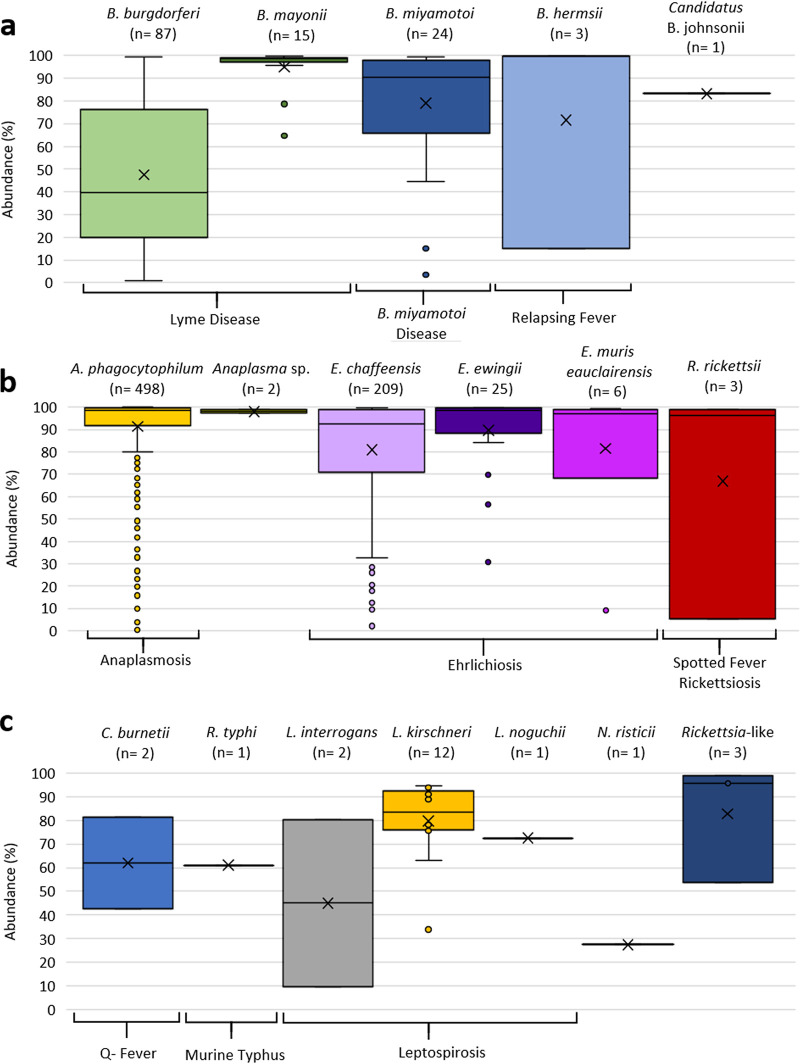
Box-and-whisker plots showing the distribution of V1-V2 16S read abundances (percentages) for bacterial taxa identified in clinical specimens. The distribution of read abundances for a given taxon relative to all other bacterial taxa detected in the same specimen is shown. The number of clinical samples positive for each of the taxa is indicated at the top of each plot. If known, the disease associated with the bacterial taxon is indicated at the bottom of the y axis. The middle line of the box-and-whisker plot indicates the median, and “X” indicates the mean. The dots outside boxes indicate outliers. Read abundances are shown for Spirochaetales (a), Rickettsiales (b), and other validated taxa not known to be tick transmitted (c).
FIG 3
FIG 3
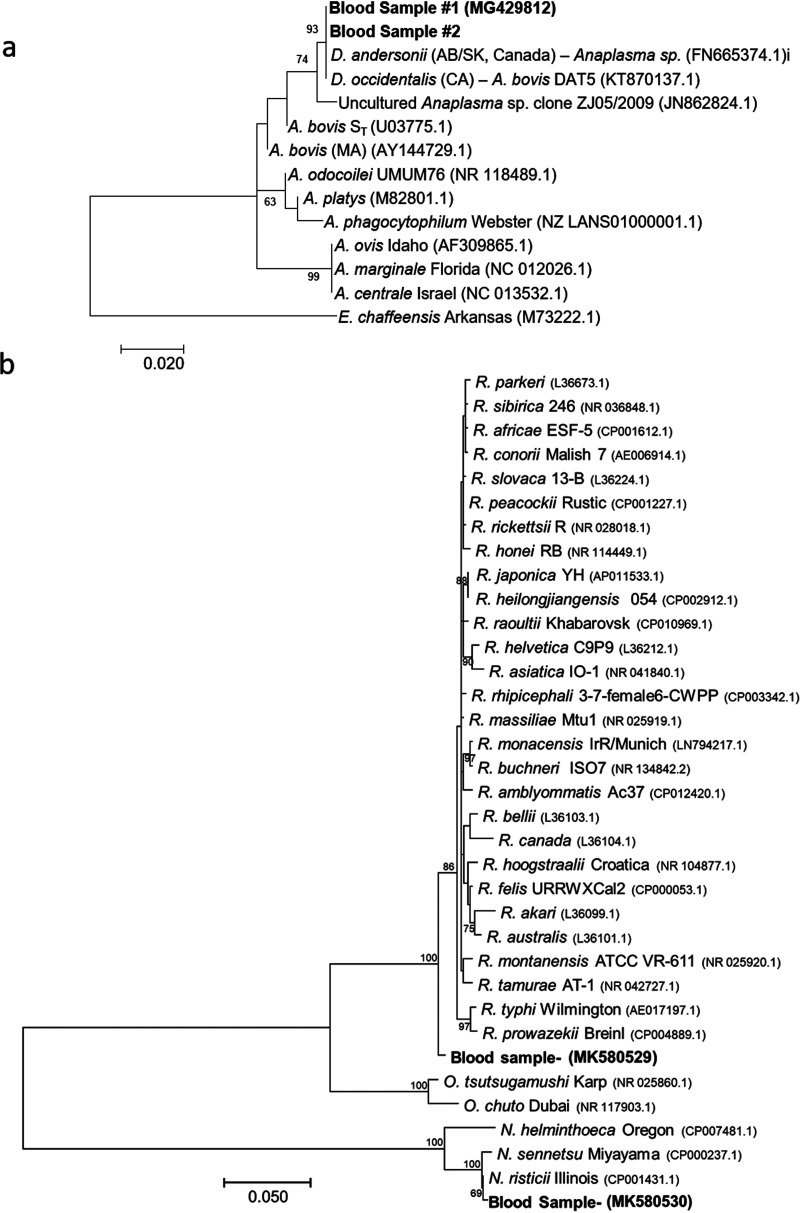
Maximum likelihood trees for bacterial species not previously associated with human illness. (a) Phylogenetic analysis of a 357-bp fragment of the 16S rRNA gene amplified from two patient blood specimens compared to Anaplasma species and E. chaffeensis. The bar corresponds to 0.02 substitutions per site. (b) Phylogenetic analysis of an 834-bp fragment of the 16S rRNA gene amplified from patient blood specimens positive for N. risticii and the Rickettsia-like agent compared to other Rickettsia, Orientia, and Neorickettsia species. The bar corresponds to 0.05 substitutions per site. Bootstrap values of >60 are shown.

Comment in

References

    1. Paules CI, Marston HD, Bloom ME, Fauci AS. 2018. Tickborne diseases—confronting a growing threat. N Engl J Med 379:701–703. doi:10.1056/NEJMp1807870. - DOI - PubMed
    1. Rosenberg R, Lindsey NP, Fischer M, Gregory CJ, Hinckley AF, Mead PS, Paz-Bailey G, Waterman SH, Drexler NA, Kersh GJ, Hooks H, Partridge SK, Visser SN, Beard CB, Petersen LR. 2018. Vital signs: trends in reported vectorborne disease cases—United States and territories, 2004-2016. MMWR Morb Mortal Wkly Rep 67:496–501. doi:10.15585/mmwr.mm6717e1. - DOI - PMC - PubMed
    1. Hinckley AF, Connally NP, Meek JI, Johnson BJ, Kemperman MM, Feldman KA, White JL, Mead PS. 2014. Lyme disease testing by large commercial laboratories in the United States. Clin Infect Dis 59:676–681. doi:10.1093/cid/ciu397. - DOI - PMC - PubMed
    1. Nelson CA, Saha S, Kugeler KJ, Delorey MJ, Shankar MB, Hinckley AF, Mead PS. 2015. Incidence of clinician-diagnosed Lyme disease, United States, 2005–2010. Emerg Infect Dis 21:1625–1631. doi:10.3201/eid2109.150417. - DOI - PMC - PubMed
    1. Stanek G, Fingerle V, Hunfeld KP, Jaulhac B, Kaiser R, Krause A, Kristoferitsch W, O’Connell S, Ornstein K, Strle F, Gray J. 2011. Lyme borreliosis: clinical case definitions for diagnosis and management in Europe. Clin Microbiol Infect 17:69–79. doi:10.1111/j.1469-0691.2010.03175.x. - DOI - PubMed

Publication types

Substances