. 2020 Sep 2;10(1):14447.
doi: 10.1038/s41598-020-71071-1.

Targeted and redox-responsive drug delivery systems based on carbonic anhydrase IX-decorated mesoporous silica nanoparticles for cancer therapy

Affiliations

Targeted and redox-responsive drug delivery systems based on carbonic anhydrase IX-decorated mesoporous silica nanoparticles for cancer therapy

Minmin Chen et al. Sci Rep. .

Abstract

In this work, we developed a new antibody-targeted and redox-responsive drug delivery system "MSNs-CAIX" by binding the anti-carbonic anhydrase IX antibody (A-CAIX Ab) on the surface of mesoporous silica nanoparticles (MSNs) via disulfide linkages. The design of the composite particles "MSNs-CAIX" involved the synthesis and surface functionalization with thiol groups, 2,2'-dipyridyl disulfide and CAIX antibody. In vitro, CAIX capping the doxorubicin hydrochloric (DOX)-loaded nanoparticles (DOX@MSNs-CAIX) exhibited effectively redox-responsive release in the presence of glutathione (GSH) owing to the cleavage of the disulfide bond. Compared with CAIX negative Mef cells (mouse embryo fibroblast), remarkably more DOX@MSNs-CAIX was internalized into CAIX positive 4T1 cells (mouse breast cancer cells) by receptor-mediation. Tumor targeting in vivo studies clearly demonstrated DOX@MSNs-CAIX accumulated in tumors and induced more tumor cells apoptosis in 4T1 tumor-bearing mice. With great potential, this drug delivery system is a promising candidate for targeted and redox-responsive cancer therapy.


Conflict of interest statement

The authors declare no competing interests.

Figures
Scheme 1
Scheme 1
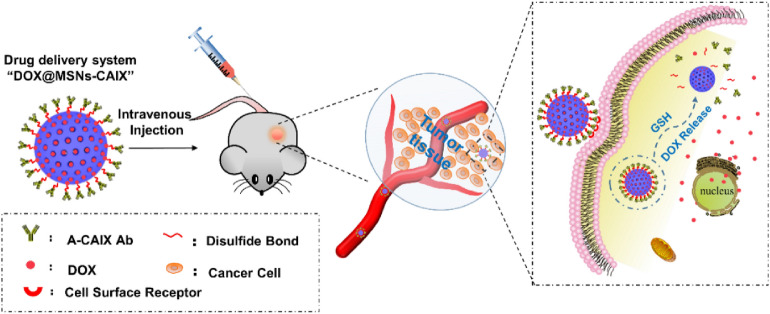
Illustration of A-CAIX Ab targeted mesoporous silica nanoparticles as a redox-responsive drug delivery system.
Scheme 2
Scheme 2
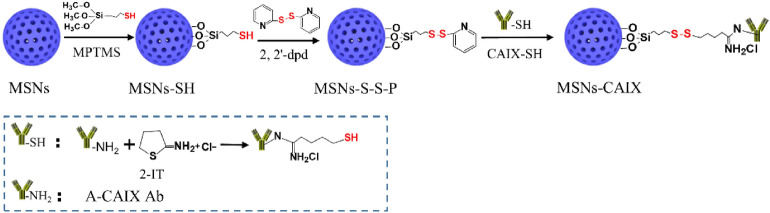
Synthetic route of CAIX targeted mesoporous silica nanoparticles “MSNs-CAIX”.
Figure 1
Figure 1
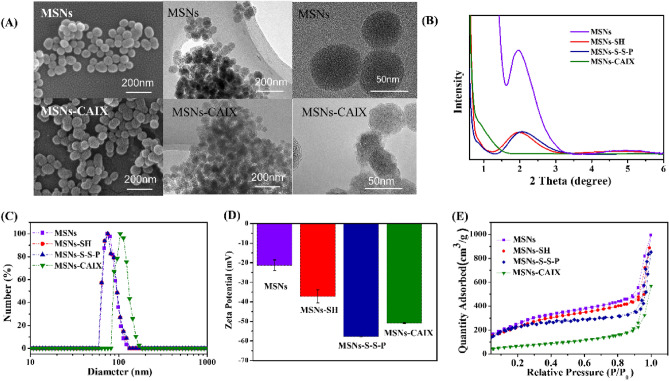
(A) SEM and TEM images of MSNs and MSNs-CAIX. (B) XRD patterns, (C) size distribution, (D) zeta potential, (E) nitrogen adsorption desorption isotherms of MSNs, MSNs-SH, MSNs-S-S-P and MSNs-CAIX.
Figure 2
Figure 2
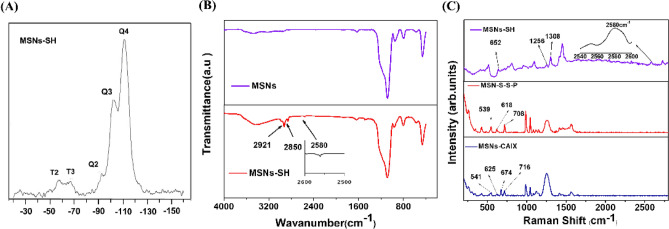
(A) 29Si-MAS-NMR of MSNs-SH. (B) The FT-IR of MSNs and MSNs-SH. (C) The Raman patterns of MSNs-SH, MSNs-S-S-P and MSNs-CAIX.
Figure 3
Figure 3
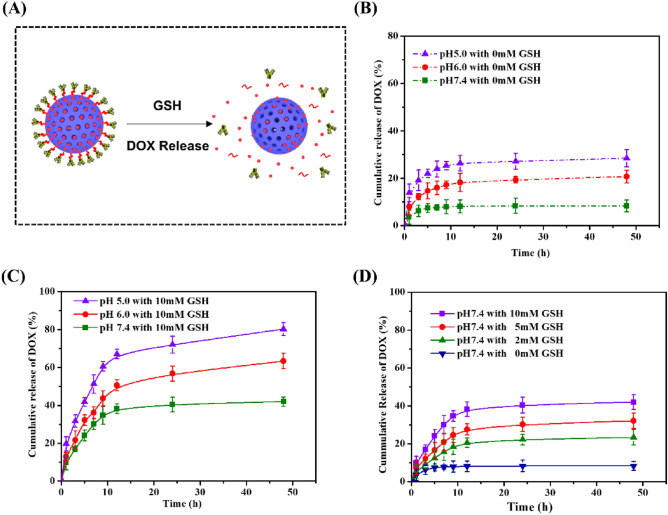
(A) Illustration of GSH-triggered DOX release from DOX@MSNs-CAIX. DOX release from DOX@MSNs-CAIX in PBS with (B) 0 mM GSH and (C) 10 mM GSH at different pH values (5.0, 6.0, 7.4). (D) DOX release from DOX@MSNs-CAIX in PBS at pH 7.4 with different concentrations of GSH (0 mM, 2 mM, 5 mM, 10 mM).
Figure 4
Figure 4
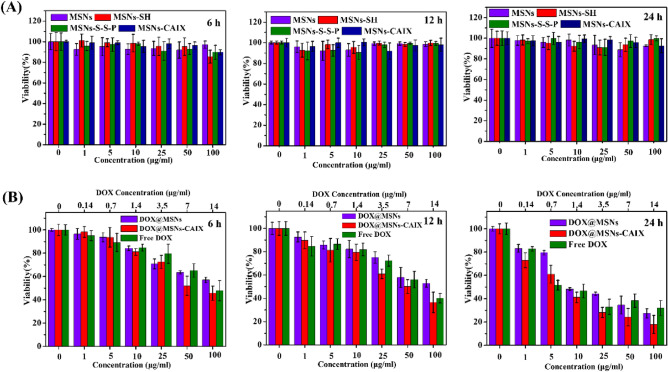
In vitro cytotoxicity of (A) MSNs, MSNs-SH, MSNs-S-S-P, MSNs-CAIX and (B) DOX@MSNs, DOX@MSNs-CAIX, free DOX cultured with 4T1 cells for 6 h, 12 h, 24 h, respectively.
Figure 5
Figure 5
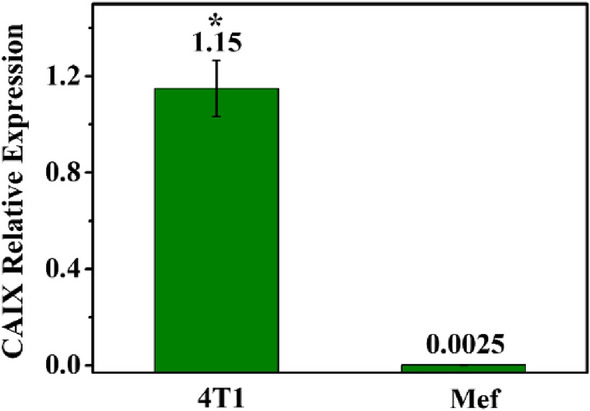
CAIX relative expression in 4T1 and Mef cells. (*P < 0.05 as compared with Mef group).
Figure 6
Figure 6
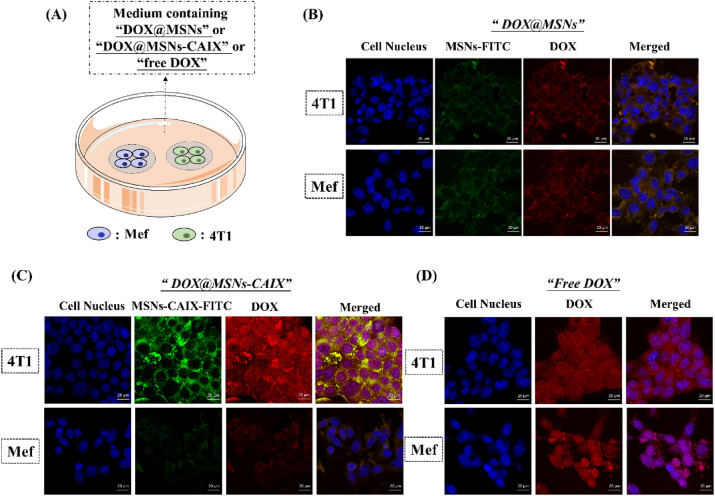
(A) Illustration of co-culture of 4T1 and Mef cells with DOX@MSNs, DOX@MSNs-CAIX and free DOX, respectively. CLSM images of 4T1 and Mef cells cultured with (B) DOX@MSNs, (C) DOX@ MSNs-CAIX, (D) Free DOX. Blue: cell nucleus staining by DAPI. Green: MSNs-CAIX labeled by FITC. Red: DOX.
Figure 7
Figure 7
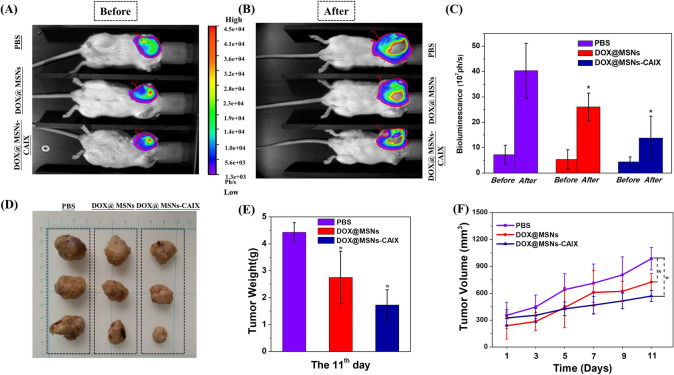
4T1-Luc tumor-bearing mice treated with different samples (PBS, DOX@MSNs and DOX@MSNs-CAIX) for 11 days. The tumors bioluminescence imaging before (A) and after (B) intervention with the above samples. (C) The tumors bioluminescence intensity before (the 0th day) and after (the 11th day) intervention with the above samples. (D)The tumors' photographs from the scarified mice. (E)The final average tumor weight. (F) The variation curves of average tumor volume. (*P < 0.05 as compared with PBS group).
Figure 8
Figure 8
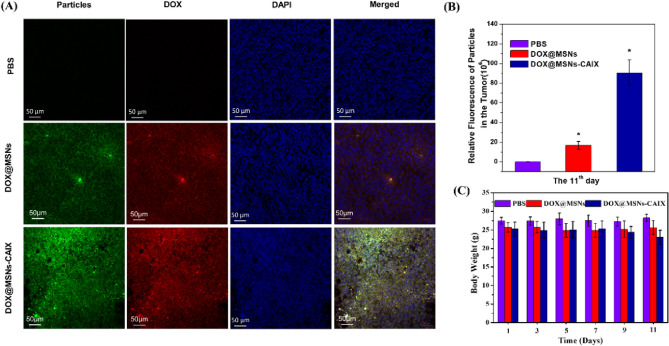
(A) Particles and DOX distribution in tumors after being treated with the above samples for 11 days (green: particles labeled by FITC; red: DOX; blue: cell nucleus staining by DAPI). (B) Particles relative fluorescence intensity in the tumor. (C) The variation of average body weight with time (*P < 0.05 as compared with PBS group).

References

    1. Fernandes C, Suares D, Yergeri MC. Tumor microenvironment targeted nanotherapy. Front. Pharmacol. 2018;9:1230. doi: 10.3389/fphar.2018.01230. - DOI - PMC - PubMed
    1. Bray F, et al. Global cancer statistics 2018: GLOBOCAN estimates of incidence and mortality worldwide for 36 cancers in 185 countries. Ca-Cancer J. Clin. 2018;68:394–424. doi: 10.3322/caac.21492. - DOI - PubMed
    1. Castillo RR, Colilla M, Vallet-Regí M. Advances in mesoporous silica-based nanocarriers for co-delivery and combination therapy against cancer. Expert Opin. Drug Deliv. 2017;14:229–243. doi: 10.1080/17425247.2016.1211637. - DOI - PubMed
    1. Kesse S, et al. Mesoporous silica nanomaterials: Versatile nanocarriers for cancer theranostics and drug and gene delivery. Pharmaceutics. 2019;11:77. doi: 10.3390/pharmaceutics11020077. - DOI - PMC - PubMed
    1. Song Y, Li Y, Xu Q, Liu Z. Mesoporous silica nanoparticles for stimuli-responsive controlled drug delivery: Advances, challenges, and outlook. Int. J. Nanomed. 2017;12:87–110. doi: 10.2147/IJN.S117495. - DOI - PMC - PubMed

Publication types

MeSH terms