. 2020 Aug 12:2020:6839103.
doi: 10.1155/2020/6839103. eCollection 2020.

Blood and Bronchoalveolar Lavage Fluid Metagenomic Next-Generation Sequencing in Pneumonia

Affiliations

Blood and Bronchoalveolar Lavage Fluid Metagenomic Next-Generation Sequencing in Pneumonia

Xu Chen et al. Can J Infect Dis Med Microbiol. .

Abstract

Background: Metagenomic next-generation sequencing (mNGS) has made a revolution in the mode of pathogen identification. We decided to explore the diagnostic value of blood and bronchoalveolar lavage fluid (BALF) as mNGS samples in pneumonia.

Methods: We retrospectively reviewed 467 mNGS results and assessed the diagnostic performance of paired blood and BALF mNGS in 39 patients with pneumonia.

Results: For bacteria and fungi, 16 patients had culture-confirmed pathogen diagnosis, while 13 patients were culture-negative. BALF mNGS was more sensitive than blood mNGS (81.3% vs. 25.0%, p=0.003), and the specificity in BALF and blood mNGS was not statistically significant different (76.9% vs. 84.6%, p=0.317). For 10 patients without culture test, treatments were changed in 2 patients. For viruses, Epstein-Barr virus was positive in blood mNGS in 9 patients. Human adenovirus was detected in both BALF and blood mNGS in 3 patients.

Conclusion: Our study suggests that BALF mNGS is more sensitive than blood mNGS in detecting bacteria and fungi, but blood also has advantages to identify the pathogens of pneumonia, especially for some viruses.


Conflict of interest statement

The authors declare that they have no conflicts of interest.

Figures
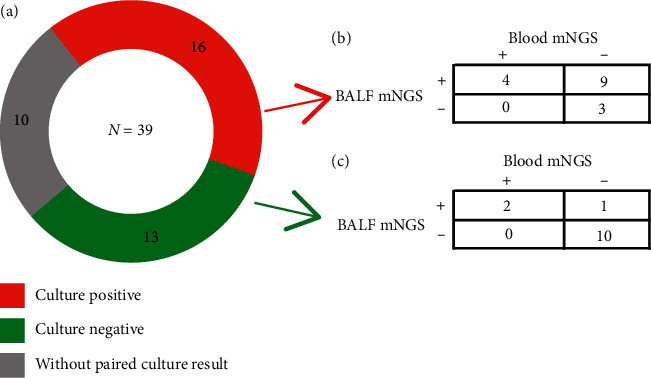
Figure 1
Figure 1
Blood and BALF mNGS for bacteria and fungi pathogen identification. (a) The culture results in 39 patients. 16 patients had positive culture results, shown in red; 13 patients had negative results, shown in green; the remaining 10 patients had no paired culture results which were sampled simultaneously with mNGS, shown in grey. (b) Pathogen identification of BALF and blood mNGS in patients with positive culture results. The sensitivity of the BALF mNGS and blood mNGS was (13/16 = 81.3%) and (4/16 = 25.0%), respectively. (c) Pathogen identification of BALF and Blood mNGS in patients with negative culture results. The specificity of the BALF mNGS and blood mNGS was (10/13 = 76.9%) and (11/13 = 84.6%), respectively. Abbreviations: mNGS, metagenomic next-generation sequencing; BALF, bronchoalveolar lavage fluid.
Figure 2
Figure 2
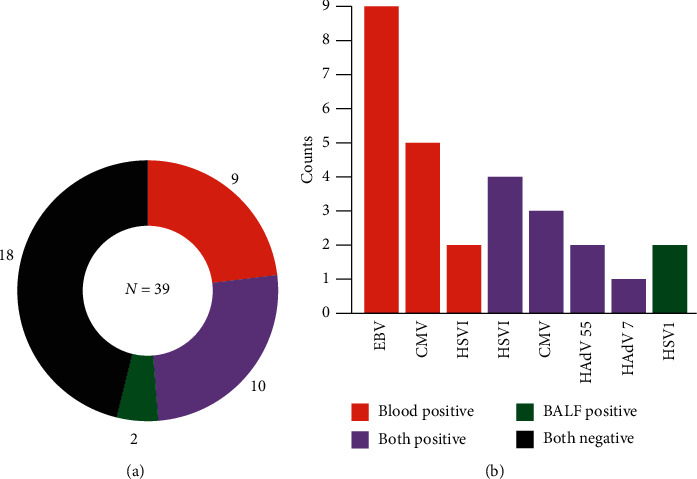
Blood and BALF mNGS for viral detection. (a) The mNGS results for viral detection in 39 patients. 18 patients (black) had negative results in both blood and BALF mNGS. Viruses were detected in 21 patients, among whom 10 patients (purple) had positive results in both blood and BALF mNGS, 9 patients (red) had positive blood mNGS results, and 2 patients (green) had positive BALF mNGS results. The number of cases and percentage of different conditions are listed near the plot. (b) The distribution of pathogens identified by blood mNGS and BALF mNGS. Abbreviations: mNGS, metagenomic next-generation sequencing; BALF, bronchoalveolar lavage fluid; EBV, Epstein-Barr virus; CMV, Cytomegalovirus; HAdV, human adenovirus.
Figure 3
Figure 3
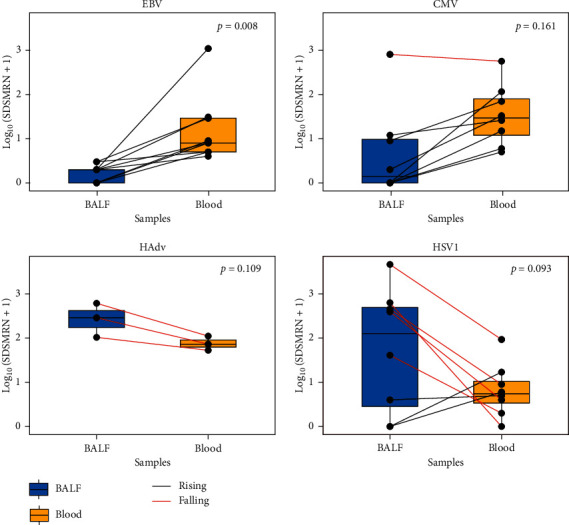
Comparison of the number of reads in BALF and blood mNGS for different viruses. The Log10(SDSMRN + 1) of viruses detected by BALF and blood mNGS were shown in blue and yellow. The paired data were connected by a straight line: red suggested a higher result in BALF and black suggested higher in blood. Abbreviations: mNGS, metagenomic next-generation sequencing; BALF, bronchoalveolar lavage fluid; EBV, Epstein-Barr virus; CMV, Cytomegalovirus; HAdv, human adenovirus; HSV1, Herpes Simplex Virus type 1; SDSMRN, the number of reads stringently mapped to pathogen species.

References

    1. Gu W., Miller S., Chiu C. Y. Clinical metagenomic next-generation sequencing for pathogen detection. Annual Review of Pathology: Mechanisms of Disease. 2019;14(1):319–338. doi: 10.1146/annurev-pathmechdis-012418-012751. - DOI - PMC - PubMed
    1. Chiu C. Y., Miller S. A. Clinical metagenomics. Nature Reviews Genetics. 2019;20(6):341–355. doi: 10.1038/s41576-019-0113-7. - DOI - PMC - PubMed
    1. Blauwkamp T. A., Thair S., Rosen M. J., et al. Analytical and clinical validation of a microbial cell-free DNA sequencing test for infectious disease. Nature Microbiology. 2019;4(4):663–674. doi: 10.1038/s41564-018-0349-6. - DOI - PubMed
    1. Wilson M. R., Sample H., Zorn K. C., Arevalo S. Clinical metagenomic sequencing for diagnosis of meningitis and encephalitis. The New England Journal of Medicine. 2019;380(24):2327–2340. doi: 10.1056/NEJMoa1803396. - DOI - PMC - PubMed
    1. Cheng J., Hu H., Kang Y., et al. Identification of pathogens in culture-negative infective endocarditis cases by metagenomic analysis. Annals of Clinical Microbiology and Antimicrobials. 2018;17(1):p. 43. doi: 10.1186/s12941-018-0294-5. - DOI - PMC - PubMed

LinkOut - more resources