


Effectiveness of a Tailored Work-Related Support Intervention for Patients Diagnosed with Gastrointestinal Cancer: A Multicenter Randomized Controlled Trial
- PMID: 32880094
- PMCID: PMC8172517
- DOI: 10.1007/s10926-020-09920-z
Effectiveness of a Tailored Work-Related Support Intervention for Patients Diagnosed with Gastrointestinal Cancer: A Multicenter Randomized Controlled Trial
Abstract
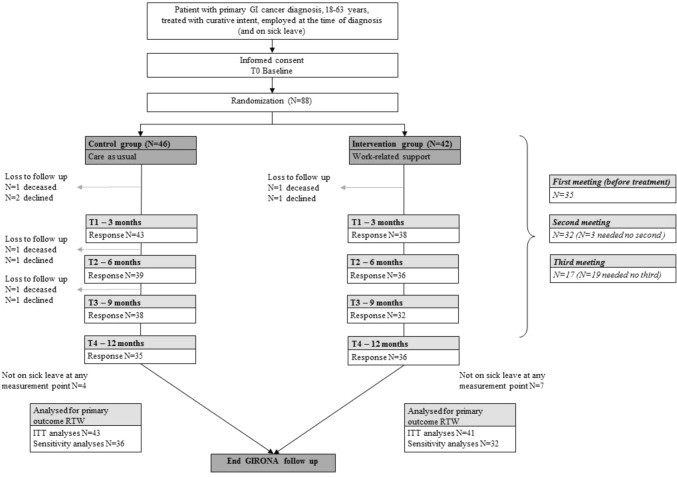
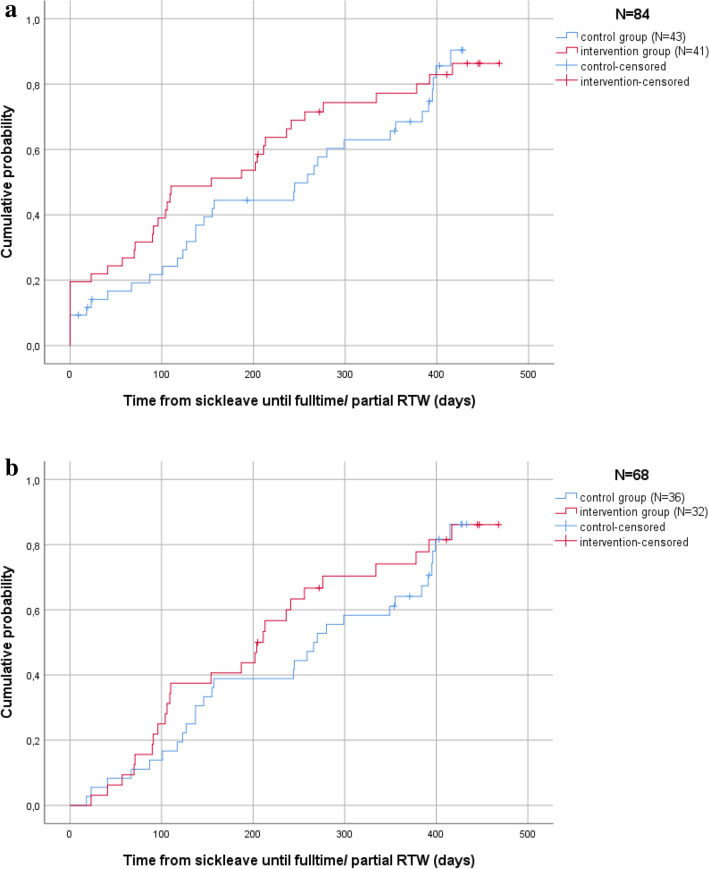
Purpose The aim of this research was to study the effectiveness on return to work (RTW) of an early tailored work-related support intervention in patients diagnosed with curative gastrointestinal cancer. Methods A multicenter randomized controlled trial was undertaken, in which patients were assigned randomly to the intervention or the control group (usual care). The intervention encompassed three psychosocial work-related support meetings, starting before treatment. Five self-reported questionnaires were sent over twelve months of follow-up. Primary outcome was days until RTW (fulltime or partial) and secondary outcomes included work status, quality of life, work ability, and work limitations. Descriptive analysis, Kaplan-Meier analysis, relative risk ratio and linear mixed models were applied. Results Participants (N = 88) had a mean age of 55 years; 67% were male and the most common cancer type was colon cancer (66%). Of the participants, 42 were randomized to the intervention group. The median time from sick leave until RTW was 233 days (range 187-279 days) for the control group, versus 190 days (range 139-240 days) for the intervention group (log-rank p = 0.37). The RTW rate at twelve months after baseline was 83.3% for the intervention group and 73.5% for the control group. Work limitations did statistically differ between the groups over time (p = 0.01), but quality of life and work ability did not. Conclusion Patients in the intervention group seem to take fewer days to RTW, albeit not to a statistically significant extent.Trial registration Trial NL4920 (NTR5022) (Dutch Trial Register https://www.trialregister.nl ).
Keywords: Neoplasms; Randomized controlled trial; Rehabilitation research; Return to work; Vocational rehabilitation.
Conflict of interest statement
The authors declare that they have no conflict of interest.
Figures
References
-
- Harrington CB, Hansen JA, Moskowitz M, Todd BL, Feuerstein M. It's not over when it's over: long-term symptoms in cancer survivors: a systematic review. Int J Psychiatry Med. 2010;40(2):163–181. - PubMed
-
- Weis J. Cancer-related fatigue: prevalence, assessment and treatment strategies. Expert Rev. Pharmacoecon. Outcomes Res. 2011;11(4):441–446. - PubMed
-
- Duijts SF, van Egmond MP, Spelten E, van Muijen P, Anema JR, van der Beek AJ. Physical and psychosocial problems in cancer survivors beyond return to work: a systematic review. Psychooncology. 2014;23(5):481–492. - PubMed
Publication types
MeSH terms
Associated data
LinkOut - more resources
Full Text Sources
