


Hypertension and Metabolic Syndrome in Persons with HIV
- PMID: 32880756
- PMCID: PMC7467859
- DOI: 10.1007/s11906-020-01089-3
Hypertension and Metabolic Syndrome in Persons with HIV
Abstract
Purpose of review: With the advent of highly active antiretroviral therapy (ART), the life span of persons with HIV (PWH) has been nearly normalized. With aging, prevalence of the metabolic syndrome (MetS), including hypertension, has increased in the HIV population and exceeds that in the general population in some studies. This is due to a combination of traditional risk factors in addition to the effects attributable to the virus and ART. We review recent findings on the mechanisms contributing to MetS and hypertension in PWH, particularly those specific to the viral infection and to ART.
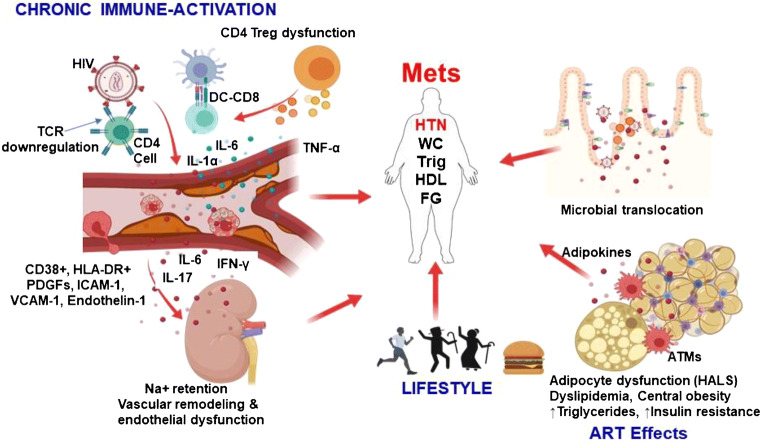
Recent findings: Activation of the renin-angiotensin-aldosterone system (RAAS) and chronic immune activation contribute to the development of MetS and hypertension in PWH. HIV proteins and some ART agents alter adipocyte health contributing to dyslipidemias, weight gain, and insulin resistance. HIV infection also contributes to hypertension by direct effects on the RAAS that intertwine with inflammation by the RAAS also contributing to T cell activation. Recent data suggest that in addition to current ART, therapeutic targeting of the MetS and hypertension in PWH, by interfering with the RAAS, treating insulin resistance directly or by use of immunomodulators that dampen inflammation, may be critical for preventing or treating these risk factors and to improve overall cardiovascular complications in the HIV-infected aging population.
Keywords: Antiretroviral therapy; HIV; Hypertension; Immune modulators; Metabolic syndrome.
Conflict of interest statement
The authors declare no conflicts of interest relevant to this manuscript.
Figures
References
-
- CDC. HIV in the United States and Dependent Areas. 2020 [cited 2020 May 10]. Available from: https://www.cdc.gov/hiv/statistics/overview/ataglance.html
-
- •• Zicari S, Sessa L, Cotugno N, Ruggiero A, Morrocchi E, Concato C, et al. Immune Activation, Inflammation, and Non-AIDS Co-Morbidities in HIV-Infected Patients under Long-Term ART. Viruses. 2019 [cited 2020 Mar 11];11. Available from: https://www.ncbi.nlm.nih.gov/pmc/articles/PMC6466530/. This review highlights some of the underlying mechanisms the predispose HIV-infected adults to non-communicable disease and some aspects of metabolic syndrome. - PMC - PubMed
-
- Rogalska-Płońska M, Grzeszczuk A, Rogalski P, Łucejko M, Flisiak R. Metabolic syndrome in HIV infected adults in Poland. Kardiol Pol. 2018;76:548–553. - PubMed
-
- Kiama CN, Wamicwe JN, Oyugi EO, Obonyo MO, Mungai JG, Roka ZG, et al. Prevalence and factors associated with metabolic syndrome in an urban population of adults living with HIV in Nairobi, Kenya. Pan Afr Med J. 2018 [cited 2020 Mar 11];29. Available from: https://www.ncbi.nlm.nih.gov/pmc/articles/PMC5987082/ - PMC - PubMed
Publication types
MeSH terms
Grants and funding
LinkOut - more resources
Full Text Sources
Medical
Research Materials
