


Unmet social needs among low-income adults in the United States: Associations with health care access and quality
- PMID: 32880945
- PMCID: PMC7518813
- DOI: 10.1111/1475-6773.13555
Unmet social needs among low-income adults in the United States: Associations with health care access and quality
Abstract
Objective: To describe social needs among low-income adults and estimate the relationship between level of unmet social needs and key indicators of health care access and quality.
Data source: National survey data from 12 states from the 2017 Behavioral Risk Factor Surveillance System, which added a "Social Determinants of Health" Module in 2017.
Study design: We examined differences in eight measures of health care access and quality (eg, check-up in last 12 months, inability to see doctor due to cost, receipt of eye examination for diabetics) for low-income adults with 0, 1, 2-3, and 4+ unmet social needs based on 7 social needs measures. We used adjusted logistic regression models to estimate the association between level of unmet need and each outcome.
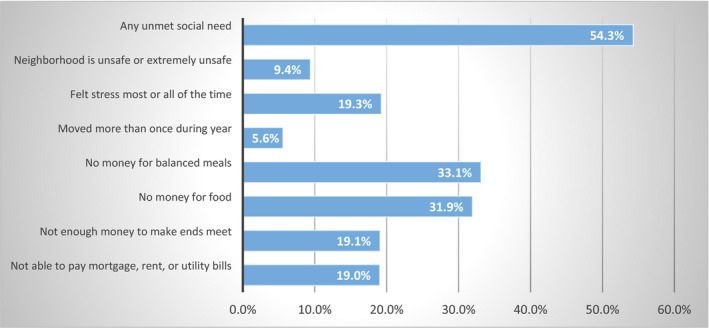
Principal findings: Most common unmet social needs included not having enough money for balanced meals (33 percent) or food (32 percent). After adjusting for observable characteristics, higher levels of unmet social need were associated with poorer access and quality. Compared to those with no reported unmet needs, having 4+ unmet needs was significantly associated with reduced probability of having a yearly check-up (65 percent vs 78 percent, adjusted difference = -7.1 percentage points (PP)), receiving a flu vaccine (33 percent vs 42 percent, adjusted difference = -5.4 PP), having a personal doctor (74 percent vs 80 percent, adjusted difference = -3.1 PP), and having a foot (63 percent vs 80 percent, adjusted difference = -12.8 PP) or eye examination (61 percent vs 73 percent, adjusted difference = -12.6 PP) for diabetic patients, and increased probability of being unable to see a doctor due to cost (44 percent vs 9 percent, adjusted difference = 27.9 PP) and having diabetes affect the eyes (22 percent vs 19 percent, adjusted difference = 8.0 PP) at α = 0.05.
Conclusions: Higher levels of unmet social needs were associated with poorer access to and quality of care among low-income adults. Addressing social needs both inside and outside of health care settings may help mitigate these negative effects. Additional research on if and how to effectively do so is critical.
Keywords: access to care; quality of care; social needs.
© 2020 The Authors. Health Services Research published by Wiley Periodicals LLC on behalf of Health Research and Educational Trust.
Figures
References
-
- Kaiser Permanente . Kaiser Permanente Research: Social Needs in America. Portland, OR: Kaiser Permanente Center for Health Research; June 2019. https://about.kaiserpermanente.org/content/dam/internet/kp/comms/import/.... Accessed October 1, 2019.
-
- Berkowitz SA, Hulberg AC, Hong C, et al. Addressing basic resource needs to improve primary care quality: a community collaboration programme. BMJ Qual Saf. 2016;25(3):164‐172. - PubMed
-
- Alley DE, Asomugha CN, Conway PH, Sanghavi DM. Accountable Health Communities–addressing social needs through Medicare and Medicaid. N Engl J Med. 2016;374(1):8‐11. - PubMed
-
- Center for Health Care Strategies . Addressing Social Determinants of Health through Medicaid Accountable Care Organizations. 2018. April 18. https://www.chcs.org/addressing-social-determinants-health-medicaid-acco.... Accessed October 1, 2019.
-
- National Academy for State Health Policy . How States address social determinants of health in their Medicaid Contracts and Contract Guidance documents. https://nashp.org/wp-content/uploads/2018/08/social-determinants-chart-8.... Accessed October 1, 2019.
Publication types
MeSH terms
Grants and funding
LinkOut - more resources
Full Text Sources
Miscellaneous
