


Familial factors may not explain the effect of moderate-to-heavy cannabis use on cognitive functioning in adolescents: a sibling-comparison study
- PMID: 32881239
- PMCID: PMC7925696
- DOI: 10.1111/add.15207
Familial factors may not explain the effect of moderate-to-heavy cannabis use on cognitive functioning in adolescents: a sibling-comparison study
Abstract
Aims: To examine whether moderate adolescent cannabis use has neurocognitive effects that are unexplained by familial confounds, which prior family-controlled studies may not have identified.
Design: A quasi-experimental, sibling-comparison design was applied to a prospective, observational study of adolescents with moderate cannabis use. Participants were recruited from 2001 to 2006 (mean age = 17 years). A second wave of data was collected from 2008 to 2013 (mean age = 24 years).
Setting: Two US metropolitan communities.
Participants: A total of 1192 adolescents from 596 families participated in this study. Participants were primarily male (64%) and racially and ethnically diverse (non-Hispanic white = 45%). A sibling in each family was a clinical proband identified due to delinquent behaviors. Whereas prior family-controlled studies have used samples of primarily infrequent cannabis users (mean = 1-2 days/month), participants here endorsed levels of cannabis use comparable to findings from epidemiological cohort studies (mean = 7-9 days/month).
Measurements: Semi-structured clinical interviews assessed drug use, and a neuropsychological battery assessed cognitive abilities. Covariates included age at assessment, gender and alcohol use.
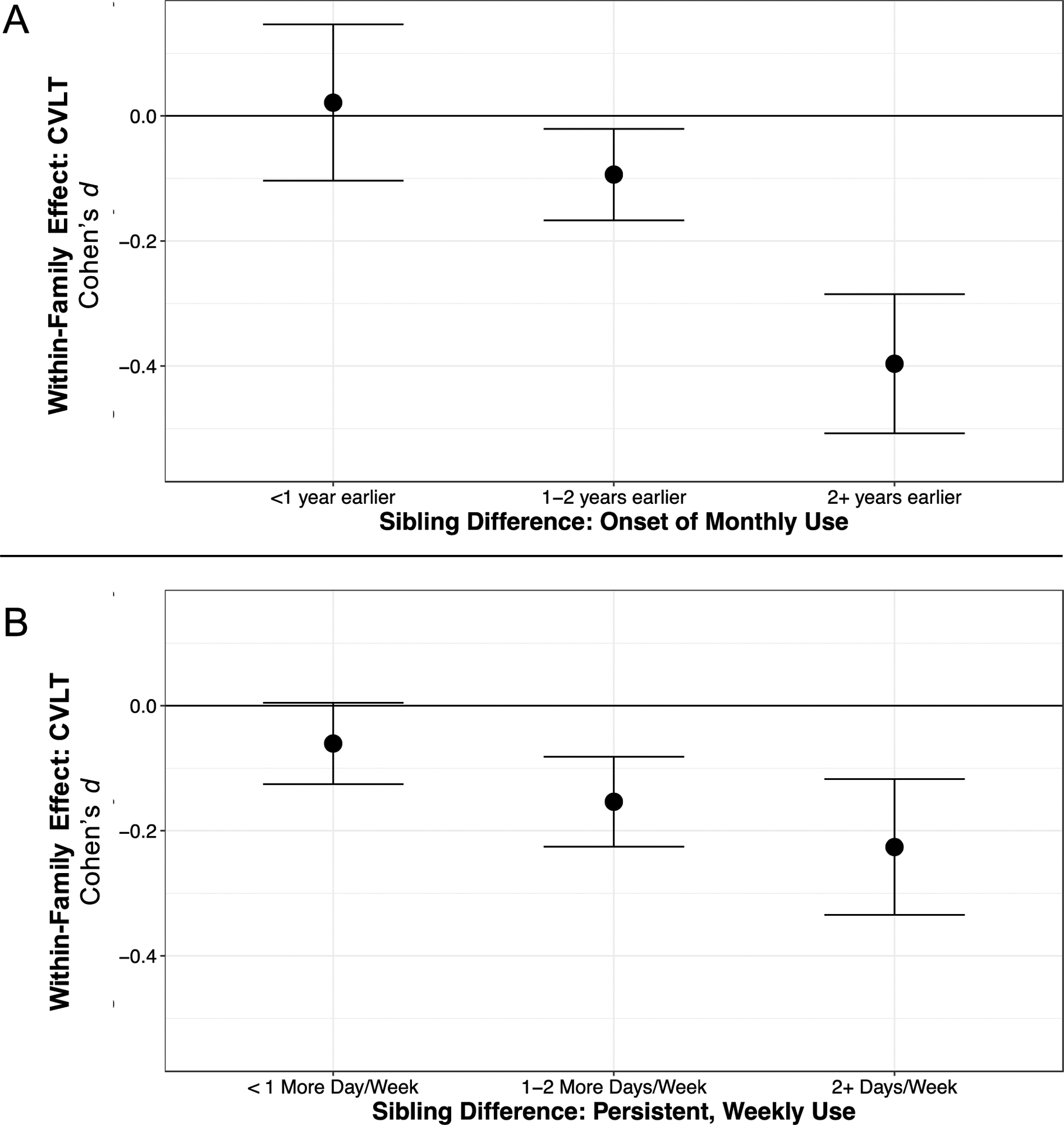
Findings: After correcting for multiple testing, a greater frequency and earlier onset of regular cannabis use were associated with poorer cognitive performance, specifically on tests of verbal memory. Further, after accounting for familial factors shared by siblings and alcohol use, poorer verbal memory performance was still associated with greater life-time frequency of cannabis use at wave 1 [b = -0.007 (-0.002, -0.012), adjusted P = 0.036]; earlier cannabis use at wave 2 [b = -0.12 (-0.05, -0.19), adjusted P = 0.006; b = -0.14 (-0.06, -0.23), adjusted P = 0.006]; and greater frequency of past 6 months use at wave 2 [b = -0.02 (-0.01, -0.03), adjusted P = 0.002; b = -0.02 (-0.01, -0.03), adjusted P = 0.008].
Conclusions: Moderate adolescent cannabis use may have adverse effects on cognitive functioning, specifically verbal memory, that cannot be explained by familial factors.
Keywords: Adolescents; cannabis; cognitive; family; marijuana; sibling.
© 2020 Society for the Study of Addiction.
Conflict of interest statement
Figures
References
-
- Fergusson DM, Horwood LJ, Swain-Campbell N. Cannabis use and psychosocial adjustment in adolescence and young adulthood. Addiction. 2002;97(9):1123–1135. - PubMed
-
- Lynskey M, Hall W. The effects of adolescent cannabis use on educational attainment: A review. Addiction. 2000;95(11):1621–1630. - PubMed
Publication types
MeSH terms
Grants and funding
LinkOut - more resources
Full Text Sources
Medical
Miscellaneous
