. 2020 Nov;13(6):1087-1095.
doi: 10.1111/cts.12880. Epub 2020 Oct 15.

The Potential of Low Molecular Weight Heparin to Mitigate Cytokine Storm in Severe COVID-19 Patients: A Retrospective Cohort Study

Affiliations

The Potential of Low Molecular Weight Heparin to Mitigate Cytokine Storm in Severe COVID-19 Patients: A Retrospective Cohort Study

Chen Shi et al. Clin Transl Sci. 2020 Nov.

Abstract

On March 11, 2020, the World Health Organization declared its assessment of coronavirus disease 2019 (COVID-19) as a global pandemic. However, specific anti-severe acute respiratory syndrome-coronavirus 2 (SARS-CoV-2) drugs are still under development, and patients are managed by multiple complementary treatments. We performed a retrospective analysis to compare and evaluate the effect of low molecular weight heparin (LMWH) treatment on disease progression. For this purpose, the clinical records and laboratory indicators were extracted from electronic medical records of 42 patients with COVID-19 (21 of whom were treated with LMWH, and 21 without LMWH) hospitalized (Union Hospital of Huazhong University of Science and Technology) from February 1 to March 15, 2020. Changes in the percentage of lymphocytes before and after LMWH treatment were significantly different from those in the control group (P = 0.011). Likewise, changes in the levels of D-dimer and fibrinogen degradation products in the LMWH group before and after treatment were significantly different from those in the control group (P = 0.035). Remarkably, IL-6 levels were significantly reduced after LMWH treatment (P = 0.006), indicating that, besides other beneficial properties, LMWH may exert an anti-inflammatory effect and attenuate in part the "cytokine storm" induced by the virus. Our results support the use of LMWH as a potential therapeutic drug for the treatment of COVID-19, paving the way for a subsequent well-controlled clinical study.


Conflict of interest statement

The authors declared no competing interests for this work.

Figures
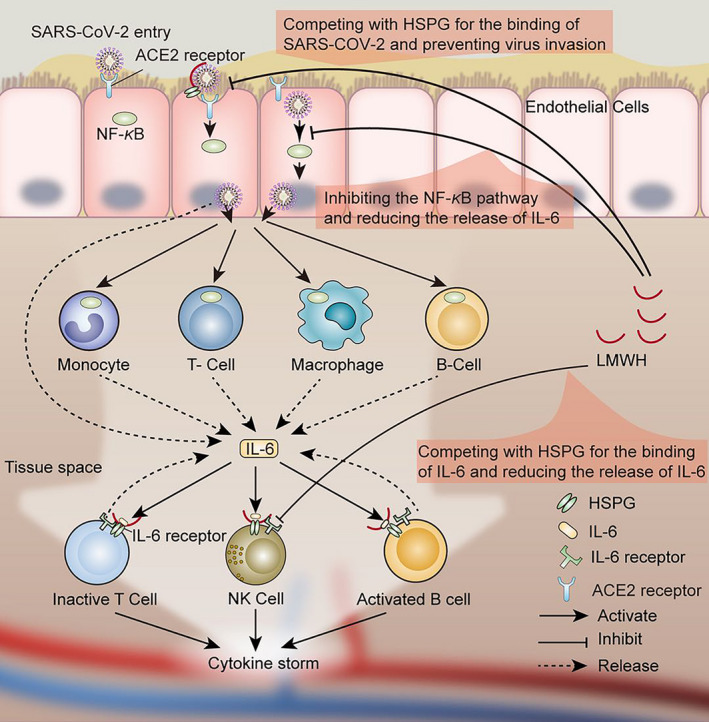
Figure 1
Figure 1
Possible mechanism of anti‐inflammatory effects of low molecular weight heparin (LMWH) in patients with coronavirus disease 2019 (COVID‐19). Under conventional antiviral treatment regimens, LMWH improves hypercoagulability, inhibits IL‐6 release, and attenuates IL‐6 biological activity. It has potential antiviral effects and helps delay or block inflammatory cytokine storms. LMWH can increases the lymphocyte% in the patients. The multiple effects of LMWH encourages its application for the treatment of patients with COVID‐19. HSPG, heparin sulfate proteoglycan; SARS‐CoV‐2, severe acute respiratory syndrome‐coronavirus 2.
Figure 2
Figure 2
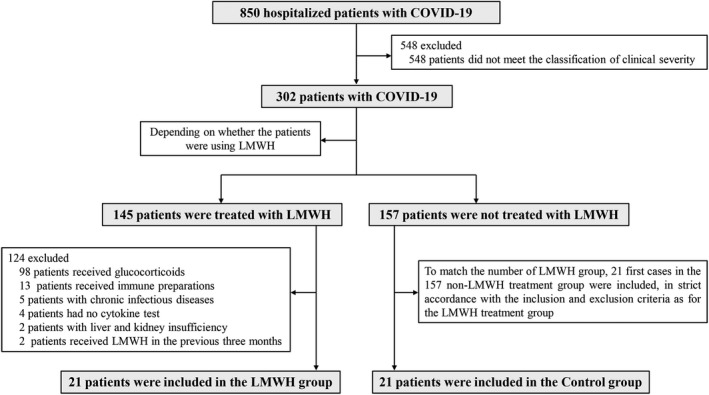
Flow chart for the inclusion and exclusion of patients with coronavirus disease 2019 (COVID‐19). Based on strict inclusion and exclusion criteria, 42 patients with COVID‐19 treated at the hospital between February 1, 2020, and March 15, 2020, were selected for the study, of which 21 underwent low molecular weight heparin (LMWH) treatment (LMWH group) and 21 did not (control group) during hospitalization.
Figure 3
Figure 3
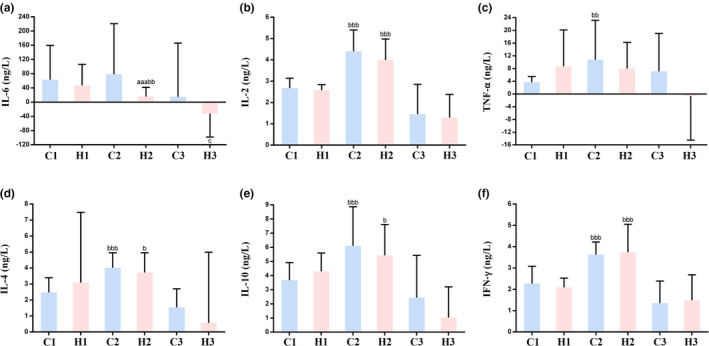
Effect of low molecular weight heparin (LMWH) on inflammatory cytokines in the included patients with coronavirus disease 2019 (COVID‐19). (a–f) IL‐6 (a), IL‐2 (b), TNF‐α (c), IL‐4 (d), IL‐10 (e), and IFN‐γ (f) levels in the two groups of patients with COVID‐19. Data are expressed as mean ± SD (n = 21). C1 vs. H1 or C2 vs. H2, a P < 0.05, aa P < 0.01, aaa P < 0.001; C1 vs. C2 or H1 vs. H2, b P < 0.05, bb P < 0.01, bbb P < 0.001; C3 vs. H3, c P < 0.05, cc P < 0.01, ccc P < 0.001. (C1: control group, indices at admission; C2: control group, indices at discharge; C3: control group, changes in indices during hospitalization; H1: LMWH group, indices before LMWH treatment; H2: LMWH group, indices after LMWH treatment; H3: LMWH group, changes in indices before and after LMWH treatment).
Figure 4
Figure 4
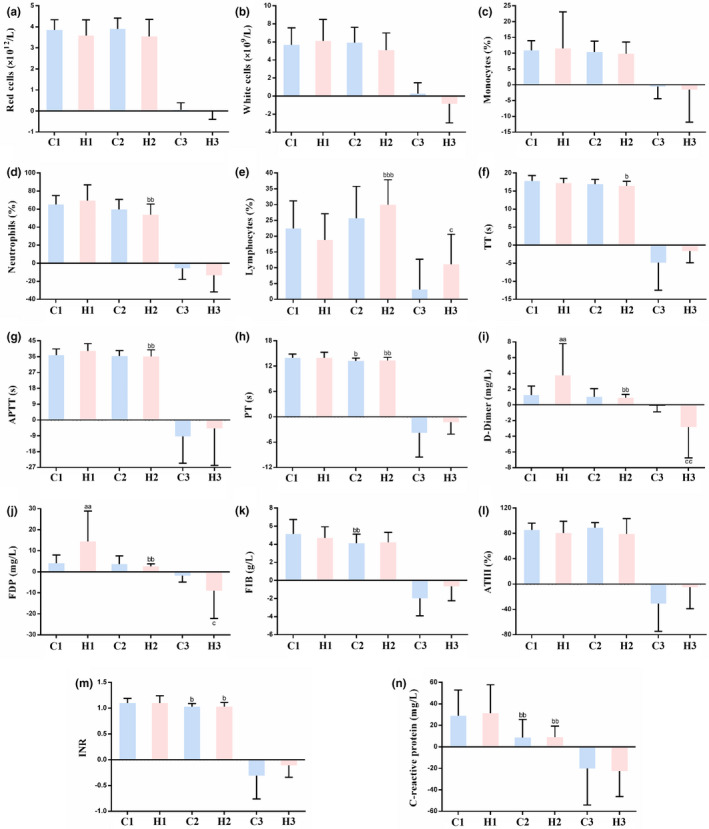
Effect of low molecular weight heparin (LMWH) on complete blood count, coagulation profile, and C‐reactive protein (CRP) in the included patients with coronavirus disease 2019 (COVID‐19). (a–n) Red blood cells (a), white blood cells (b), monocytes% (c), neutrophils% (d), lymphocytes% (e), thrombin time (TT, f), activated partial thromboplastin time (APTT, g), prothrombin time (PT, h), D‐dimer (i), fibrinogen degradation products (FDP, j), fibrinogen (FIB, k), antithrombin III (AT III, l), international normalized ratio (INR, m) and CRP (n) levels in patients with COVID‐19. Data are expressed as mean ± SD (n = 21). C1 vs. H1 or C2 vs. H2, a P < 0.05, aa P < 0.01, aaa P < 0.001; C1 vs. C2 or H1 vs. H2, b P < 0.05, bb P < 0.01, bbb P < 0.001; C3 vs. H3, c P < 0.05, cc P < 0.01, ccc P < 0.001. (C1: control group, indices at admission; C2: control group, indices at discharge; C3: control group, changes in indices during hospitalization; H1: LMWH group, indices before LMWH treatment; H2: LMWH group, indices after LMWH treatment; H3: LMWH group, changes in indices before and after LMWH treatment.)

References

    1. Wang, C. , Horby, P.W. , Hayden, F.G. & Gao, G.F. A novel coronavirus outbreak of global health concern. Lancet 395, 470–473 (2020). - PMC - PubMed
    1. Huang, C. et al Clinical features of patients infected with 2019 novel coronavirus in Wuhan, China. Lancet 395, 497–506 (2020). - PMC - PubMed
    1. Zhou, W. et al Potential benefits of precise corticosteroids therapy for severe 2019‐nCoV pneumonia. Signal Transduct. Target. Ther. 5, 18 (2020). - PMC - PubMed
    1. Tan, L.I. et al Lymphopenia predicts disease severity of COVID‐19: a descriptive and predictive study. Signal Transduct Target Ther. 5, 33 (2020). - PMC - PubMed
    1. Liao, Y.C. , Liang, W.G. , Chen, F.W. , Hsu, J.H. , Yang, J.J. & Chang, M.S. IL‐19 induces production of IL‐6 and TNF‐alpha and results in cell apoptosis through TNF‐alpha. J. Immunol. 169, 4288–4297 (2002). - PubMed

Publication types