


Positive parenting approaches and their association with child eating and weight: A narrative review from infancy to adolescence
- PMID: 32881344
- PMCID: PMC8018716
- DOI: 10.1111/ijpo.12722
Positive parenting approaches and their association with child eating and weight: A narrative review from infancy to adolescence
Abstract
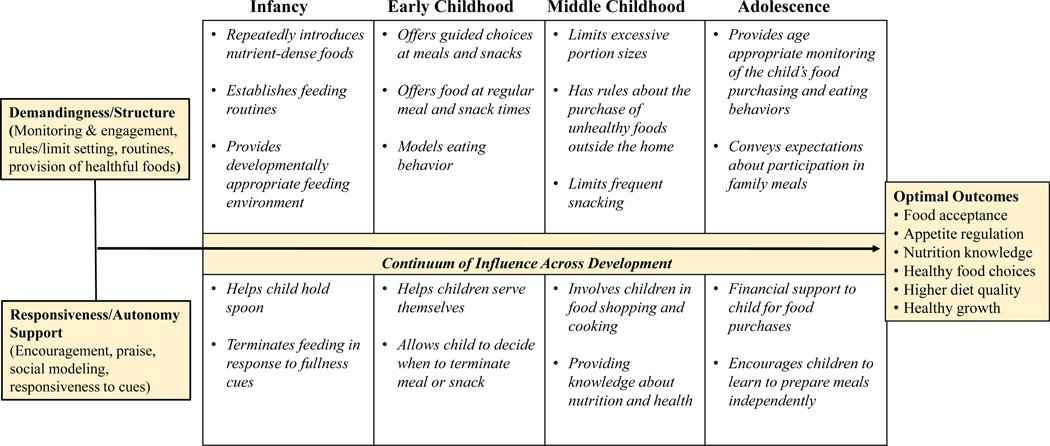
Parents play a critical role in the development of children's eating behaviours and weight status, serving as providers, models and regulators of the food environment. Many research reviews have focused on the robust body of evidence on coercive control in feeding: how parenting practices such as restriction and pressure to eat increase children's risk for developing undesirable eating behaviours and unhealthy weight outcomes. Fewer reviews adopt a strengths-based perspective focusing on the ways that parents can actively support the development of healthy eating behaviours and weight trajectories. Emerging research on such positive parenting styles and practices offers solutions beyond the avoidance of coercive control, as well as opportunities to highlight parallels between research on food parenting and the broader, well-established developmental literature on positive parenting. The focus of this review is to summarize what is known regarding benefits of positive parenting styles and practices for child eating and weight outcomes and discuss recommendations for future research. Current evidence supports starting with responsive feeding and parenting during infancy and incorporating structure and limit setting in early childhood, with monitoring and mealtime structure remaining important during middle childhood and adolescence. Areas for future research include: (1) further examination of the implications of identified food parenting practices and styles among diverse groups and caregivers; (2) increased consideration of child factors (eg, temperament) as moderators or mediators; and (3) further clarification of the relationship between general parenting and food parenting.
Keywords: adolescence; childhood; infancy; parent feeding; positive parenting.
© 2020 World Obesity Federation.
Conflict of interest statement
Conflicts of Interest
The authors report no conflict of interest.
Figures
References
-
- Faith MS, Van Horn L, Appel LJ, et al. Evaluating parents and adult caregivers as “agents of change” for treating obese children: evidence for parent behavior change strategies and research gaps: a scientific statement from the American Heart Association. Circulation. 2012;125(9):1186–1207. - PubMed
-
- Whitaker RC, Wright JA, Pepe MS, Seidel KD, Dietz WH. Predicting obesity in young adulthood from childhood and parental obesity. New England journal of medicine. 1997;337(13):869–873. - PubMed
-
- Birch LL, Fisher JO. Development of eating behaviors among children and adolescents. Pediatrics. 1998;101(Supplement 2):539–549. - PubMed
Publication types
MeSH terms
Grants and funding
LinkOut - more resources
Full Text Sources
Medical
