


BIOSOLVE-IV-registry: Safety and performance of the Magmaris scaffold: 12-month outcomes of the first cohort of 1,075 patients
- PMID: 32881396
- PMCID: PMC8359313
- DOI: 10.1002/ccd.29260
BIOSOLVE-IV-registry: Safety and performance of the Magmaris scaffold: 12-month outcomes of the first cohort of 1,075 patients
Abstract
Objectives: We aimed to assess the safety and performance of the Magmaris sirolimus-eluting bioresorbable magnesium scaffold in a large patient population.
Background: Magmaris has shown good outcomes in small-sized controlled trials, but further data are needed to confirm its usability, safety, and performance.
Methods: BIOSOLVE-IV is an international, single arm, multicenter registry including patients with a maximum of two single de novo lesions. Follow-up is scheduled up to 5 years; the primary outcome is target lesion failure (TLF) at 12 months.
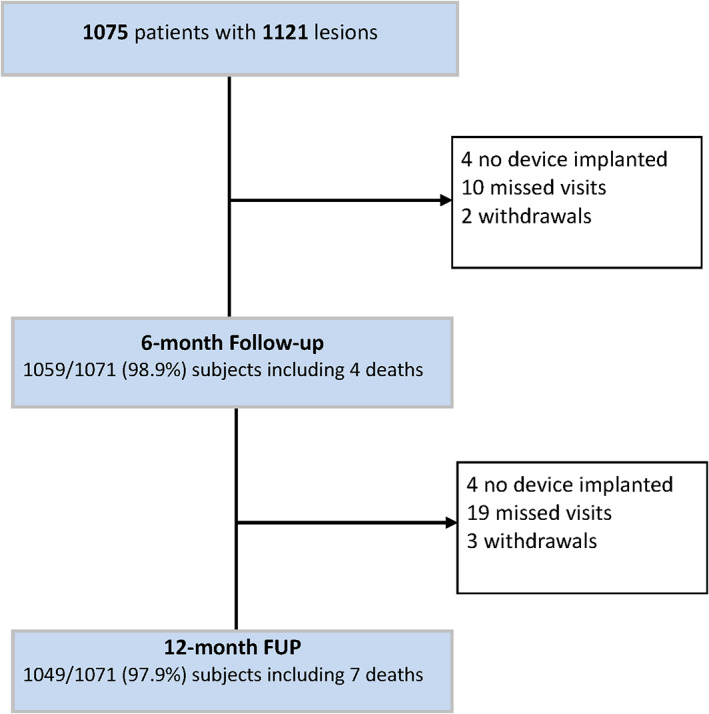
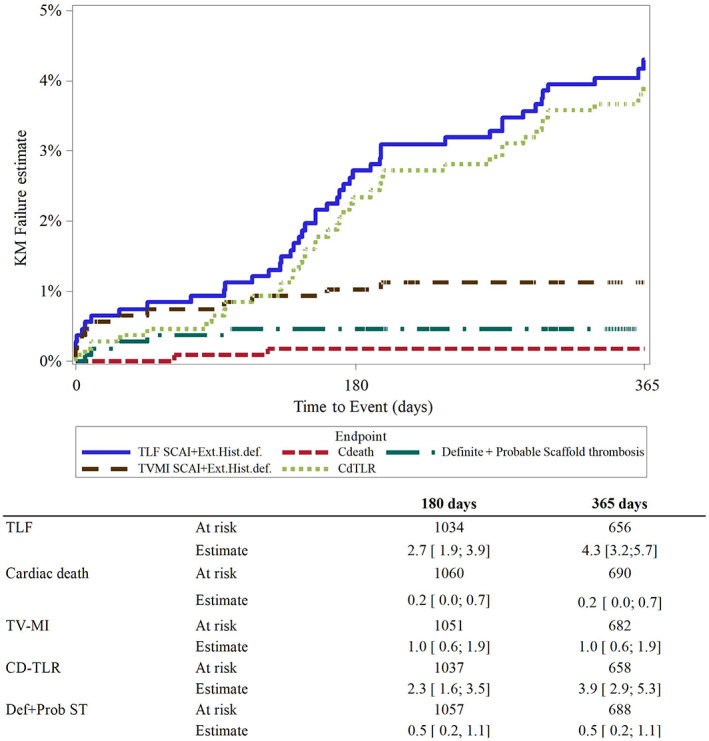
Results: A total of 1,075 patients with 1,121 lesions were enrolled. Mean patient age was 61.3 ± 10.5 years and 19.2% (n = 206) presented with non-ST-elevation myocardial infarction (NSTEMI). Lesions were 3.2 ± 0.3 mm in diameter and 14.9 ± 4.2 mm long; 5.1% (n = 57) were bifurcation lesions. Device success was 97.3% (n = 1,129) and procedure success 98.9% (n = 1,063). The Kaplan-Meier estimate of TLF at 12 months was 4.3% [95% confidence interval, CI: 3.2, 5.7] consisting of 3.9% target lesion revascularizations, 0.2% cardiac death, and 1.1% target-vessel myocardial infarction. Definite/probable scaffold thrombosis occurred in five patients (0.5% [95% CI: 0.2, 1.1]), thereof four after early discontinuation of antiplatelet/anticoagulation therapy.
Conclusion: BIOSOLVE-IV confirms the safety and performance of the Magmaris scaffold in a large population with excellent device and procedure success and a very good safety profile up to 12 months in a low-risk population.
Keywords: NSTEMI; bioresorbable scaffolds; coronary artery disease; magnesium; sirolimus.
© 2020 The Authors. Catheterization and Cardiovascular Interventions published by Wiley Periodicals LLC.
Conflict of interest statement
S.V. reports speaking fees from Biotronik, Elixir Medical, and Neovasc; M.H. reports study grants and personal fees from Biotronik, Abbott Vascular, Cardiac dimensions, and Philips, A.A.B.N. reports grants from Biotronik. J.B. has received research grants and speaking fees from Abbott Vascular and Biotronik AG. All other authors reported no conflict of interest.
Figures
References
-
- Katagiri Y, Stone G, Onuma Y, Serruys P. State of the art: the inception, advent and future of fully bioresorbable scaffolds. EuroIntervention. 2017;13:734‐750. - PubMed
-
- Serruys PW, Ormiston J, van Geuns RJ, et al. A polylactide bioresorbable scaffold eluting everolimus for treatment of coronary stenosis: 5‐year follow‐up. J Am Coll Cardiol. 2016;67:766‐776. - PubMed
-
- Onuma Y, Dudek D, Thuesen L, et al. Five‐year clinical and functional multislice computed tomography angiographic results after coronary implantation of the fully resorbable polymeric everolimus‐eluting scaffold in patients with de novo coronary artery disease: the ABSORB cohort a trial. JACC Cardiovasc Interv. 2013;6:999‐1009. - PubMed
-
- Lipinski MJ, Escarcega RO, Baker NC, et al. Scaffold thrombosis after percutaneous coronary intervention with ABSORB bioresorbable vascular scaffold: a systematic review and meta‐analysis. JACC Cardiovasc Interv. 2016;9:12‐24. - PubMed
-
- Stone GW, Ellis SG, Gori T, et al. Blinded outcomes and angina assessment of coronary bioresorbable scaffolds: 30‐day and 1‐year results from the ABSORB IV randomised trial. Lancet. 2018;392:1530‐1540. - PubMed
