Intrinsic Laryngeal Muscle Response to a Public Speech Preparation Stressor: Personality and Autonomic Predictors
- PMID: 32881649
- PMCID: PMC7890219
- DOI: 10.1044/2020_JSLHR-19-00402
Intrinsic Laryngeal Muscle Response to a Public Speech Preparation Stressor: Personality and Autonomic Predictors
Abstract
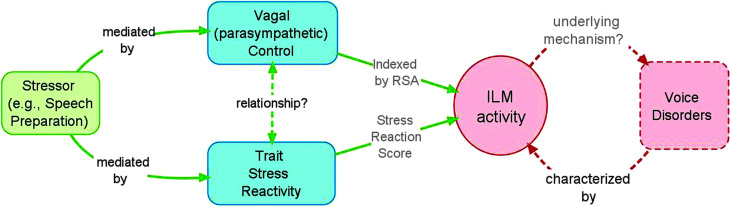
Purpose Laboratory stressors have been shown to impact the activity of the intrinsic laryngeal muscles (ILMs), which may be part of the final causal pathway in some stress-induced voice disorders. Previous research suggests that personality traits such as stress reaction might increase one's susceptibility to these problems. Also, the autonomic nervous system response is implicated in the pathogenesis of voice disorders putatively involving ILM hyperfunction. The purpose of this study was to investigate personality and autonomic nervous system predictors of ILM responses to stressor exposure. Method Thirty-seven physically and vocally healthy female adults completed a personality questionnaire and were subjected to a speech preparation task intended to induce stress. Fine wire electromyography of the ILMs was performed so that the activity of these muscles could be measured prior to and during the stressor. Participants' trait stress reaction was measured as a personality-based predictive variable, as was respiratory-corrected respiratory sinus arrhythmia, a putative measure of vagal outflow to the heart. Results The personality measure trait stress reaction uniquely predicted thyroarytenoid, trapezius, and tibialis activity, whereas respiratory sinus arrhythmia uniquely predicted the activity of all muscles studied. Differences were observed in the autonomic predictor variable as a function of whether or not effects of respiration were accounted for in the variable's calculation. Conclusions This study explores the potential mediating roles of personality and autonomic function in ILM activity during a stressor. Both variables have value in predicting ILM activity during stressor exposure.
Figures
References
-
- Aronson, A. (1980). Clinical voice disorders: An interdisciplinary approach. Brian C. Decker.
-
- Berntson, G. G. , Bigger, J. T., Jr. , Eckberg, D. L. , Grossman, P. , Kaufmann, P. G. , Malik, M. , Nagaraja, H. N. , Porges, S. W. , Saul, J. P. , Stone, P. H. , & van der Molen, M. W. (1997). Heart rate variability: Origins, methods, and interpretive caveats. Psychophysiology, 34(6), 623–648. https://doi.org/10.1111/j.1469-8986.1997.tb02140.x - PubMed
-
- Berntson, G. G. , Cacioppo, J. T. , & Quigley, K. S. (1991). Autonomic determinism: The modes of autonomic control, the doctrine of autonomic space, and the laws of autonomic constraint. Psychological Review, 98(4), 459–487. https://doi.org/10.1037/0033-295X.98.4.459 - PubMed
-
- Cohen, S. , & Hamrick, N. (2003). Stable individual differences in physiological response to stressors: Implications for stress-elicited changes in immune related health. Brain, Behavior, and Immunity, 17(6), 407–414. https://doi.org/10.1016/S0889-1591(03)00110-7 - PubMed
-
- Davis, M. , Montgomery, I. , & Wilson, G. (2002). Worry and heart rate variables: Autonomic rigidity under challenge. Journal of Anxiety Disorders, 16(6), 639–659. https://doi.org/10.1016/S0887-6185(02)00132-9 - PubMed
Publication types
MeSH terms
Grants and funding
LinkOut - more resources
Full Text Sources