


A standardized framework for testing the performance of sleep-tracking technology: step-by-step guidelines and open-source code
- PMID: 32882005
- PMCID: PMC7879416
- DOI: 10.1093/sleep/zsaa170
A standardized framework for testing the performance of sleep-tracking technology: step-by-step guidelines and open-source code
Abstract
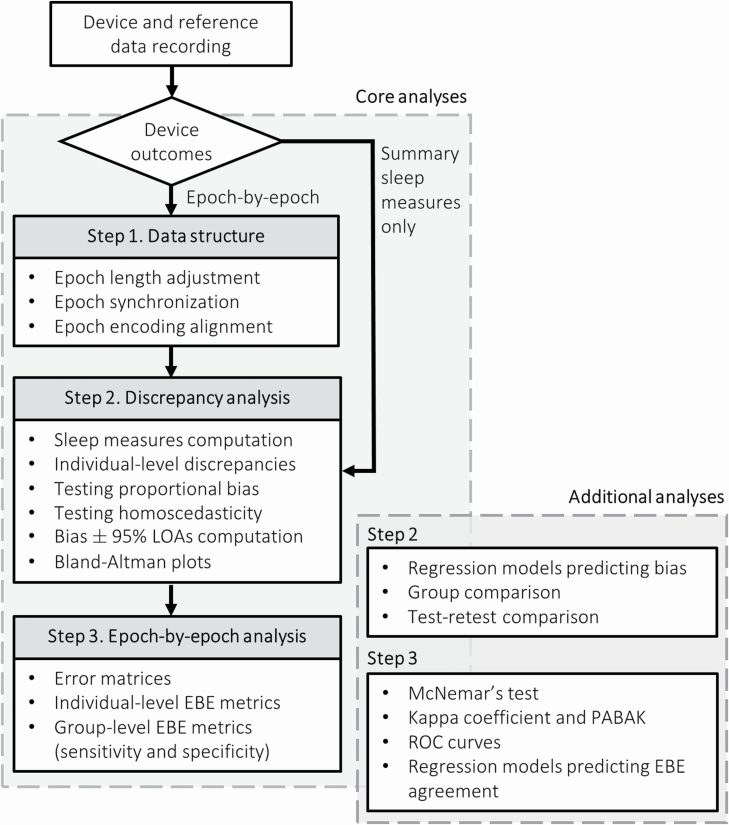
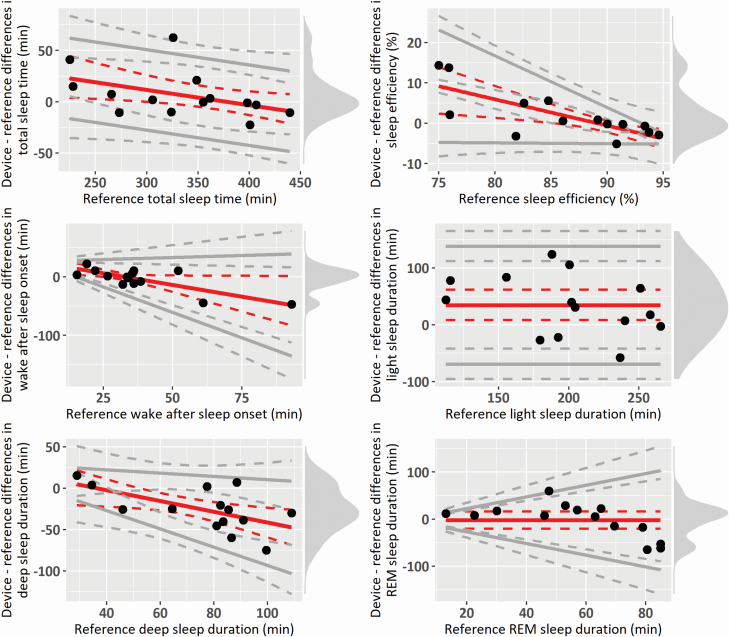
Sleep-tracking devices, particularly within the consumer sleep technology (CST) space, are increasingly used in both research and clinical settings, providing new opportunities for large-scale data collection in highly ecological conditions. Due to the fast pace of the CST industry combined with the lack of a standardized framework to evaluate the performance of sleep trackers, their accuracy and reliability in measuring sleep remains largely unknown. Here, we provide a step-by-step analytical framework for evaluating the performance of sleep trackers (including standard actigraphy), as compared with gold-standard polysomnography (PSG) or other reference methods. The analytical guidelines are based on recent recommendations for evaluating and using CST from our group and others (de Zambotti and colleagues; Depner and colleagues), and include raw data organization as well as critical analytical procedures, including discrepancy analysis, Bland-Altman plots, and epoch-by-epoch analysis. Analytical steps are accompanied by open-source R functions (depicted at https://sri-human-sleep.github.io/sleep-trackers-performance/AnalyticalPipeline_v1.0.0.html). In addition, an empirical sample dataset is used to describe and discuss the main outcomes of the proposed pipeline. The guidelines and the accompanying functions are aimed at standardizing the testing of CSTs performance, to not only increase the replicability of validation studies, but also to provide ready-to-use tools to researchers and clinicians. All in all, this work can help to increase the efficiency, interpretation, and quality of validation studies, and to improve the informed adoption of CST in research and clinical settings.
Keywords: accuracy; consumer sleep technology; guidelines; open source code; validation; wearable sleep trackers.
© Sleep Research Society 2020. Published by Oxford University Press on behalf of the Sleep Research Society. All rights reserved. For permissions, please e-mail journals.permissions@oup.com.
Figures
Comment in
-
Miles to go before we sleep…a step toward transparent evaluation of consumer sleep tracking devices.Sleep. 2021 Feb 12;44(2):zsab020. doi: 10.1093/sleep/zsab020. Sleep. 2021. PMID: 33576422 No abstract available.
References
-
- Ibáñez V, et al. Sleep assessment devices: types, market analysis, and a critical view on accuracy and validation. Expert Rev Med Devices. 2019;16(12):1041–1052. - PubMed
