


rs641738C>T near MBOAT7 is associated with liver fat, ALT and fibrosis in NAFLD: A meta-analysis
- PMID: 32882372
- PMCID: PMC7755037
- DOI: 10.1016/j.jhep.2020.08.027
rs641738C>T near MBOAT7 is associated with liver fat, ALT and fibrosis in NAFLD: A meta-analysis
Abstract
Background & aims: A common genetic variant near MBOAT7 (rs641738C>T) has been previously associated with hepatic fat and advanced histology in NAFLD; however, these findings have not been consistently replicated in the literature. We aimed to establish whether rs641738C>T is a risk factor across the spectrum of NAFLD and to characterise its role in the regulation of related metabolic phenotypes through a meta-analysis.
Methods: We performed a meta-analysis of studies with data on the association between rs641738C>T genotype and liver fat, NAFLD histology, and serum alanine aminotransferase (ALT), lipids or insulin. These included directly genotyped studies and population-level data from genome-wide association studies (GWAS). We performed a random effects meta-analysis using recessive, additive and dominant genetic models.
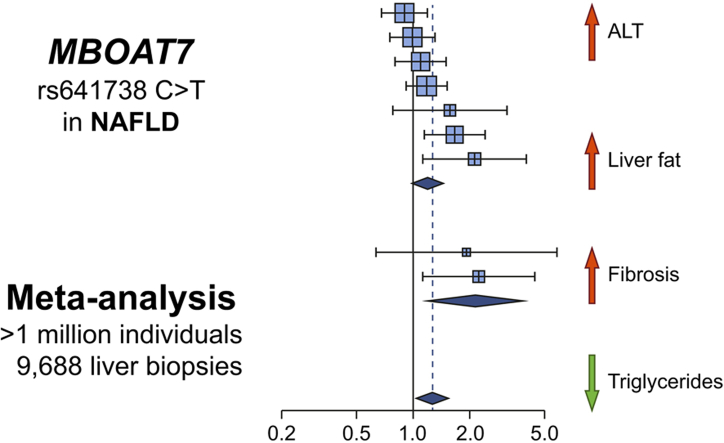
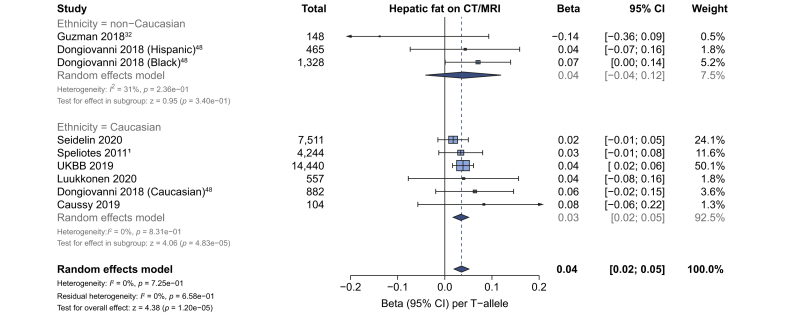
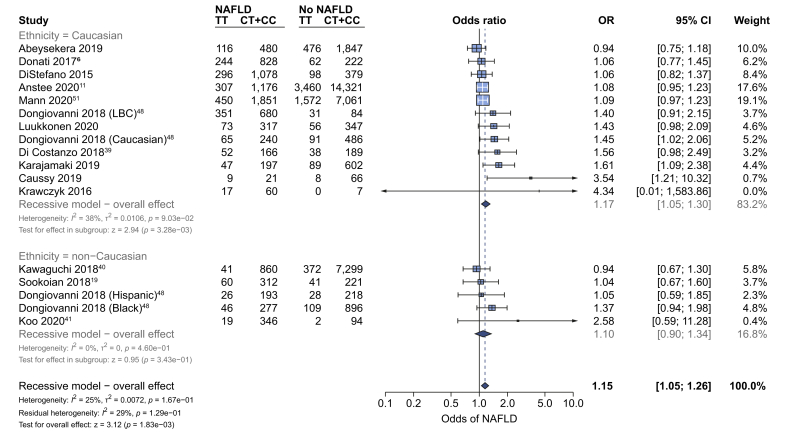
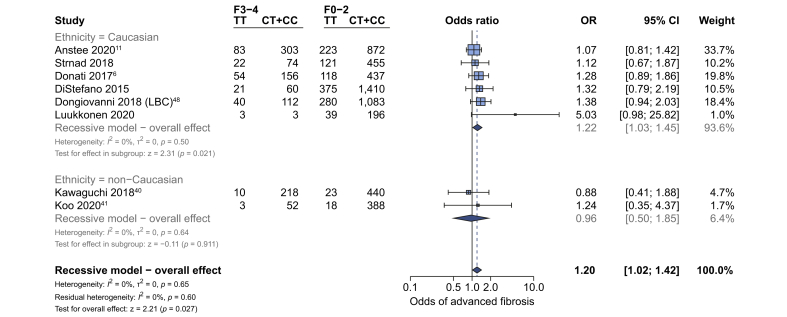
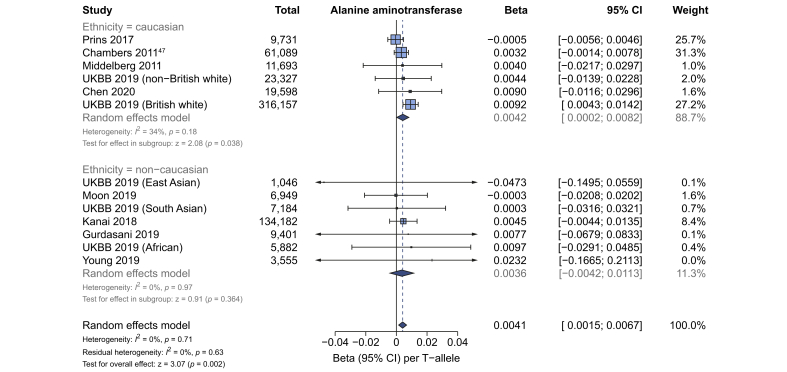
Results: Data from 1,066,175 participants (9,688 with liver biopsies) across 42 studies were included in the meta-analysis. rs641738C>T was associated with higher liver fat on CT/MRI (+0.03 standard deviations [95% CI 0.02-0.05], pz = 4.8×10⁻⁵) and diagnosis of NAFLD (odds ratio [OR] 1.17 [95% CI 1.05-1.3], pz = 0.003) in Caucasian adults. The variant was also positively associated with presence of advanced fibrosis (OR 1.22 [95% CI 1.03-1.45], pz = 0.021) in Caucasian adults using a recessive model of inheritance (CC + CT vs. TT). Meta-analysis of data from previous GWAS found the variant to be associated with higher ALT (pz = 0.002) and lower serum triglycerides (pz = 1.5×10⁻⁴). rs641738C>T was not associated with fasting insulin and no effect was observed in children with NAFLD.
Conclusions: Our study validates rs641738C>T near MBOAT7 as a risk factor for the presence and severity of NAFLD in individuals of European descent.
Lay summary: Fatty liver disease is a common condition where fat builds up in the liver, which can cause liver inflammation and scarring (including 'cirrhosis'). It is closely linked to obesity and diabetes, but some genes are also thought to be important. We did this study to see whether one specific change ('variant') in one gene ('MBOAT7') was linked to fatty liver disease. We took data from over 40 published studies and found that this variant near MBOAT7 is linked to more severe fatty liver disease. This means that drugs designed to work on MBOAT7 could be useful for treating fatty liver disease.
Keywords: ALSPAC; Diabetes; Fibrosis; MBOAT7; NAFLD; Triglyceride.
Copyright © 2020 European Association for the Study of the Liver. Published by Elsevier B.V. All rights reserved.
Conflict of interest statement
Conflict of interest C.E. reports receiving personal fees from Navitor Pharma and Novartis. The other authors declare no conflicts of interest that pertain to this work. Please refer to the accompanying ICMJE disclosure forms for further details.
Figures

References
-
- Romeo S., Sanyal A., Valenti L. Leveraging human genetics to identify potential new treatments for fatty liver disease. Cell Metab. 2020;31:35–45. - PubMed
-
- Buch S., Stickel F., Trépo E., Way M., Herrmann A., Nischalke H.D. A genome-wide association study confirms PNPLA3 and identifies TM6SF2 and MBOAT7 as risk loci for alcohol-related cirrhosis. Nat Genet. 2015;47:1443–1448. - PubMed
Publication types
MeSH terms
Substances
Grants and funding
- MC_PC_19009/MRC_/Medical Research Council/United Kingdom
- UL1 TR002548/TR/NCATS NIH HHS/United States
- R01 DK111038/DK/NIDDK NIH HHS/United States
- UL1 TR000448/TR/NCATS NIH HHS/United States
- UL1 TR000423/TR/NCATS NIH HHS/United States
- U01 DK061731/DK/NIDDK NIH HHS/United States
- 206274/Z/17/Z/WT_/Wellcome Trust/United Kingdom
- R01 DK091601/DK/NIDDK NIH HHS/United States
- UL1 TR000058/TR/NCATS NIH HHS/United States
- UL1 TR000439/TR/NCATS NIH HHS/United States
- R01 HL060944/HL/NHLBI NIH HHS/United States
- UL1 TR000436/TR/NCATS NIH HHS/United States
- UL1 TR001881/TR/NCATS NIH HHS/United States
- R01 DK118062/DK/NIDDK NIH HHS/United States
- U01 DK061738/DK/NIDDK NIH HHS/United States
- UL1 TR001863/TR/NCATS NIH HHS/United States
- R01 DK085175/DK/NIDDK NIH HHS/United States
- 216329/Z/19/Z/WT_/Wellcome Trust/United Kingdom
- R01 DK114504/DK/NIDDK NIH HHS/United States
- U01 DK061718/DK/NIDDK NIH HHS/United States
- R01 HL060919/HL/NHLBI NIH HHS/United States
- U01 DK061737/DK/NIDDK NIH HHS/United States
- MC_UU_12015/1/MRC_/Medical Research Council/United Kingdom
- UL1 TR000006/TR/NCATS NIH HHS/United States
- U01 DK061732/DK/NIDDK NIH HHS/United States
- R01 HL061019/HL/NHLBI NIH HHS/United States
- MC_PC_15018/MRC_/Medical Research Council/United Kingdom
- U01 DK061713/DK/NIDDK NIH HHS/United States
- R01 HL060894/HL/NHLBI NIH HHS/United States
- MC UU 12015/5/MRC_/Medical Research Council/United Kingdom
- U01 DK061730/DK/NIDDK NIH HHS/United States
- R01 HD028016/HD/NICHD NIH HHS/United States
- UL1 TR000100/TR/NCATS NIH HHS/United States
- P30 DK045735/DK/NIDDK NIH HHS/United States
- R01 AA018333/AA/NIAAA NIH HHS/United States
- UL1 TR002319/TR/NCATS NIH HHS/United States
- P30 DK063491/DK/NIDDK NIH HHS/United States
- MR/L022206/1/MRC_/Medical Research Council/United Kingdom
- U01 DK061728/DK/NIDDK NIH HHS/United States
- UL1 TR001105/TR/NCATS NIH HHS/United States
- UL1 TR002345/TR/NCATS NIH HHS/United States
- UL1 TR000004/TR/NCATS NIH HHS/United States
- G9815508/MRC_/Medical Research Council/United Kingdom
- U01 DK061734/DK/NIDDK NIH HHS/United States
LinkOut - more resources
Full Text Sources
Other Literature Sources
Medical
Miscellaneous
