Peri-implantitis Update: Risk Indicators, Diagnosis, and Treatment
- PMID: 32882741
- PMCID: PMC7536094
- DOI: 10.1055/s-0040-1715779
Peri-implantitis Update: Risk Indicators, Diagnosis, and Treatment
Abstract
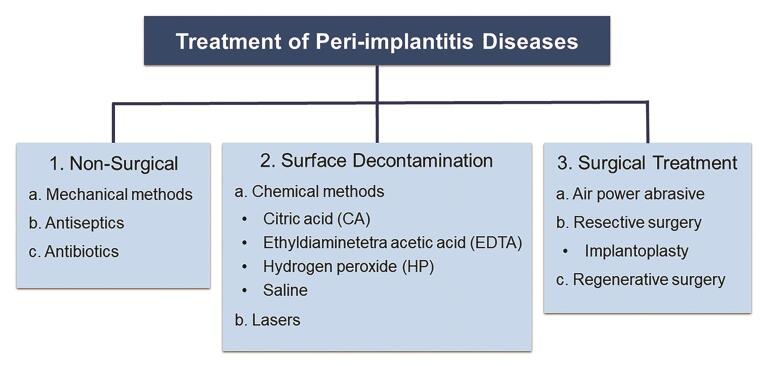
Despite the success rates of dental implants, peri-implantitis presents as the most common complication in implant dentistry. This review discusses various factors associated with peri-implantitis and various available treatments, highlighting their advantages and disadvantages. Relevant articles on peri-implantitis published in English were reviewed from August 2010 to April 2020 in MEDLINE/PubMed, Scopus, and ScienceDirect. The identified risk indicators of peri-implant diseases are plaque, smoking, history of periodontitis, surface roughness, residual cement, emergence angle >30 degrees, radiation therapy, keratinized tissue width, and function time of the implant, sex, and diabetes. Peri-implantitis treatments can be divided into nonsurgical (mechanical, antiseptic, and antibiotics), surface decontamination (chemical and laser), and surgical (air powder abrasive, resective, and regenerative). However, mechanical debridement alone may fail to eliminate the causative bacteria, and this treatment should be combined with other treatments (antiseptics and surgical treatment). Surface decontamination using chemical agents may be used as an adjuvant treatment; however, the definitive clinical benefit is yet not proven. Laser treatment may result in a short-term decrease in periodontal pocket depth, while air powder abrasive is effective in cleaning a previously contaminated implant surface. Surgical elimination of a pocket, bone recontouring and plaque control are also effective for treating peri-implantitis. The current evidence indicates that regenerative approaches to treat peri-implant defects are unpredictable.
Conflict of interest statement
The manuscript has not been published or submitted elsewhere. The manuscript has been read and approved by all the authors.None declared.
Figures
References
-
- Amornvit P, Rokaya D, Bajracharya S, Keawcharoen K, Supavanich W. Management of obstructive sleep apnea with implant retained mandibular advancement device. World J Dent. 2014;5(03):184–189.
-
- Moraschini V, Poubel L A, Ferreira V F, Barboza E dosS. Evaluation of survival and success rates of dental implants reported in longitudinal studies with a follow-up period of at least 10 years: a systematic review. Int J Oral Maxillofac Surg. 2015;44(03):377–388. - PubMed
-
- Lee C T, Huang Y W, Zhu L, Weltman R. Prevalences of peri-implantitis and peri-implant mucositis: systematic review and meta-analysis. J Dent. 2017;62:1–12. - PubMed
-
- Berglundh T, Armitage G, Araujo M G et al. Peri-implant diseases and conditions: consensus report of workgroup 4 of the 2017 World Workshop on the Classification of Periodontal and Peri-Implant Diseases and Conditions. J Clin Periodontol. 2018;45 20:S286–S291. - PubMed
LinkOut - more resources
Full Text Sources
Other Literature Sources
Miscellaneous