Trends of Sensitization to Inhalant Allergens in Korean Children Over the Last 10 Years
- PMID: 32882764
- PMCID: PMC7471077
- DOI: 10.3349/ymj.2020.61.9.797
Trends of Sensitization to Inhalant Allergens in Korean Children Over the Last 10 Years
Abstract
Purpose: Climate and lifestyle changes increase an individual's susceptibility to various allergens and also the incidence of allergic diseases. We aimed to examine the changes in sensitization rate for aeroallergens over a 10-year period in Korean children.
Materials and methods: We retrospectively reviewed the medical records of 4493 children who visited the allergy clinic at a tertiary hospital in Korea for allergic rhinitis or asthma from January 2009 to December 2018. The serum specific immunoglobulin E (IgE) levels were measured to confirm the sensitization against Dermatophagoides farinae (D. farinae), Alternaria, weed and tree pollen mixtures, as well as cat and dog dander through ImmunoCAP test.
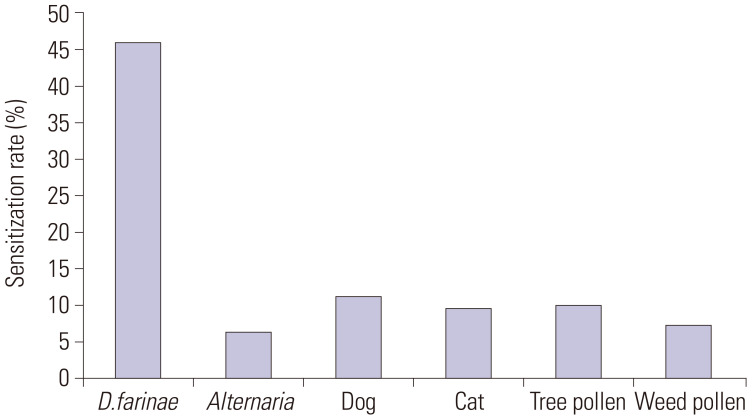
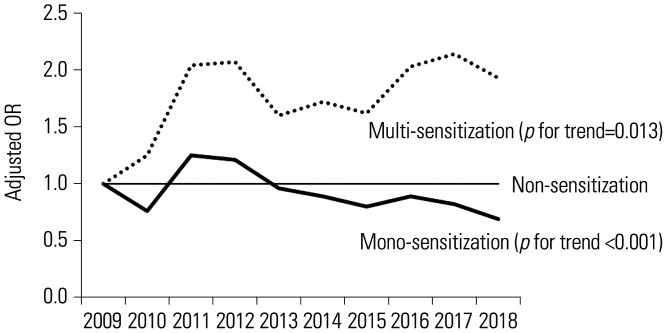
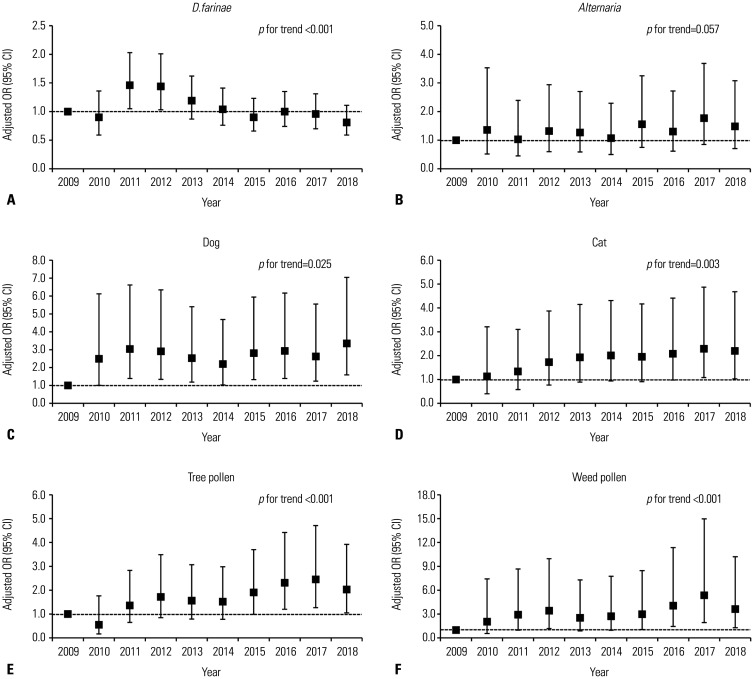
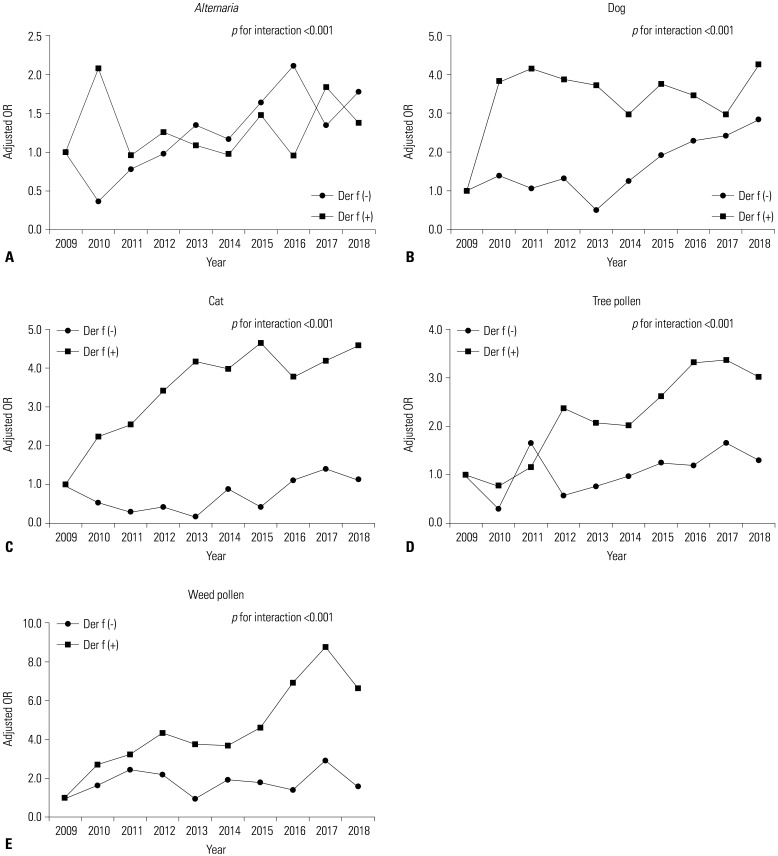
Results: D. farinae was the most common sensitizing aeroallergen (45.9%) during the 10-year span. The sensitization rate for tree pollen mixture (p for trend <0.001), weed pollen mixtures (p for trend <0.001), dog dander (p for trend=0.025), and cat dander (p for trend=0.003) showed ascending trends during the 10-year study period. Furthermore, the sensitization rate for multiple allergens (≥2) in 2018 increased significantly compared to that in 2009 (p for trend=0.013). Compared with children without sensitization to D. farinae, those with sensitization to D. farinae showed higher sensitization rates to other aeroallergens (p for interaction <0.001).
Conclusion: Children's sensitization rate to cat and dog dander and weed and tree pollen mixtures significantly increased during the 10-year period in Korea. Children with sensitization to D. farinae are likely to be sensitized to other aeroallergens as well.
Keywords: Allergy; aeroallergen; children; sensitization; specific IgE.
© Copyright: Yonsei University College of Medicine 2020.
Conflict of interest statement
The authors have no potential conflicts of interest to disclose.
Figures
References
-
- Mehulić M, Mehulić K, Vuljanko IM, Kukulj S, Grle SP, Vukić AD, et al. Changing pattern of sensitization in Croatia to aeroallergens in adult population referring to allergy clinic during a period of 15 years. Coll Antropol. 2011;35:529–536. - PubMed
-
- Linneberg A, Nielsen NH, Madsen F, Frølund L, Dirksen A, Jørgensen T. Increasing prevalence of specific IgE to aeroallergens in an adult population: two cross-sectional surveys 8 years apart: the Copenhagen Allergy Study. J Allergy Clin Immunol. 2000;106:247–252. - PubMed
-
- Ariano R, Canonica GW, Passalacqua G. Possible role of climate changes in variations in pollen seasons and allergic sensitizations during 27 years. Ann Allergy Asthma Immunol. 2010;104:215–222. - PubMed
MeSH terms
Substances
LinkOut - more resources
Full Text Sources
Medical
Miscellaneous