


Modern Techniques in Colorado Potato Beetle (Leptinotarsa decemlineata Say) Control and Resistance Management: History Review and Future Perspectives
- PMID: 32882790
- PMCID: PMC7563253
- DOI: 10.3390/insects11090581
Modern Techniques in Colorado Potato Beetle (Leptinotarsa decemlineata Say) Control and Resistance Management: History Review and Future Perspectives
Abstract
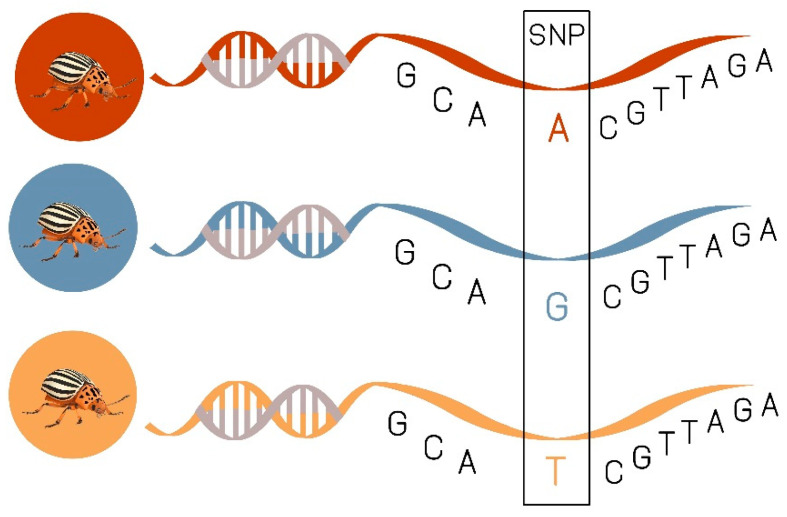
Colorado potato beetle, CPB (Leptinotarsa decemlineata Say), is one of the most important pests of the potato globally. Larvae and adults can cause complete defoliation of potato plant leaves and can lead to a large yield loss. The insect has been successfully suppressed by insecticides; however, over time, has developed resistance to insecticides from various chemical groups, and its once successful control has diminished. The number of available active chemical control substances is decreasing with the process of testing, and registering new products on the market are time-consuming and expensive, with the possibility of resistance ever present. All of these concerns have led to the search for new methods to control CPB and efficient tools to assist with the detection of resistant variants and monitoring of resistant populations. Current strategies that may aid in slowing resistance include gene silencing by RNA interference (RNAi). RNAi, besides providing an efficient tool for gene functional studies, represents a safe, efficient, and eco-friendly strategy for CPB control. Genetically modified (GM) crops that produce the toxins of Bacillus thuringiensis (Bt) have many advantages over agro-technical, mechanical, biological, and chemical measures. However, pest resistance that may occur and public acceptance of GM modified food crops are the main problems associated with Bt crops. Recent developments in the speed, cost, and accuracy of next generation sequencing are revolutionizing the discovery of single nucleotide polymorphisms (SNPs) and field of population genomics. There is a need for effective resistance monitoring programs that are capable of the early detection of resistance and successful implementation of integrated resistance management (IRM). The main focus of this review is on new technologies for CPB control (RNAi) and tools (SNPs) for detection of resistant CPB populations.
Keywords: Colorado potato beetle; GM potato; RNAi; SNPs; control strategies; resistance problem.
Conflict of interest statement
The authors declare no conflict of interest.
Figures
References
-
- Food and Agriculture Organization of the United Nations FAO STAT. [(accessed on 31 March 2020)]; Available online: http://www.fao.org/faostat/en/#data/QC/visualize.
-
- James C. Global Status of Commercialized Biotech/GM Crops. Volume 44 ISAAA; Ithaca, NY, USA: 2011.
-
- Oerke E.C. Crop losses to pests. J. Agric. Sci. 2006;144:31–43. doi: 10.1017/S0021859605005708. - DOI
-
- Radcliffe E.B., Lagnaoui A. Pests and Diseases. In: Vreugdenhil D., Bradshaw J., Gebhardt C., Govers F., Taylor M.A., MacKerron D.K., Ross H.A., editors. Potato Biology and Biotechnology: Advances and Perspectives. 1st ed. Elsevier; Oxford, UK: 2007. pp. 545–554.
-
- Weber D. Colorado beetle: Pest on the move. Pestic. Outlook. 2003;14:256–259. doi: 10.1039/b314847p. - DOI
Publication types
Grants and funding
LinkOut - more resources
Full Text Sources
Other Literature Sources
