


Association Between 90-Minute Door-to-Balloon Time, Selective Exclusion of Myocardial Infarction Cases, and Access Site Choice: Insights From the Cardiac Care Outcomes Assessment Program (COAP) in Washington State
- PMID: 32883103
- PMCID: PMC9125502
- DOI: 10.1161/CIRCINTERVENTIONS.120.009179
Association Between 90-Minute Door-to-Balloon Time, Selective Exclusion of Myocardial Infarction Cases, and Access Site Choice: Insights From the Cardiac Care Outcomes Assessment Program (COAP) in Washington State
Abstract
Background: For patients presenting with ST-segment-elevation myocardial infarction, national quality initiatives monitor hospitals' proportion of cases with door-to-balloon (D2B) time under 90 minutes. Hospitals are allowed to exclude patients from reporting and may modify behavior to improve performance. We sought to identify whether there is a discontinuity in the number of cases included in the D2B time metric at 90 minutes and whether operators were increasingly likely to pursue femoral access in patients with less time to meet the 90-minute quality metric.
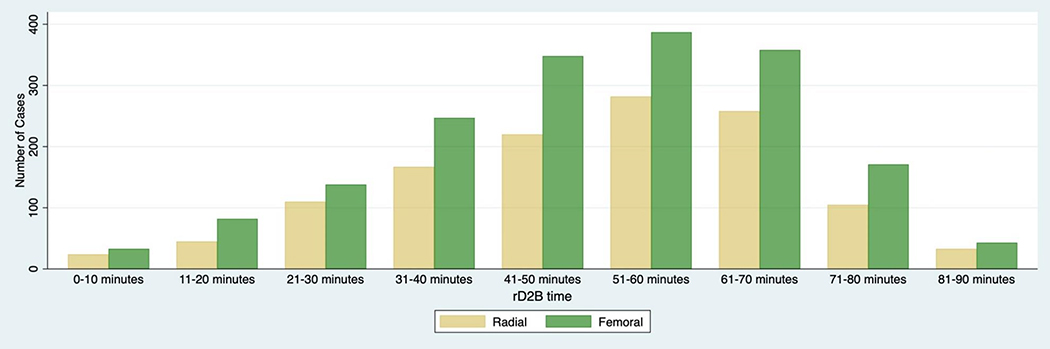
Methods: Adult patients with ST-segment-elevation myocardial infarction undergoing primary percutaneous coronary intervention from 2011 to 2018 were identified from the Cardiac Care Outcomes Assessment Program, a quality improvement registry in Washington state. We used the regression discontinuity framework to test for discontinuity at 90 minutes among the included cases. We defined a novel variable, remaining D2B as 90 minutes minus the time between hospital arrival and catheterization laboratory arrival. We estimated multivariable logistic regression models to assess the relationship between remaining D2B time and access site.
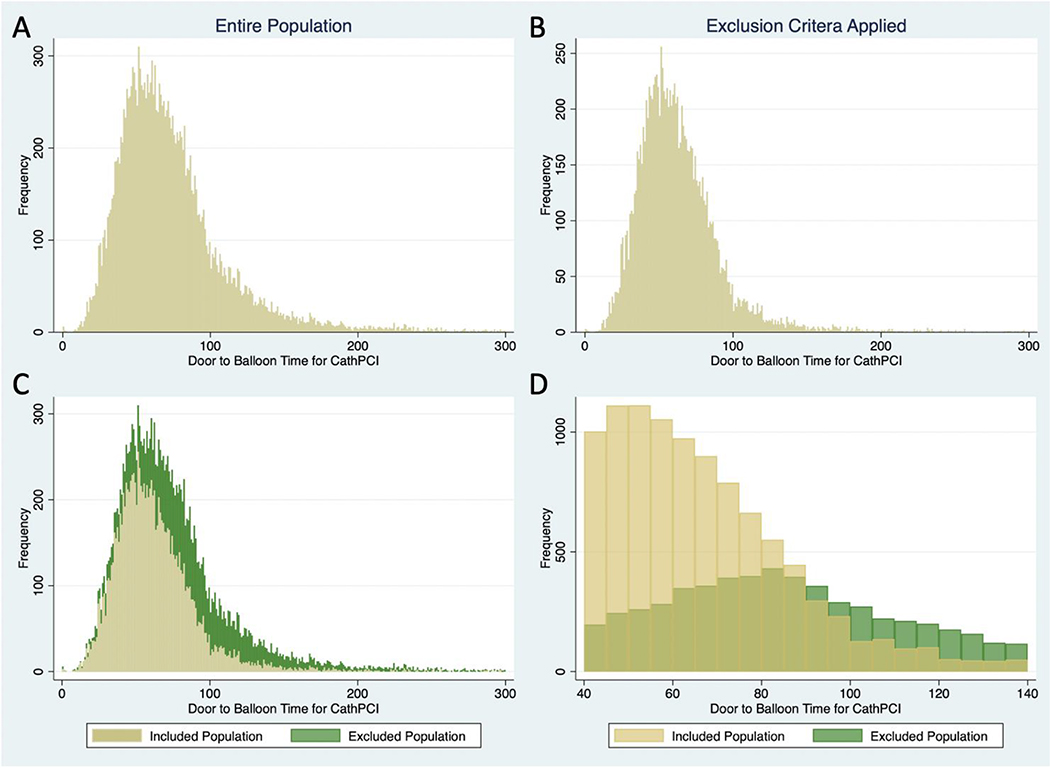
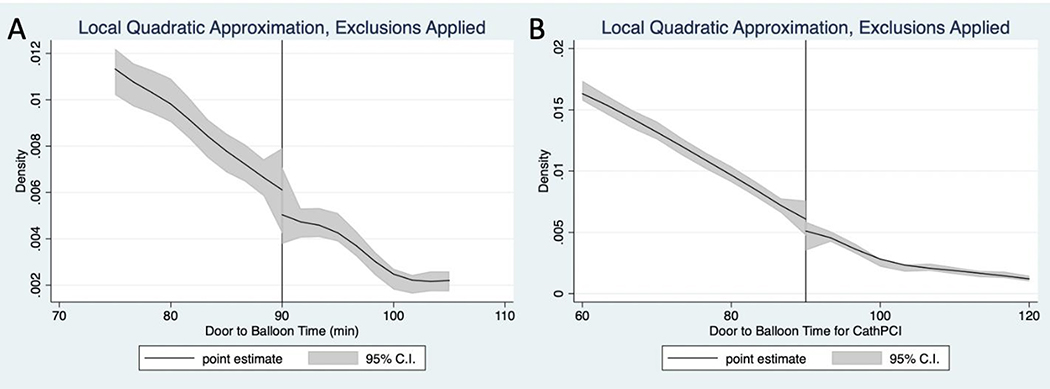
Results: A total of 19 348 patients underwent primary percutaneous coronary intervention and were included in the analysis. Overall, 7436 (38.4%) were excluded from the metric. There appeared to be a visual discontinuity in included cases around 90 minutes; however, local quadratic regression around the 90-minute cutoff did not reveal evidence of a significant discontinuity (P=0.66). Multivariable analysis showed no significant relationship between remaining D2B time and the odds of undergoing femoral access (P=0.73).
Conclusions: Among patients undergoing percutaneous coronary intervention for ST-segment-elevation myocardial infarction, we did not find evidence of a statistically significant discontinuity in the frequency of included cases around 90 minutes or an increased preference for femoral access correlated with decreasing time to meet the 90-minute D2B time quality metric. Together, these findings indicate no evidence of widespread inappropriate methods to improve performance on D2B time metrics.
Keywords: association; catheterization; hospitals; myocardial infarction; percutaneous coronary intervention.
Figures
Comment in
-
Using Discontinuity to Cross the Quality Chasm.Circ Cardiovasc Interv. 2020 Sep;13(9):e009887. doi: 10.1161/CIRCINTERVENTIONS.120.009887. Epub 2020 Sep 4. Circ Cardiovasc Interv. 2020. PMID: 32883105 No abstract available.
References
-
- McNamara RL, Wang Y, Herrin J, et al. Effect of door-to-balloon time on mortality in patients with ST-segment elevation myocardial infarction. J Am Coll Cardiol. 2006;47:2180–2186. - PubMed
-
- Berger PB, Ellis SG, Holmes DR Jr, Granger CB, Criger DA, Betriu A, Topol EJ, Califf RM. Relationship between delay in performing direct coronary angioplasty and early clinical outcome in patients with acute myocardial infarction: results from the global use of strategies to open occluded arteries in Acute Coronary Syndromes (GUSTO-IIb) trial. Circulation. 1999;100:14–20. - PubMed
-
- O’Gara PT, Kushner FG, Ascheim DD, et al. 2013 ACCF/AHA guideline for the management of ST-elevation myocardial infarction: a report of the American College of Cardiology Foundation/American Heart Association Task Force on Practice Guidelines. J Am Coll Cardiol. 2013;61:e78–e140. - PubMed
-
- Ibanez B, James S, Agewall S, et al. 2017 ESC Guidelines for the management of acute myocardial infarction in patients presenting with ST-segment elevation: The Task Force for the management of acute myocardial infarction in patients presenting with ST-segment elevation of the European Society of Cardiology (ESC). Eur Heart J. 2018;39:119–177. - PubMed
-
- Nallamothu BK, Wang Y, Bradley EH, Ho KK, Curtis JP, Rumsfeld JS, Masoudi FA, Krumholz HM. Comparing hospital performance in door-to-balloon time between the Hospital Quality Alliance and the National Cardiovascular Data Registry. J Am Coll Cardiol. 2007;50:1517–1519. - PubMed
Publication types
MeSH terms
Grants and funding
LinkOut - more resources
Full Text Sources
