


Risk factors of hospitalization for any medical condition among patients with prior emergency department visits for mental health conditions
- PMID: 32883239
- PMCID: PMC7469095
- DOI: 10.1186/s12888-020-02835-2
Risk factors of hospitalization for any medical condition among patients with prior emergency department visits for mental health conditions
Abstract
Background: This longitudinal study identified risk factors for frequency of hospitalization among patients with any medical condition who had previously visited one of six Quebec (Canada) emergency departments (ED) at least once for mental health (MH) conditions as the primary diagnosis.
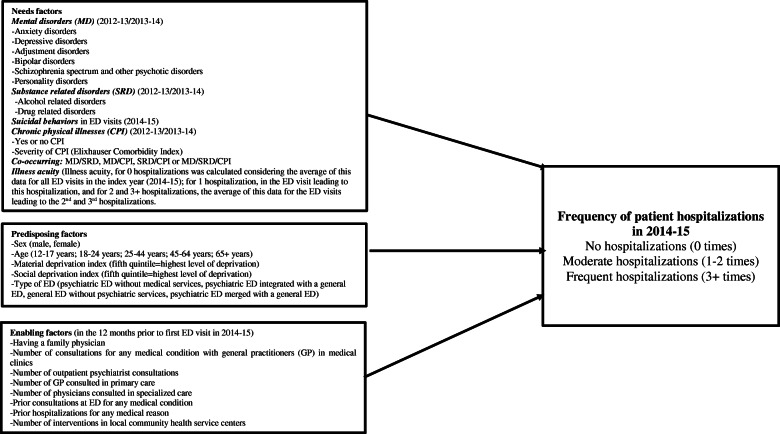
Methods: Records of n = 11,367 patients were investigated using administrative databanks (2012-13/2014-15). Hospitalization rates in the 12 months after a first ED visit in 2014-15 were categorized as no hospitalizations (0 times), moderate hospitalizations (1-2 times), and frequent hospitalizations (3+ times). Based on the Andersen Behavioral Model, data on risk factors were gathered for the 2 years prior to the first visit in 2014-15, and were identified as predisposing, enabling or needs factors. They were tested using a hierarchical multinomial logistic regression according to the three groups of hospitalization rate.
Results: Enabling factors accounted for the largest percentage of total variance explained in the study model, followed by needs and predisposing factors. Co-occurring mental disorders (MD)/substance-related disorders (SRD), alcohol-related disorders, depressive disorders, frequency of consultations with outpatient psychiatrists, prior ED visits for any medical condition and number of physicians consulted in specialized care, were risk factors for both moderate and frequent hospitalizations. Schizophrenia spectrum and other psychotic disorders, bipolar disorders, and age (except 12-17 years) were risk factors for moderate hospitalizations, while higher numbers (4+) of overall interventions in local community health service centers were a risk factor for frequent hospitalizations only. Patients with personality disorders, drug-related disorders, suicidal behaviors, and those who visited a psychiatric ED integrated with a general ED in a separate site, or who visited a general ED without psychiatric services were also less likely to be hospitalized. Less urgent and non-urgent illness acuity prevented moderate hospitalizations only.
Conclusions: Patients with severe and complex health conditions, and higher numbers of both prior outpatient psychiatrist consultations and ED visits for medical conditions had more moderate and frequent hospitalizations as compared with non-hospitalized patients. Patients at risk for frequent hospitalizations were more vulnerable overall and had important biopsychosocial problems. Improved primary care and integrated outpatient services may prevent post-ED hospitalization.
Keywords: Enabling factors; Hospitalization; mental disorders; substance related disorders; risk factors; Medical conditions; Needs factors; Predictors; Predisposing factors; Service use.
Conflict of interest statement
The authors declare no conflicts of interest with respect to the research, authorship, and/or publication of this article.
Figures
References
-
- Evans LJ, Harris V, Newman L, Beck A. Rapid and frequent psychiatric readmissions: associated factors. Int J Psychiatry Clin Pract. 2017;21(4):271–276. - PubMed
-
- Hewlett E, Moran V. Making Mental Health Count: The Social and Economic Costs of Neglecting Mental Health Care [Internet]. OECD; 2014 [cited 2019 Aug 2]. (OECD Health Policy Studies). Available from: https://www.oecd-ilibrary.org/social-issues-migration-health/making-ment....
-
- Morlino M, Calento A, Schiavone V, Santone G, Picardi A, de Girolamo G. Use of psychiatric inpatient services by heavy users: findings from a national survey in Italy. Eur Psychiatry. 2011;26(4):252–259. - PubMed
-
- Pelayo-Terán JM, Gajardo Galán VG, de la Ortiz-García de la Foz V, Martínez-García O, Tabarés-Seisdedos R, Crespo-Facorro B, et al. Rates and predictors of relapse in first-episode non-affective psychosis: a 3-year longitudinal study in a specialized intervention program (PAFIP) Eur Arch Psychiatry Clin Neurosci. 2017;267(4):315–323. - PubMed
Publication types
MeSH terms
Grants and funding
LinkOut - more resources
Full Text Sources
Medical
