


Mesenchymal stem cell-based cell-free strategies: safe and effective treatments for liver injury
- PMID: 32883343
- PMCID: PMC7469278
- DOI: 10.1186/s13287-020-01895-1
Mesenchymal stem cell-based cell-free strategies: safe and effective treatments for liver injury
Abstract
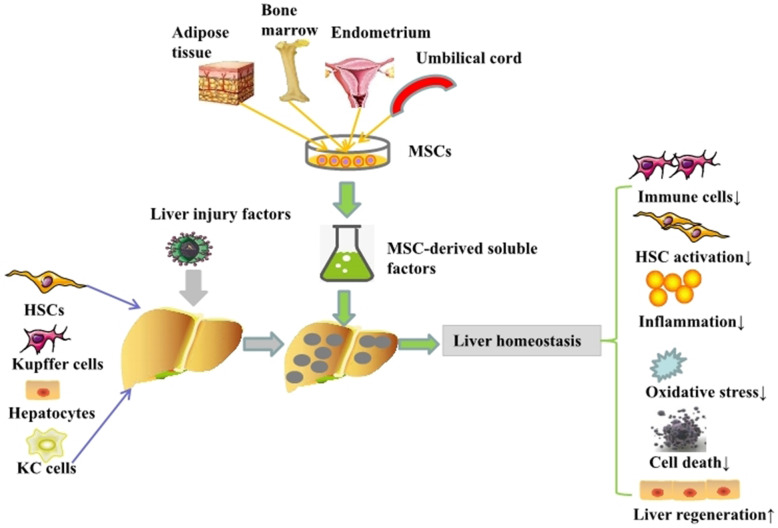
Various hepatoxic factors, such as viruses, drugs, lipid deposition, and autoimmune responses, induce acute or chronic liver injury, and 3.5% of all worldwide deaths result from liver cirrhosis, liver failure, or hepatocellular carcinoma. Liver transplantation is currently limited by few liver donors, expensive surgical costs, and severe immune rejection. Cell therapy, including hepatocyte transplantation and stem cell transplantation, has recently become an attractive option to reduce the overall need for liver transplantation and reduce the wait time for patients. Recent studies showed that mesenchymal stem cell (MSC) administration was a promising therapeutic approach for promoting liver regeneration and repairing liver injury by the migration of cells into liver sites, hepatogenic differentiation, immunoregulation, and paracrine mechanisms. MSCs secrete a large number of molecules into the extracellular space, and soluble proteins, free nucleic acids, lipids, and extracellular vesicles (EVs) effectively repair tissue injury in response to fluctuations in physiological states or pathological conditions. Cell-free-based therapies avoid the potential tumorigenicity, rejection of cells, emboli formation, undesired differentiation, and infection transmission of MSC transplantation. In this review, we focus on the potential mechanisms of MSC-based cell-free strategies for attenuating liver injury in various liver diseases. Secretome-mediated paracrine effects participate in the regulation of the hepatic immune microenvironment and promotion of hepatic epithelial repair. We look forward to completely reversing liver injury through an MSC-based cell-free strategy in regenerative medicine in the near future.
Keywords: Cell death; Cell-free; Liver injury; Mesenchymal stem cell; Treatment.
Conflict of interest statement
The authors declare that they have no competing interests.
Figures
References
-
- Asrani SK, Devarbhavi H, Eaton J, Kamath PS. Burden of liver diseases in the world. J Hepatol. 2019;70(1):151–171. - PubMed
-
- Forbes SJ, Alison MR. Regenerative medicine. Knocking on the door to successful hepatocyte transplantation. Nat Rev Gastroenterol Hepatol. 2014;11(5):277–278. - PubMed
-
- Miceli M, Baldi D, Cavaliere C, Soricelli A, Salvatore M, Napoli C. Peripheral artery disease: the new frontiers of imaging techniques to evaluate the evolution of regenerative medicine. Expert Rev Cardiovasc Ther. 2019;17(7):511–532. - PubMed
Publication types
MeSH terms
LinkOut - more resources
Full Text Sources
Medical
