


Chronic kidney disease in adults aged 18 years and older in Chile: findings from the cross-sectional Chilean National Health Surveys 2009-2010 and 2016-2017
- PMID: 32883732
- PMCID: PMC7473630
- DOI: 10.1136/bmjopen-2020-037720
Chronic kidney disease in adults aged 18 years and older in Chile: findings from the cross-sectional Chilean National Health Surveys 2009-2010 and 2016-2017
Abstract
Objectives: This study estimates the prevalence of chronic kidney disease (CKD) among Chilean adults and examines its associations with sociodemographic characteristics, health behaviours and comorbidities.
Design: Analysis of cross-sectional data from the two most recent large nationally representative Chilean Health Surveys (Encuesta Nacional de Salud, ENS) 2009-2010 and 2016-2017.
Participants: Adults aged 18+ years with serum creatine data (ENS 2009-2010: n=4583; ENS 2016-2017: n=5084).
Primary and secondary outcome measures: Reduced kidney function (CKD stages 3a-5) based on the estimated glomerular filtration rate (eGFR <60 mL/min/1.73 m2) was the primary outcome measure. Using the urine albumin-to-creatinine ratio (ACR ≥30 mg/g), increased albuminuria was ascertained among adults aged 40+ years with diabetes and/or hypertension. Both outcomes were analysed using logistic regression with results summarised using OR. CKD prevalence (stages 1-5) among adults aged 40+ years was estimated including participants with an eGFR of >60 mL/min/1.73 m2 but with increased albuminuria (stages 1-2).
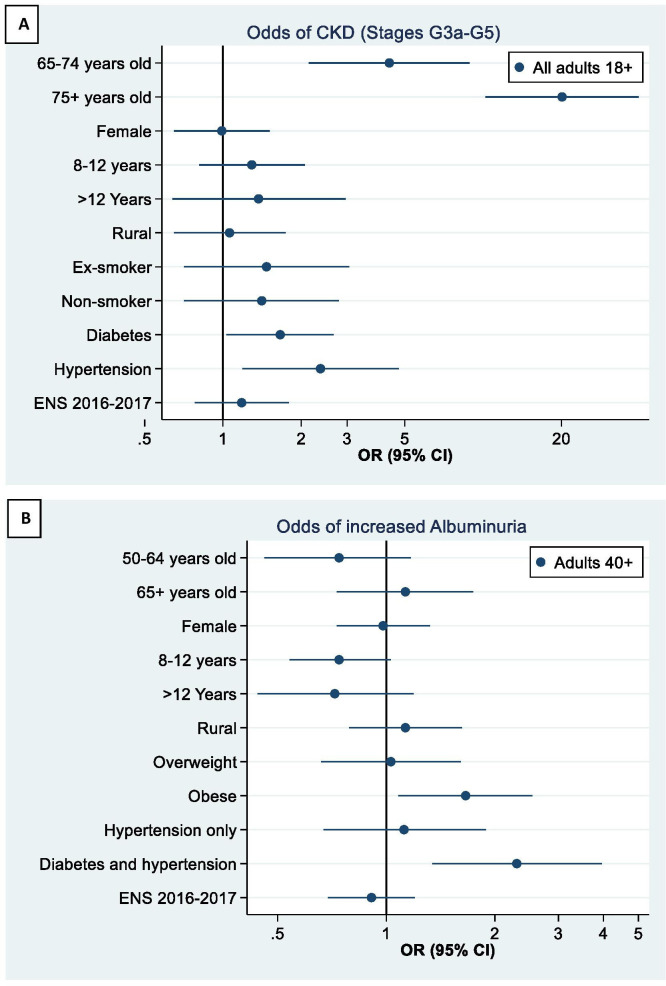
Results: Overall, 3.2% (95% CI: 2.4% to 3.8%) of adults aged 18+ in ENS 2016-2017 had reduced kidney function. After full adjustment, participants with hypertension (OR: 2.37; 95% CI: 1.19 to 4.74) and those with diabetes (OR: 1.66; 95% CI: 1.03 to 2.66) had significantly higher odds of reduced kidney function. In ENS 2016-2017, 15.5% (13.5% to 17.8%) of adults aged 40+ years with diabetes and/or hypertension had increased albuminuria. Being obese versus normal-weight (OR: 1.66; 95% CI: 1.08 to 2.54) and having both diabetes and hypertension versus having diabetes alone (OR: 2.30; 95% CI: 1.34 to 3.95) were significantly associated with higher odds of increased albuminuria in fully-adjusted analyses. At least 15.4% of adults aged 40+ years in ENS 2016-2017 had CKD (stages 1-5), including the 9.6% of adults at CKD stages 1-2.
Conclusions: Prevention strategies and Chilean guidelines should consider the high percentage of adults aged 40 years and older at CKD stages 1-2.
Keywords: chronic renal failure; epidemiology; nephrology; public health.
© Author(s) (or their employer(s)) 2020. Re-use permitted under CC BY-NC. No commercial re-use. See rights and permissions. Published by BMJ.
Conflict of interest statement
Competing interests: None declared.
Figures
References
-
- National Guideline C KDIGO 2012 clinical practice guideline for the evaluation and management of chronic kidney disease, 2012. - PubMed
Publication types
MeSH terms
LinkOut - more resources
Full Text Sources
Medical
Research Materials
Miscellaneous
