. 2020 Sep 3;10(1):14514.
doi: 10.1038/s41598-020-71589-4.

Towards personalized induction therapy for esophageal adenocarcinoma: organoids derived from endoscopic biopsy recapitulate the pre-treatment tumor

Affiliations

Towards personalized induction therapy for esophageal adenocarcinoma: organoids derived from endoscopic biopsy recapitulate the pre-treatment tumor

Mathieu F Derouet et al. Sci Rep. .

Abstract

Esophageal adenocarcinoma has few known recurrent mutations and therefore robust, reliable and reproducible patient-specific models are needed for personalized treatment. Patient-derived organoid culture is a strategy that may allow for the personalized study of esophageal adenocarcinoma and the development of personalized induction therapy. We therefore developed a protocol to establish EAC organoids from endoscopic biopsies of naïve esophageal adenocarcinomas. Histologic characterization and molecular characterization of organoids by whole exome sequencing demonstrated recapitulation of the tumors' histology and genomic (~ 60% SNV overlap) characteristics. Drug testing using clinically appropriate chemotherapeutics and targeted therapeutics showed an overlap between the patient's tumor response and the corresponding organoids' response. Furthermore, we identified Barrett's esophagus epithelium as a potential source of organoid culture contamination. In conclusion, organoids can be robustly cultured from endoscopic biopsies of esophageal adenocarcinoma and recapitulate the originating tumor. This model demonstrates promise as a tool to better personalize therapy for esophageal adenocarcinoma patients.


Conflict of interest statement

The authors declare no competing interests.

Figures

Figure 1
Figure 1
Histological and genomic characterization of the EDOs. (A) Representative images of H&E and IHC of P53 and CK7 between all 5 pairs of endoscopic biopsy and organoid. (B) Concordance and discordance plots of SNVs for both endoscopy tumors and EDO. (C) Violin plots of the frequency plots of concordant and discordant SNVs for both endoscopy tumors and EDOs. (D) Oncoprint table for all 5 paired samples. The gene list was established from previous publication (see “Methods”). (E) Copy Number Variation plots of patient 46 and 74 paired samples (endoscopy and EDO).
Figure 2
Figure 2
EDO sensitivity to chemotherapy drugs. (A) Dose response curves plots for EDO 46, 92 and 74 against 4 chemotherapy drugs and Mubritinib. (B) Heatmap and hierarchical clustering representing the 1-AUC values of each EDO against a single drug. “C”: Complete response in the patient to induction therapy, “N” No induction therapy in the patient, “P” Partial response in the patient to induction therapy.
Figure 3
Figure 3
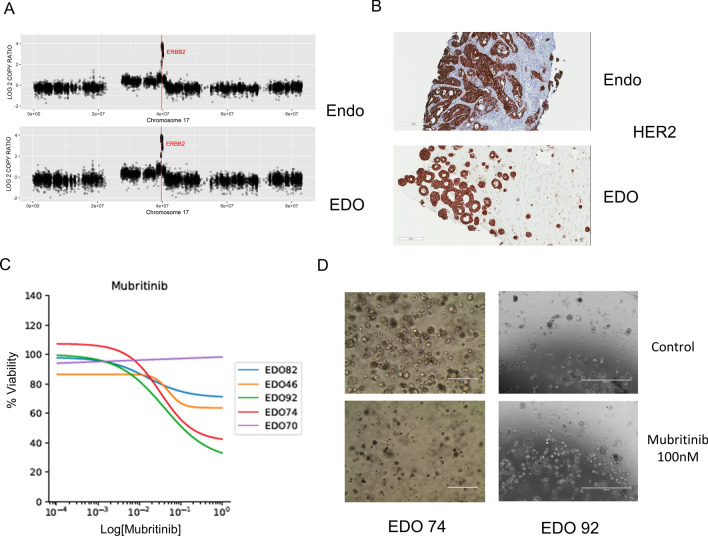
EDO can be used to test patient specific treatments. (A) Copy number variation on chromosome 17 for patient 74. ERBB2 amplification is highlighted for both endoscopy and EDO. (B) Representative picture of HER2 IHC on endoscopy and EDO. (C) Mubritinib dose response for all five EDOs. (D) Bright light microscopy pictures of EDO 74 and 92 treated with and without Mubritinib (100 nM) for 7 days.
Figure 4
Figure 4
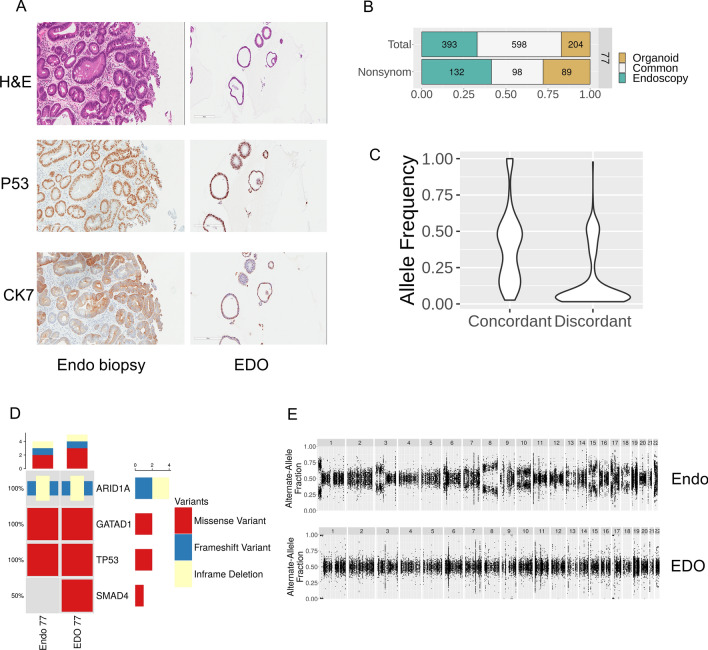
Barrett cells represent a potential contaminant source in EDO. (A) Representative images of H&E and IHC of P53 and CK7 of patient 77 endoscopic biopsy and EDO. (B) Concordance and discordance plots of SNV for patient 77 endoscopic biopsy and EDO. (C) Violin plots of the frequency plots of concordant and discordant SNV for both endoscopy tumors and EDO. (D) Oncoprint table for endoscopy and EDO samples from patient 77. (E) Copy Number Variation plots of patient 77 paired sample (endoscopy and EDO).

References

    1. van Hagen P, et al. Preoperative chemoradiotherapy for esophageal or junctional cancer. N. Engl. J. Med. 2012;366:2074–2084. doi: 10.1056/NEJMoa1112088. - DOI - PubMed
    1. Cunningham D, et al. Perioperative chemotherapy versus surgery alone for resectable gastroesophageal cancer. N. Engl. J. Med. 2006;355:11–20. doi: 10.1056/NEJMoa055531. - DOI - PubMed
    1. Conroy T, et al. Definitive chemoradiotherapy with FOLFOX versus fluorouracil and cisplatin in patients with oesophageal cancer (PRODIGE5/ACCORD17): Final results of a randomised, phase 2/3 trial. Lancet Oncol. 2014;15:305–314. doi: 10.1016/S1470-2045(14)70028-2. - DOI - PubMed
    1. Al-Batran, S.E. et al. The RENAISSANCE (AIO-FLOT5) trial: Effect of chemotherapy alone vs. chemotherapy followed by surgical resection on survival and quality of life in patients with limited-metastatic adenocarcinoma of the stomach or esophagogastric junction—a phase III trial of the German AIO/CAO-V/CAOGI. BMC Cancer17, 893 (2017). - PMC - PubMed
    1. Garcia E, et al. Authentication and characterisation of a new oesophageal adenocarcinoma cell line: MFD-1. Sci. Rep. 2019;9:32417. - PMC - PubMed

Publication types

Supplementary concepts