. 2020 Sep 3;10(1):14605.
doi: 10.1038/s41598-020-71648-w.

A CRISPR activation and interference toolkit for industrial Saccharomyces cerevisiae strain KE6-12

Affiliations

A CRISPR activation and interference toolkit for industrial Saccharomyces cerevisiae strain KE6-12

Elena Cámara et al. Sci Rep. .

Abstract

Recent advances in CRISPR/Cas9 based genome editing have considerably advanced genetic engineering of industrial yeast strains. In this study, we report the construction and characterization of a toolkit for CRISPR activation and interference (CRISPRa/i) for a polyploid industrial yeast strain. In the CRISPRa/i plasmids that are available in high and low copy variants, dCas9 is expressed alone, or as a fusion with an activation or repression domain; VP64, VPR or Mxi1. The sgRNA is introduced to the CRISPRa/i plasmids from a double stranded oligonucleotide by in vivo homology-directed repair, allowing rapid transcriptional modulation of new target genes without cloning. The CRISPRa/i toolkit was characterized by alteration of expression of fluorescent protein-encoding genes under two different promoters allowing expression alterations up to ~ 2.5-fold. Furthermore, we demonstrated the usability of the CRISPRa/i toolkit by improving the tolerance towards wheat straw hydrolysate of our industrial production strain. We anticipate that our CRISPRa/i toolkit can be widely used to assess novel targets for strain improvement and thus accelerate the design-build-test cycle for developing various industrial production strains.


Conflict of interest statement

The authors declare no competing interests.

Figures
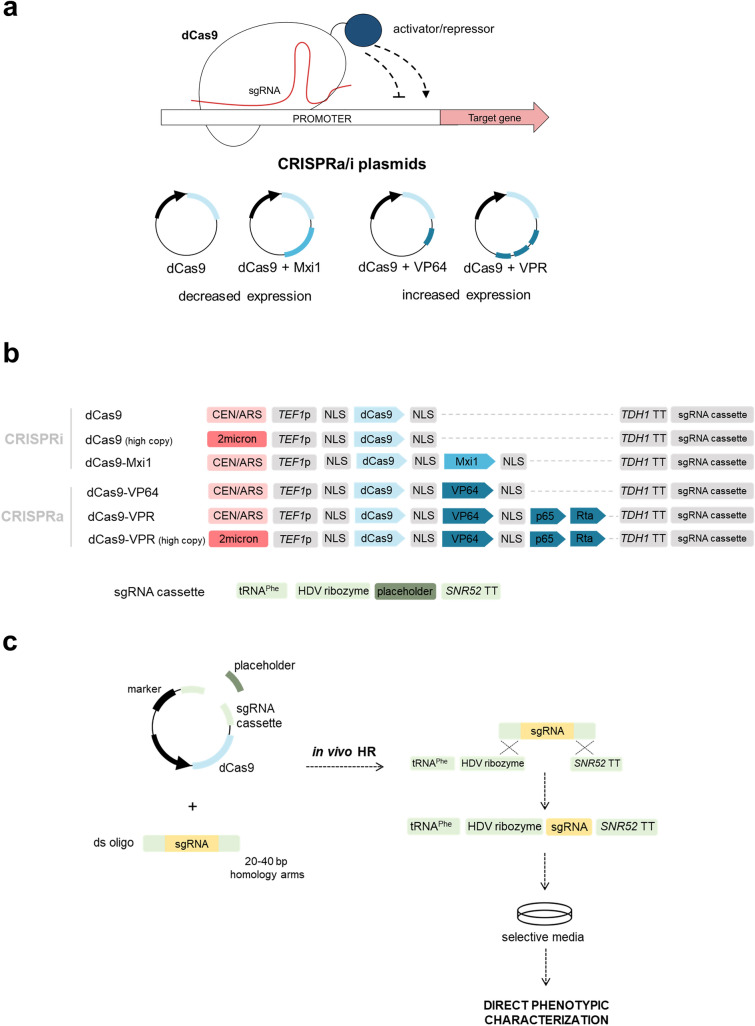
Figure 1
Figure 1
Design of the CRISPRa/i toolkit for transcriptional modulation. (a) The CRISPRa/i technology utilizes a catalytically inactive Cas9 (dCas9) to modulate the expression of genes targeted by an sgRNA. This can be further increased by fusing activation or repressor domains to dCas9. (b) Schematic representation of the CRISPRa/i components included in the CRISPRa/i plasmids and of the sgRNA expression cassette, present in all the plasmids. (c) The target-specific sgRNA from a double stranded oligonucleotide (ds oligo) was inserted into the CRISPRa/i plasmid through in vivo homologous recombination, allowing direct phenotypic characterization of strains with altered gene expression.
Figure 2
Figure 2
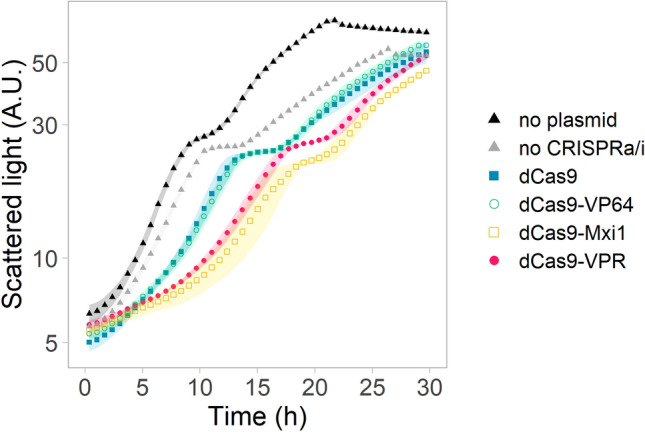
Growth of KE6-12-Ruby strains carrying different CRISPRa/i plasmids expressing dCas9 (blue solid squares), dCas9-VP64 (open turquoise circles), dCas9-Mxi1 (open yellow squares), dCas9-VPR (solid pink circles) or an empty plasmid lacking the dCas9 or sgRNA expression cassette (no CRISPRa/i strain, grey triangles). KE6-12-Ruby was added as a control to evaluate the plasmid effect (no plasmid strain, black triangles). The strains were grown in microbioreactors in YPD medium supplemented with geneticin for plasmid maintenance, and without antibiotic for the no plasmid strain. Data obtained from three biological replicates; shadowed regions show the standard deviation.
Figure 3
Figure 3
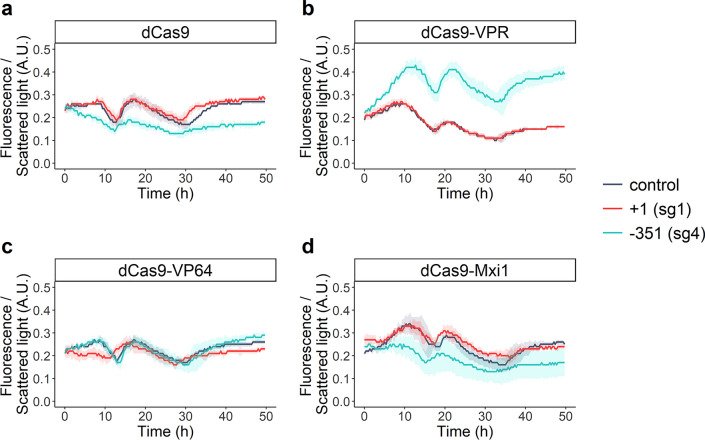
CRISPRa/i based change in expression of a fluorescent protein, measured over time in microbioreactors. Normalized fluorescence of strains expressing dCas9 (a), dCas9-VPR (b), dCas9-VP64 (c) or dCas9-Mxi1 (d) and sgRNAs targeting a region at + 1 (sg1; red line) or − 351 (sg4; turquoise line) bp relative to the TSS or the CRISPRa/i plasmid with a placeholder (control; grey line). Data obtained from three biological replicates; shadowed regions show the standard deviation.
Figure 4
Figure 4
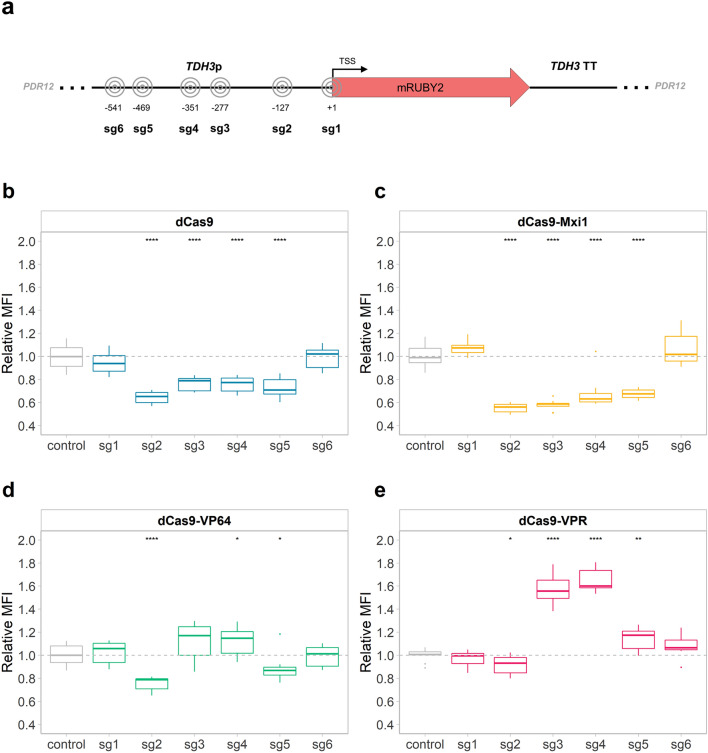
Modulation of mRuby2 fluorescence by different CRISPRa/i plasmids. (a) Six sgRNAs targeting different loci of TDH3p were tested. (b)–(e) Relative MFI of strains expressing dCas9 (b), dCas9-Mxi1 (c), dCas9-VP64 (d) and dCas9-VPR (e) together with either of the sgRNAs (sg1–6) or the placeholder (control). The box plots show the relative fluorescence, compared to KE6-12-Ruby expressing the corresponding CRISPRa/i plasmid with the placeholder (control, grey dashed line). Data obtained from three biological and three technical replicates. The line dividing the box represents the median of the data, the whiskers indicate the data outside the middle 50% and the outliers are shown as individual points. Statistical significance represented as “*” for p ≤ 0.05, “**” for p ≤ 0.01, “***” for p ≤ 0.001 and “****” for p ≤ 0.0001.
Figure 5
Figure 5
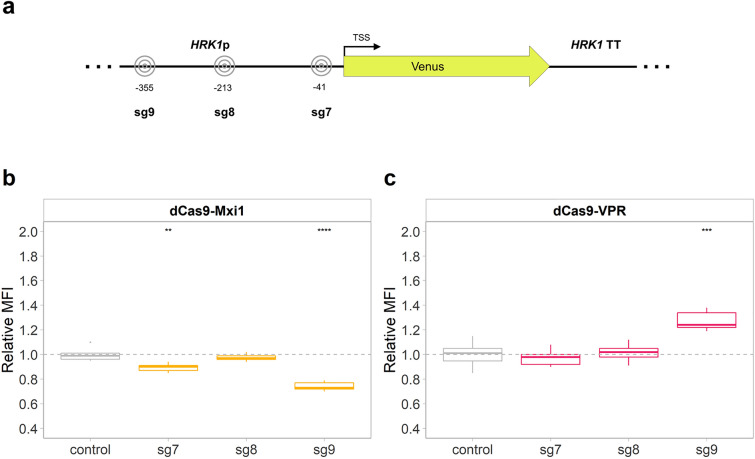
Modulation of fluorescence of Venus expressed under HRK1p by CRISPRa/i. (a) Three sgRNAs targeting different loci of HRK1p were tested. (b)–(c) Relative MFI of strains expressing dCas9-Mxi1 (b), and dCas9-VPR (c) together with either of the sgRNAs (sg7–9) or the placeholder (control). The box plots show the relative fluorescence, compared to KE6-12-Ruby-Venus expressing the corresponding CRISPRa/i plasmid with the placeholder (control, grey dashed line). Data obtained from three biological and three technical replicates. The line dividing the box represents the median of the data, the whiskers indicate the data outside the middle 50% and the outliers are shown as individual points. Statistical significance represented as “*” for p ≤ 0.05, “**” for p ≤ 0.01, “***” for p ≤ 0.001 and “****” for p ≤ 0.0001.
Figure 6
Figure 6
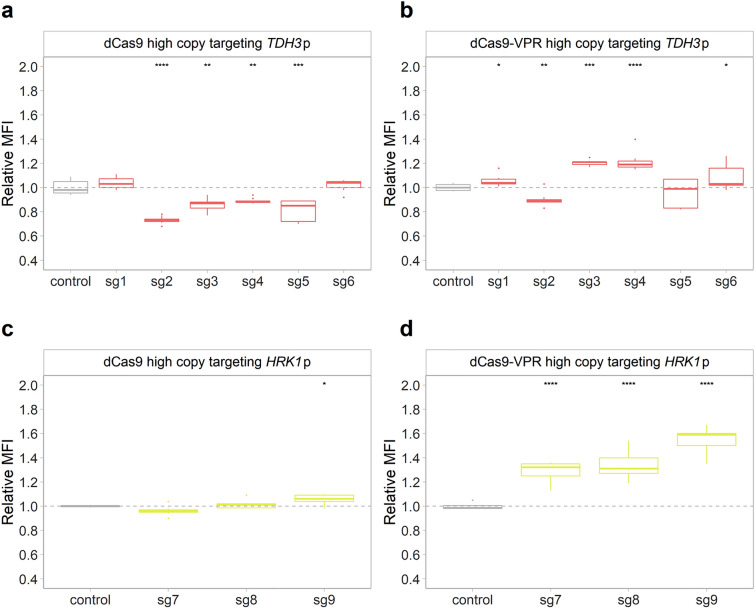
Modulation of fluorescence using high copy CRISPRa/i plasmids. (a) Relative MFI of strains expressing dCas9 (a), or dCas9-VPR (b) together with either of the sgRNAs targeting TDH3p (sg1–6) or HRK1p (sg7–9) or the placeholder (control). The box plots show the relative fluorescence, compared to KE6-12-Ruby (a, b) or KE6-12-Ruby-Venus (c, d) expressing the corresponding high copy CRISPRa/i plasmid with the placeholder (control, grey dashed line). Data obtained from three biological and three technical replicates. The line dividing the box represents the median of the data, the whiskers indicate the data outside the middle 50% and the outliers are shown as individual points. Statistical significance represented as “*” for p ≤ 0.05, “**” for p ≤ 0.01, “***” for p ≤ 0.001 and “****” for p ≤ 0.0001.
Figure 7
Figure 7
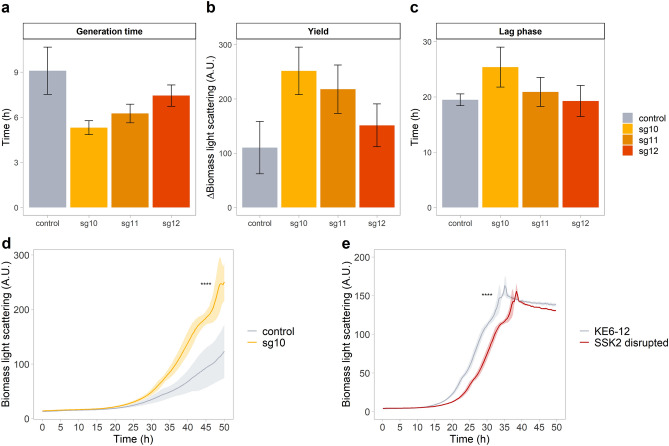
Application of CRISPRi for improving growth in wheat straw hydrolysate. (a) generation time, (b) biomass yield and (c) lag phase of KE6-12 expressing dCas9 and different sgRNAs targeting SSK2p. (d) Growth of KE6-12 strain expressing dCas9 and sg10 or the placeholder. (e) Growth of KE6-12 strain compared to KE6-12 with SSK2 gene disrupted. The strains were grown in microbioreactors in 64% wheat straw hydrolysate for 50 h. Data obtained from three biological replicates (ad) or three technical replicates (e) are expressed as mean ± standard deviation (SD). Statistical significance represented as “*” for p ≤ 0.05, “**” for p ≤ 0.01, “***” for p ≤ 0.001 and “****” for p ≤ 0.0001.

References

    1. Krivoruchko A, Nielsen J. Production of natural products through metabolic engineering of Saccharomyces cerevisiae. Curr. Opin. Biotechnol. 2015;35:7–15. - PubMed
    1. Mattanovich D, Sauer M, Gasser B. Yeast biotechnology: Teaching the old dog new tricks. Microb. Cell. Fact. 2014;13:34. - PMC - PubMed
    1. Du J, Shao Z, Zhao H. Engineering microbial factories for synthesis of value-added products. J. Ind. Microbiol. Biotechnol. 2011;38:873–890. - PMC - PubMed
    1. Rosales-Calderon O, Arantes V. A review on commercial-scale high-value products that can be produced alongside cellulosic ethanol. Biotechnol. Biofuels. 2019;12:240. - PMC - PubMed
    1. Hemansi et al. Second generation bioethanol production: The state of art. In Sustainable Approaches for Biofuels Production Technologies: From Current Status to Practical Implementation (eds. Srivastava et al.) 121–46 (Springer, Berlin, 2019).

Publication types

MeSH terms

Substances