


An audit of the changes in thiamine levels during higher caloric nutritional rehabilitation of adolescent patients hospitalised with a restrictive eating disorder
- PMID: 32884809
- PMCID: PMC7460783
- DOI: 10.1186/s40337-020-00318-z
An audit of the changes in thiamine levels during higher caloric nutritional rehabilitation of adolescent patients hospitalised with a restrictive eating disorder
Abstract
Background: Routine supplementation of thiamine in patients with restrictive eating disorders prior to initiation of nutritional rehabilitation, is an example of a clinical guideline based on expert opinion rather than evidence-based recommendations. This study investigates whether adolescents hospitalised with a restrictive eating disorder commenced on a higher caloric refeeding regimen, present with or develop thiamine deficiency during their admission.
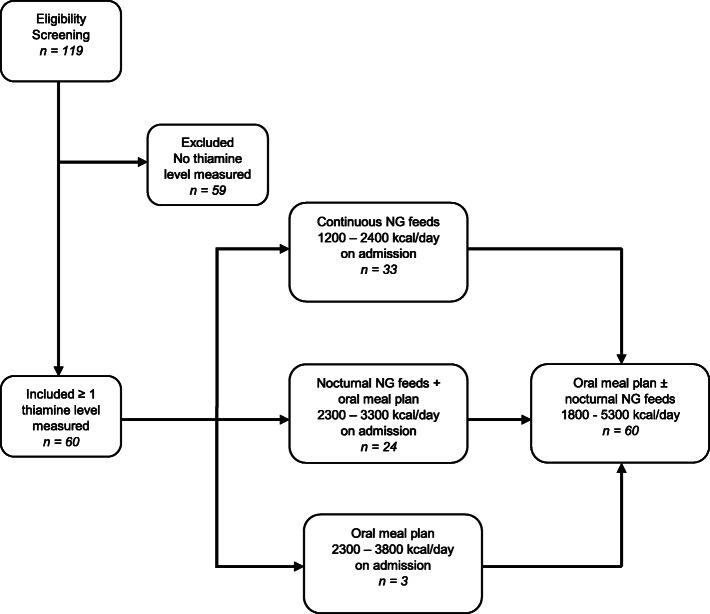
Methods: An eighteen month retrospective audit of 119 consecutive admissions for nutritional rehabilitation was conducted on patients admitted with an eating disorder in a large tertiary teaching hospital in Western Sydney. Data from paper-based and electronic medical records were collected. Baseline and weekly blood thiamine levels were documented, as well as patient demographic information including admission weight, age, length of stay, percentage median body mass index, weight change throughout admission and caloric prescription.
Results: Sixty admissions met inclusion criteria, mean age 17.2 years (SD 1.2); 88% female; BMI 16.8 kg/m2 (SD 1.8) on admission. A linear mixed effects model identified that median thiamine levels increased by 9.2 nmol/L per week (p < 0.001). No patient developed thiamine deficiency during their admission, one patient was admitted with thiamine levels below the normal range at 62 nmol (normal range 67 - 200 nmol/L) which resolved by the second week of admission. In 15 out of 60 patients (25%), thiamine levels were observed to rise above the upper limit.
Conclusions: Nutritional management of 60 malnourished adolescents hospitalised with an eating disorder was conducted safely with the provision of only 10 mg thiamine in a multivitamin daily, and no additional thiamine supplementation. The high caloric refeeding protocol, inclusive of a daily multivitamin, provided adequate thiamine to prevent thiamine deficiency. Further research should examine thiamine requirements in an exclusive severely malnourished population to assess the need for thiamine replacement in the most vulnerable group.
Keywords: Anorexia nervosa; Eating disorder; Nutrition; Thiamine; Vitamin B1.
© The Author(s) 2020.
Conflict of interest statement
Competing interestsThe authors declare that they have no competing interests.
Figures


References
-
- American Psychiatric Association, Practice Guideline for the Treatment of Patients with Eating Disorders . American Psychiatric Association Publishing. 3 2006.
-
- National Institute for Clinical Excellence (NICE) “Nutrition support in adults: oral nutrition support, enteral tube feeding and parenteral nutrition,” NICE Clinical Guideline 32. London: National Institute for Health and Clinical Excellence; 2006. - PubMed
LinkOut - more resources
Full Text Sources
Miscellaneous
