


Efficacy and Safety of Direct Oral Anticoagulant for Treatment of Atrial Fibrillation in Cerebral Amyloid Angiopathy
- PMID: 32884877
- PMCID: PMC7462646
- DOI: 10.7759/cureus.10143
Efficacy and Safety of Direct Oral Anticoagulant for Treatment of Atrial Fibrillation in Cerebral Amyloid Angiopathy
Abstract
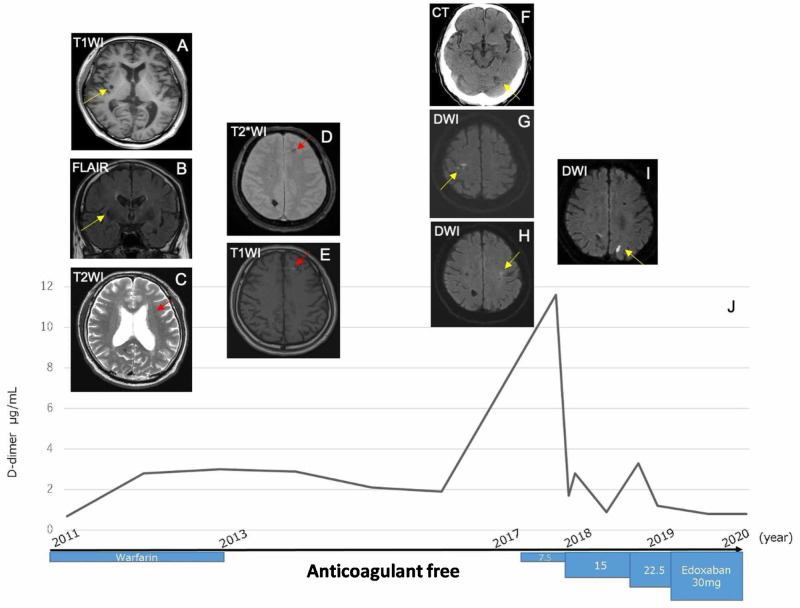
A 75-year-old man with a history of atrial fibrillation (AF) and anticoagulant therapy presented with a headache. Cerebral amyloid angiopathy (CAA) was diagnosed after MRI of the brain revealed cortical superficial siderosis, lobar intracerebral hemorrhage, and lobar microbleeds. Anticoagulant therapy was carefully discontinued. Several years later, he was admitted with sudden onset left upper-extremity weakness. In addition to CAA bleeding lesions, a diffusion-weighted brain MRI showed multiple infarct lesions of high signal intensity. The administration of edoxaban 7.5 mg/day (later increased up to 30 mg/day) prevented ischemic stroke recurrence without exacerbation of cerebral bleeding. This could indicate that CAA patients with AF who had previous adverse effects from warfarin can safely use newer direct oral anticoagulants, such as edoxaban, to prevent ischemic stroke without danger of cerebral hemorrhage. The superiority of edoxaban as compared with warfarin might be due to its antioxidant effect because vascular oxidative stress plays a causal role in CAA-induced cerebrovascular dysfunction, CAA-induced cerebral hemorrhage, and CAA formation itself. We explained the beneficial effect of edoxaban for CAA by the mechanism of oxidative stress in the paper.
Keywords: anticoagulant therapy; atrial fibrillation; cerebral amyloid angiopathy; direct oral anticoagulant; oxidative stress.
Copyright © 2020, Narita et al.
Conflict of interest statement
EA belongs to the Department of Therapeutic Strategy for Heart Failure, Graduate School of Medicine, University of Tokyo, which is endowed by Actelion Pharmaceuticals Japan Ltd., Otsuka Pharmaceutical, NIPRO CORPORATION, Terumo Corp., Senko Medical Instrument Mfg., Century Medical Inc., Kinetic Concepts Inc., and St. Jude Medical.
Figures
References
-
- Antithrombotic therapy in atrial fibrillation associated with valvular heart disease: a joint consensus document from the European Heart Rhythm Association (EHRA) and European Society of Cardiology Working Group on Thrombosis, endorsed by the ESC Working Group on Valvular Heart Disease, Cardiac Arrhythmia Society of Southern Africa (CASSA), Heart Rhythm Society (HRS), Asia Pacific Heart Rhythm Society (APHRS), South African Heart (SA Heart) Association and Sociedad Latinoamericana de Estimulación Cardíaca y Electrofisiología (SOLEACE) Lip GYH, Collet JP, de Caterina R, et al. Europace. 2017;19:1757–1758. - PubMed
-
- 2019 AHA/ACC/HRS focused update of the 2014 AHA/ACC/HRS guideline for the management of patients with atrial fibrillation: a report of the American College of Cardiology/American Heart Association Task Force on Clinical Practice Guidelines and the Heart Rhythm Society. January CT, Wann LS, Calkins H, et al. J Am Coll Cardiol. 2019;74:104–132. - PubMed
-
- Avoiding central nervous system bleeding during antithrombotic therapy: recent data and ideas. Hart RG, Tonarelli SB, Pearce LA. Stroke. 2005;36:1588–1593. - PubMed
-
- Dual antithrombotic therapy increases severe bleeding events in patients with stroke and cardiovascular disease: a prospective, multicenter, observational study. Toyoda K, Yasaka M, Iwade K, et al. Stroke. 2008;39:1740–1745. - PubMed
-
- Review: sporadic cerebral amyloid angiopathy. Attems J, Jellinger K, Thal DR, Van Nostrand W. https://pubmed.ncbi.nlm.nih.gov/20946241/#:~:text=Cerebral%20amyloid%20a... Neuropathol Appl Neurobiol. 2011;37:75–93. - PubMed
Publication types
LinkOut - more resources
Full Text Sources