


Toward refining Alzheimer's disease into overlapping subgroups
- PMID: 32885025
- PMCID: PMC7453148
- DOI: 10.1002/trc2.12070
Toward refining Alzheimer's disease into overlapping subgroups
Abstract
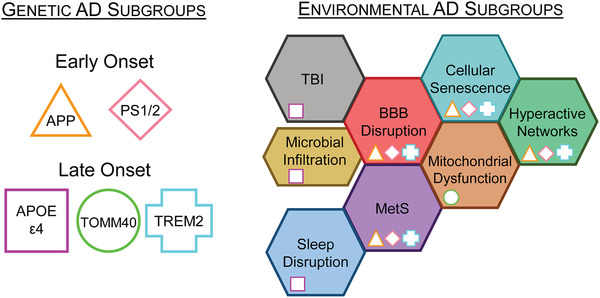
Alzheimer's disease (AD) is an age-related neurodegenerative disorder characterized by progressive anterograde amnesia, cerebral atrophy, and eventual death. Current treatment has limited efficacy and cannot decelerate the disease progression. Clinical trials targeting the removal of the neuropathological hallmarks of AD, including accumulation of amyloid plaques or neurofibrillary tangles, have failed to modify disease progression. Without new or innovative hypotheses, AD is poised to become a public health crisis within this decade. We present an alternative hypothesis-that AD is the result of multiple interrelated causalities. The intention of this manuscript is to initiate a discussion regarding these multiple causalities and their overlapping similarities. The idea of creating subgroups allows for better identification of biomarkers across a narrower patient population for improved pharmacotherapeutic opportunities. The interrelatedness of many of these proposed subgroups indicates the complexity of this disorder. However, it also supports that no one single factor may initiate the cascade of events.
Keywords: cellular senescence; hyperexcitable neuronal networks; metabolic syndrome; mitochondrial cascade hypothesis; sleep disturbances; traumatic brain injury; two‐hit vascular hypothesis.
© 2020 The Authors. Alzheimer's & Dementia: Translational Research & Clinical Interventions published by Wiley Periodicals, Inc. on behalf of Alzheimer's Association.
Conflict of interest statement
The authors declare no competing financial interests.
Figures
References
-
- Khachaturian AS, Hayden KM, Mielke MM, et al. Future prospects and challenges for Alzheimer's disease drug development in the era of the NIA‐AA Research Framework. Alzheimers Dement. 2018;14:532‐534. - PubMed
-
- Ahlqvist E, Storm P, Käräjämäki A, et al. Novel subgroups of adult‐onset diabetes and their association with outcomes: a data‐driven cluster analysis of six variables. Lancet Diabetes Endocrinol. 2018;6:361‐369. - PubMed
-
- Cacace R, Sleegers K, Van Broeckhoven C. Molecular genetics of early‐onset Alzheimer's disease revisited. Alzheimer's Dement. 2016;12:733‐748. - PubMed
Grants and funding
LinkOut - more resources
Full Text Sources